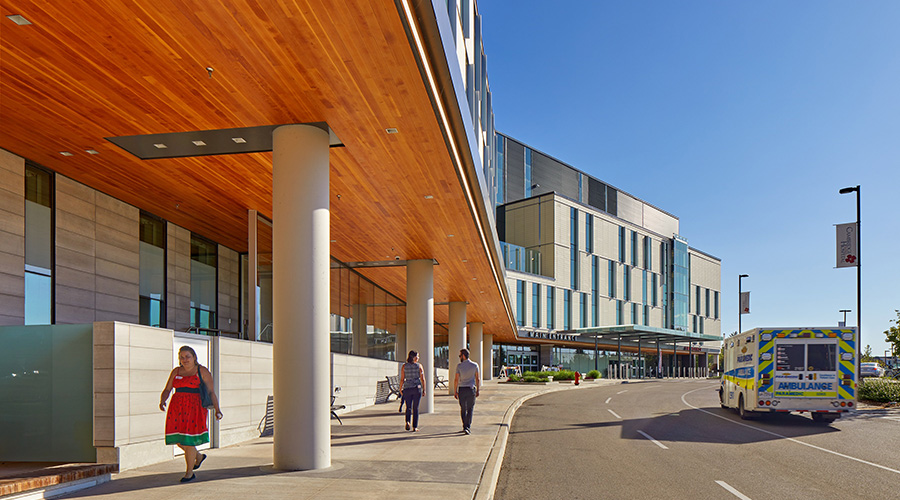
One might assume that a hospital’s envelope, which keeps out bad weather and pollution, is important. But in healthcare design, the building envelope is a small portion of the overall space. High-performance design usually focuses on a hospital’s ventilation needs. Building envelope design is not considered critical to energy performance in hospitals.
But recent project experiences reveal that a truly high-performance building envelope must address much more than energy metrics. Hospitals and other healthcare facilities can benefit from a holistic approach to high-performance building envelope design. Building envelope and facade designers and consultants for healthcare regularly see from an analytics and performance perspective the way building envelope design can impact a project.
Why building envelopes are important
The building envelope separates the interior and exterior environments. It keeps wind, rain and snow out and acts as a thermal barrier, and it helps maintain environmental control of the indoor space — temperature, humidity, ventilation, natural light and air quality. A building envelope is comprised of walls, windows, doors and roofs. In healthcare, components like curtain walls, concrete masonry and steel stud walls make up the envelope.
The envelope has an aesthetic function, too. Healthcare facilities require tighter control of temperature and humidity to promote health and recovery. Healthcare is an essential service, so building envelopes need to be extra durable. An ideal healthcare building envelope should last a long time and should not need a lot of downtime for service and maintenance.
In recent decades, the trend in healthcare design has been toward more sustainable high-performance buildings. First, the industry focused on reducing energy costs. Then it started looking at building energy efficiency and cutting energy use. After that, the focus shifted to reducing greenhouse gas emissions through decarbonization studies around operations and now embodied carbon.
Smart decarbonization in healthcare is a more nuanced approach than full electrification. Today, healthcare designers are called upon to achieve decarbonization within capital cost constraints. In Canada, design budgets focus on achieving clinical priorities and then decarbonization within these cost constraints.
Higher performance design often comes with additional costs. It is natural for decision makers to ask, "What are we getting from this? Does it help with energy efficiency? Does it help us hit our energy targets?"
In healthcare facilities, ventilation requirements dominate energy use, so improvements to building envelopes often have limited impact on energy targets. The result is that envelope upgrades have been deprioritized in healthcare buildings despite other benefits. Healthcare projects often feature a wall design simply because it hits an effective R-value — insulation performance — to meet energy targets and budget.
But healthcare design is increasingly concerned with thermal comfort. Designing a space that is inherently more comfortable is better than relying on the HVAC system to create those comfortable conditions that could drive up carbon appetite. Looking at thermal comfort in this way, the building envelope is much more important.
Related Content: Building Envelopes Emerge As Key Facility Components
Conversations about building envelopes need to be more nuanced, and the design is more holistic. What kind of space is it? Is it acute care or a medical office? What are the ventilation needs? These factors drive energy use.
Envelopes: What is possible
A recent healthcare design project provided an opportunity to pursue a carefully considered approach to the building envelope. On this public-private partnership project, our firm serves as planning, design and construction consultant, offering the chance to talk about windows and thermal comfort.
In healthcare design, windows are important. When it comes to inpatient units, architects and designers care about creating a connection to the outside with windows. This connection has been shown to benefit building occupants.
Envelope designers need to consider the placement of windows, as well as their shape and orientation. What is the window area compared to the wall area? Designers must balance the windows’ impact on the overall envelope with a visual connection to the outside and access to daylight while balancing thermal comfort and avoiding condensation.
When we modeled the energy use for this acute care hospital in Canada, we looked at using a higher performance envelope with more insulation and triple-pane windows. That approach did not make a big dent in energy use because, as mentioned, in this kind of building, ventilation uses the most energy.
Having an efficient, low-carbon HVAC system means low-temperature heating. The goal was to avoid having perimeter radiators because they use high-temperature water. They usually need boilers. High-temperature heat pumps are an option, but right now they are expensive.
What kind of envelope design would allow us to get rid of perimeter radiators? Consider thermal comfort in relation to window and diffuser placement, as well as window shape and orientation. Wide window design requires more diffusers and radiators. By making the windows narrower and taller, we were able to reduce these requirements.
Using tall narrow windows made it possible to reduce HVAC system requirements and install fewer diffusers to control condensation on the project. A wider window design would require a longer run of diffusers. We were able to adjust the building envelope design and design the window placement for thermal comfort without using perimeter radiators.
Benefits of holistic envelope
Building envelope design in healthcare should consider durability, thermal comfort, airtightness, resilience and occupant well-being, not just energy efficiency. In this approach, the design team tries to balance these considerations with a connection to the outdoors and budget:
Thermal comfort. Getting the envelope and window placement and sizing right can improve efficiency and reduce energy use. A high-performance building envelope can result in a building that relies less on systems for thermal comfort.
Efficient systems. An airtight building envelope has benefits for decarbonization and energy use. It helps keep the cold or warm air in, so systems do not need to work as hard.
Acoustic comfort. An airtight envelope is quieter, resulting in greater acoustic comfort in patient areas.
Environmental control. An airtight envelope also keeps out pollutants and articulate matter. For example, wildfire smoke has been an issue in recent years. In 2023, Canadian wildfire smoke increased hospital visits for heart and lung issues thousands of miles away.
One good way to limit exposure is to have an airtight building envelope. But many existing buildings were not designed to be airtight. To control particulates, operators typically pressurize the building by blowing air out to keep particulates from entering, but blowing air intensifies building energy use and operational costs. A good envelope keeps out particulates.
Integrated approach to envelopes
Building performance experts and integrated design teams can optimize envelope and facade decisions, meeting project goals holistically and avoiding suboptimal, prescriptive measures. Involving envelope and sustainability experts early in the design process can influence facade decisions, especially in integrated firms, rather than retrofitting solutions after architectural concepts are set.
Building envelope design needs to balance decarbonization, embodied carbon and operational efficiency. The optimal envelope design varies by project location, function and organizational needs. A flexible, context-sensitive approach to building envelope design serves project and community needs better than a one-size-fits-all, budget-driven method.
While ventilation loads often take high-performance building envelopes out of the healthcare conversation, designers must not forget about them. Energy models alone are insufficient for guiding building envelope decisions in healthcare environments.
Thoughtful design can enhance resilience and comfort in a variety of building types. Building envelopes should be an outcome of an integrated process that brings together architects, engineers and building scientists. A building’s skin is just as important as it sounds.
Ivan Lee is a senior building science engineer with Page, now Stantec, an engineering, architecture and environmental consulting firm. Elmira Reis is a building performance consultant with the firm.
 What Accessibility in Senior Care Facilities Should Look Like
 Corewell Health to Expand Grand Rapids and Troy Hospitals
 Shoshone Medical Center Reports Data Breach
 Cyberattack Results in Patient Reroutes at Anne Arundel Medical Center
 Tangram Furnishes Be Well OC Irvine Behavioral Health Campus