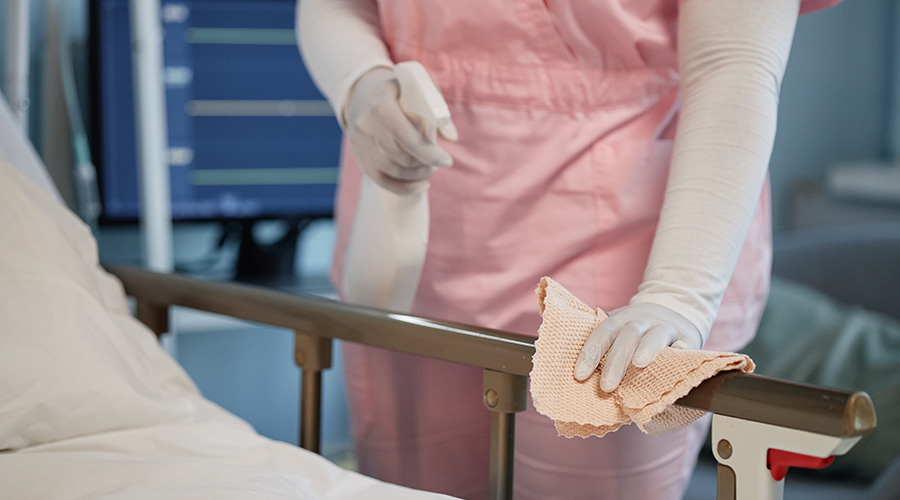
Environmental services (EVS) are known to be one of the most important fighters of infection control as the primary cleaners in healthcare facilities. However, the department is commonly overworked and understaffed, raising pressures and workloads. When EVS is running behind, other staff may have to step up to the task.
Nurses are already responsible for cleaning bodily fluids and biohazards in patient rooms. They also often wipe down shared equipment and discard dirty linens and trash. But with budget cuts, and some hospitals even removing EVS altogether, nurses are increasingly forced to undertake the bulk of environmental cleaning duties.
These additional assignments can be stressors, especially for healthcare workers untrained in environmental cleaning. Researchers in a 2024 study from Infection, Disease, and Health journal identified nurses and midwives—the frontline with the highest contact with patients—as crucial in maintaining infection control. Because cleaning is so important in preventing healthcare-associated infections (HAIs), the study surveys nurses and midwives cleaning knowledge, attitudes and practices.
The Results
Broadly, participants stated that they understood the importance of cleaning. Researchers concurred that nurses and midwives play a key role in cleaning duties. However, there was significant ambiguity about who was responsible for cleaning patient areas or certain pieces of equipment.
The majority indicated that nursing/midwifery staff should clean the IV pole and pump. Only 40 percent believed that bed rails and nurse call bells were their responsibility. Meanwhile, 10 percent were unsure who should clean shared equipment, i.e. the IV pole and pump.
HFT Recommends: The Disconnect Between EVS and Clinical Teams
There was also less certainty on when or how to properly use disinfectants and their effectiveness on different microorganisms. Additionally, over a third (39 percent) of participants failed to identify the correct way to wipe a surface (the S-shaped or serpentine method). This has major implications, as disinfectants only work when used properly. Different products have unique dwell times, kill claims and dry times. Nurses that have not been trained to read Environmental Protection Agency (EPA) labels or armed with the knowledge of the proper cleaning and disinfecting processes may be increasing the risk of HAIs.
The participants called for more easily accessible information about the different types of cleaning products and when to use them, increased clarity around cleaning responsibilities, more access to cleaning products and increased accountability from staff and management.
Researchers recommended increasing staff knowledge in product use through communication, training, audit and using an implementation framework.
Most of the participants (68 percent) said they had received information about the importance of cleaning, availability of products and their applications. Yet 11 percent received that information over three years ago, while 32 percent could not remember or never received any cleaning information.
Despite the majority receiving cleaning information, there was a general lack of simple information about simple products. Participants wanted easy instructions on product use, which researchers suggest can be done through nurse educators, online platforms or from manufacturing or distributing representatives.
While environmental cleaning shouldn’t be the responsibility of nurses and midwives, sometimes they have no choice. Healthcare facilities should take care to properly educate them on cleaning best practices, as well as improving communication and providing greater operational support.
Elisa Miller is an assistant editor for CleanLink.com, Contracting Profits, Facility Cleaning Decisions, and Sanitary Maintenance.
 Preparing Healthcare Facilities for Wildfire Air Quality Events
 UW Health Set to Open Expansion at East Madison Hospital
 Central Ohio Primary Care Physicians Falls Victim to Cyberattack
 The Role of Biophilic Design in Healthcare Facilities
 TriStar Centennial Medical Center Invests $90M in Women, Children's Hospital Expansions