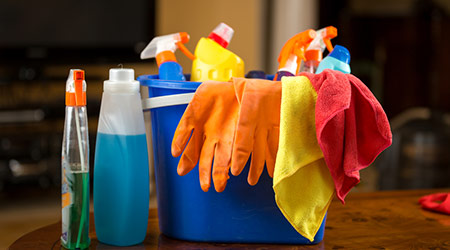
When cleaning chemicals are improperly mixed, the best case scenario can be a strange smell, the worst an injury or death, according to an infographic on the Manage Men website.
To avoid these accidents, OSHA has the revised Hazard Communication Standard (HCS 2012) that requires organizations to provide training. According to the EPA, as many as 2.8 million people in the cleaning industry are exposed to potentially dangerous chemicals each day.
It’s up to the employer to make sure their employees know what they’re doing and have the training to know how to detect hazardous chemicals in the work area. OSHA’s revised standard includes training on:
• Measures employees can take to protect themselves from these hazards.
• Details of the hazard communication program developed by the employer, including an explanation of the labels received on shipped containers and workplace labeling system, the SDS and how employees can use the appropriate hazard information.
While not required by the standard, employers can further reduce risk of an incident resulting from improper chemical handling by providing ongoing training.
 Sustainability as a Baseline in Healthcare Facilities
 Penobscot Valley Hospital Reports Data Security Incident
 Ballad Health Acquires Land for Future Unicoi County Hospital
 Why Healthcare Facilities Management Is Critical to Patient Safety
  Brookdale Senior Living Announces Acquisition of the Brookdale Galleria Community