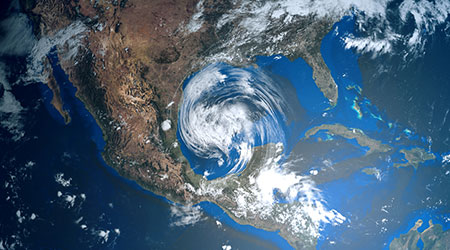
Hospitals have the responsibility of keeping backup power on-site to provide care for critically ill patients in the event of a power outage. However, many other kinds of healthcare facilities, like nursing homes and rehabilitation facilities, do not have to adhere to critical care power requirements. These facilities also provide care for patients who depend on medical devices operating on grid power, yet they remain vulnerable to power outages and grid irregularities. While this is a serious concern for patients everywhere, only a handful of states, like Florida, implement firm regulations on energy resilience for healthcare facilities. There is no national standard for resilience at non-critical care facilities.
A global survey of healthcare providers reveals that 71 percent* don’t have backup power. Forty-six percent go on to say their organization suffered an interruption of energy supply due to external factors in the previous 12 months.
The lack of resilience plans, therefore, can hardly be attributed to a lack of awareness of the issue. Additionally, 77 percent of healthcare respondents agreed that the cost of being energy resilient is far lower than the impact of a power outage. What’s the holdup then?
Healthcare facility professionals are grappling with how to make facilities and campuses more resilient and energy-efficient. Aging, unreliable infrastructure places patients in jeopardy, while staff shortages and the move to digital healthcare place additional pressure on existing personnel resources.
The digitization of healthcare systems, like EMR (electronic medical records), demands even more energy to keep these systems running. In most cases, facilities increase electricity loads to a level which older backup solutions cannot support. The right energy partner, however, can help secure budget, maximize operational efficiency, ensure the resilience of critical services, and improve environmental performance.
To complicate matters, many healthcare facilities take a “set it and forget it” approach to resilience and energy management, which can carry grave unintended and unprecedented consequences. For example, when the hurricane dubbed ‘Superstorm Sandy’ hit New York City in 2012, many hospitals experienced power outages due to poorly maintained generators and related equipment. Power outages are bound to happen and can occur anywhere at any time. As recently as July 2019, New York City and Washington D.C. experienced massive power outages which put thousands of patients in healthcare facilities at risk.
*Energy Advantage Research, Centrica Business Solutions. Healthcare respondents statistics based on a six-country survey of more than 1,000 energy decision-makers in large organizations.
Karin Aviles is the Head of Demand Generation & Field Marketing North America and Dan Svjenar is the Vice President, Head of Commercial North America for Centrica Business Solutions.
 Sustainability as a Baseline in Healthcare Facilities
 Penobscot Valley Hospital Reports Data Security Incident
 Ballad Health Acquires Land for Future Unicoi County Hospital
 Why Healthcare Facilities Management Is Critical to Patient Safety
  Brookdale Senior Living Announces Acquisition of the Brookdale Galleria Community