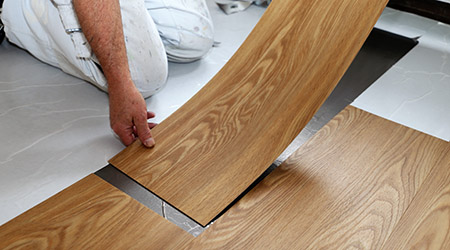
Flooring can make or break a hospital or other healthcare facility when it comes to staying within budget. Long-term maintenance can make affordable material cost two to three times more than a more expensive product that has fewer maintenance requirements.
Cost considerations
While several emerging trends are affecting flooring options, pricing remains a concern for facility managers.
“Unfortunately, clients are often more concerned about the upfront cost of materials because they are trying to work within a limited project budget,” says Amy Harrell, principal with JCJ Architecture. “In these cases, we have found that material life-cycle costs are even more important to show to your client. Even on a limited budget, we can use life-cycle cost comparisons to guide a client to a material that both fits their budget and saves them money and headaches in the future.
“Products that differ by $0.25-0.50 per square foot on day one can be thousands of dollars different in one or two years. With today’s labor shortages, this exercise has become even more important to our clients. Showing a client that they would need fewer staff members to maintain a product is critical right now, when employees are hard to find and maintain.”
Minimizing risk
Choosing the lower-priced option also can put employees at risk. Inappropriate flooring material choices are the leading causes of slips, trips and falls, making flooring one of the leading causes of claims in facilities, Harrell says. Managers can reduce these risks by paying attention to the flooring’s dynamic coefficient of friction rating (DCOF) and the transition between flooring materials. Most commercial flooring has a DCOF of at least 0.42, but managers whose facilities have many high-traffic areas are considering a DCOF of 0.6 to better maintain safety.
“Transitions between flooring materials need to be less than ¼ inch in rise to meet ADA standards in commercial spaces,” Harrell says. “Often, this is only closely considered in areas where the public will be. It is critical to maintain this standard for back-of-house transitions, as well, not only for ADA compliance but for employee safety.
“Transitions that are too high are trip hazards for employees and make it hard to roll carts or equipment over them, which can also lead to employee injuries. By simply paying attention to the height and style of transitions throughout a facility, risks are reduced for all users of the space, whether employees or patrons.”
New shapes and sizes
Still, flooring priorities for one facility might not be the same for a nearby facility. The tile industry is seeing more introductions of new shapes and larger sizes. Just five years ago, 12x24 tile was the most common format, but now tile sizes have increased to 24x24 and 24x48.
“As tile sizes increase, it is critical for designers and contractors to remember the importance of proper floor preparation,” Harrell says. “These larger sizes offer greater creativity options in flooring patterns but they are susceptible to cracking if the subfloor is not level and sound."
Meanwhile, luxury vinyl tile (LVT) is becoming more popular because of advances in printing technologies make the materials look more realistic. In addition, 5mm LVT offerings are increasing as manufacturers offer enhanced acoustical properties and transition more evenly to carpets and other adjacent materials. But these advances lead to more competitive pricing.
“With more and more LVT to choose from, it is important for designers and facility managers to pay attention to the wear layer,” Harrel says. “With wear layers ranging from 6 mil to 20 mil, you need to pay attention. The higher the wear layer, the more durable and less scratch-resistant the tile will be. Even $0.05-0.10 more per square foot can get you a much more durable wear layer, which will drastically prolong the life and appearance of your LVT.”
Mackenna Moralez is assistant editor of Healthcare Facilities Today.
 Sustainability as a Baseline in Healthcare Facilities
 Penobscot Valley Hospital Reports Data Security Incident
 Ballad Health Acquires Land for Future Unicoi County Hospital
 Why Healthcare Facilities Management Is Critical to Patient Safety
  Brookdale Senior Living Announces Acquisition of the Brookdale Galleria Community