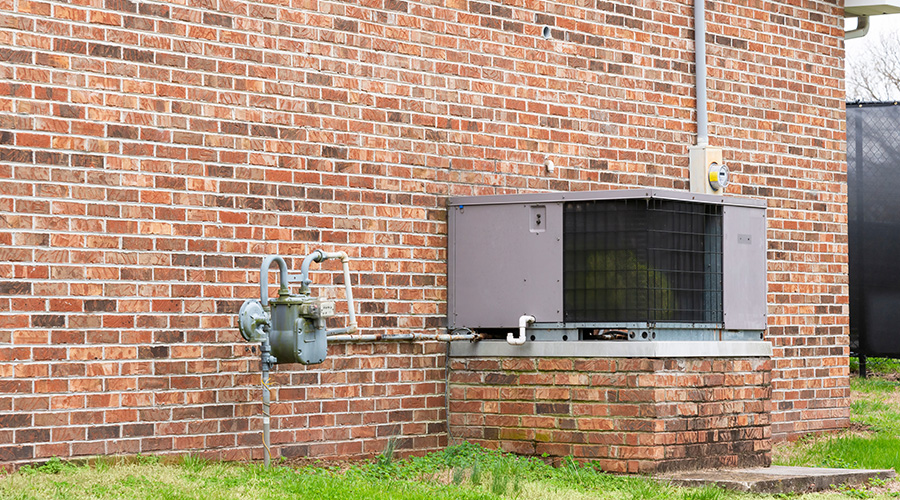
When a healthcare facility’s central cooling system goes down, everyone knows about it. The facilities teams start their protocols. Vendors are on speed dial. The fix gets prioritized because the consequences are immediate and visible.
Smaller cooling units do not get that level of attention. They serve patient rooms, waiting areas, rehab spaces, clinics and administrative offices. They run unnoticed in the background, and unless someone is standing in an uncomfortable room or staring at an unusually high utility bill, no one is looking at them. That is a problem.
In healthcare facilities, these units are often the last components reviewed in an energy assessment and the first thing deferred when budgets tighten. The assumption is that if they are running, they are fine. That assumption is costing facilities more than most owners and managers realize.
Unseen waste
The most common issues with small and mid-sized cooling units are not dramatic failures. Instead, they are slow leaks on performance — the kind that do not trigger alarms but accumulate undetected over months and years.
When schedules are outdated or overridden, units continue conditioning spaces that are empty or lightly used. Dirty filters and low refrigerant charges add strain, making equipment work harder to maintain setpoint. Even small control issues can create problems. A temperature sensor that is out of calibration might trigger short cycling or extended runtimes, while a failed economizer can keep mechanical cooling online when outside air could meet the load at little to no cost.
We have seen how much waste can sit inside small cooling units that appear to be functioning normally. In one project involving a group of basic units, the issue was not that every unit needed to be replaced. The opportunity was in the way those units were being controlled. Adding fan speed control, web-based monitoring, economizer optimization and more intentional setback scheduling made the hidden operating patterns visible and gave the facility team a better way to manage performance.
None of these issues are catastrophic. All of them are common. In one building, the impact is modest, but across a healthcare portfolio with dozens or perhaps hundreds of units, the cumulative costs add up fast. The result is inconsistent temperatures across spaces, staff complaints that get logged as work orders rather than system problems and energy spend that looks normal until someone looks closely.
Staying under the radar
Part of the challenge in successfully managing small cooling units is prioritization. Facilities teams are managing competing demands, and a unit serving an administrative corridor rarely rises to the top of the list. A common maintenance philosophy is understandable but expensive: Run it until it fails, then replace it.
For major systems, predictive maintenance has become standard practice in many healthcare facilities. For smaller AC units, that same discipline often does not apply. The units are considered lower stakes, so they get reactive attention at best.
The other factor is visibility. Without a systematic review, there is no easy way to know how many units have calibration issues, how many are running on outdated schedules or how many economizers are not functioning. The information exists in energy data and equipment records, but connecting it across a portfolio requires time and a structured approach most internal teams do not have capacity for.
What a portfolio review reveals
The value in looking at small and mid-sized cooling units at scale is pattern recognition. One unit with a calibration issue is a maintenance ticket, but 20 units across three sites with the same issue is a systemic problem with a systemic solution.
A portfolio-style review identifies where the same problems are repeating. That problem might be a specific equipment model that consistently develops economizer issues, a scheduling configuration set during construction and never revisited or a maintenance gap showing up differently across buildings but tracing back to the same root cause.
That view changes what managers do next. Instead of addressing units one at a time as problems surface, they can prioritize upgrades based on impact, standardize fixes where the same issue appears repeatedly and sequence the work around the operating calendar and capital budget.
It also changes the internal conversation. When a facilities manager can show leadership a clear picture of how many units have performance issues, what those issues are costing and what a phased improvement plan looks like, the case for investment becomes easier to make.
Not every manager has the capacity to audit every small cooling unit in their facilities at once. The starting point is usually a targeted review of units that are high-use, serving sensitive spaces or flagged by energy data as outliers. Patterns tend to emerge quickly from there.
The broader question of whether to optimize or replace a given unit is a separate analysis, one that depends on age, condition and the specific issues identified. What matters first is knowing what managers have and how it is performing. For many managers, that information does not exist in any usable form. Building it is where the value starts.
Chris Cutcliff is chief operating officer at Chateau Energy Solutions, where he leads the delivery of energy efficiency and HVAC optimization programs for healthcare systems and large commercial operators nationwide.
 Designing for the Psychology of Waiting
 UT Health Sciences Breaks Ground on College of Medicine Interdisciplinary Building
 Vandalia Health, Mary Free Bed Break Ground on New Rehabilitation Hospital
 Why New Era of Care Demands an Ambulatory Facilities Approach
 ClearSky Health Plans New Medical Rehabilitation Hospital in North Carolina