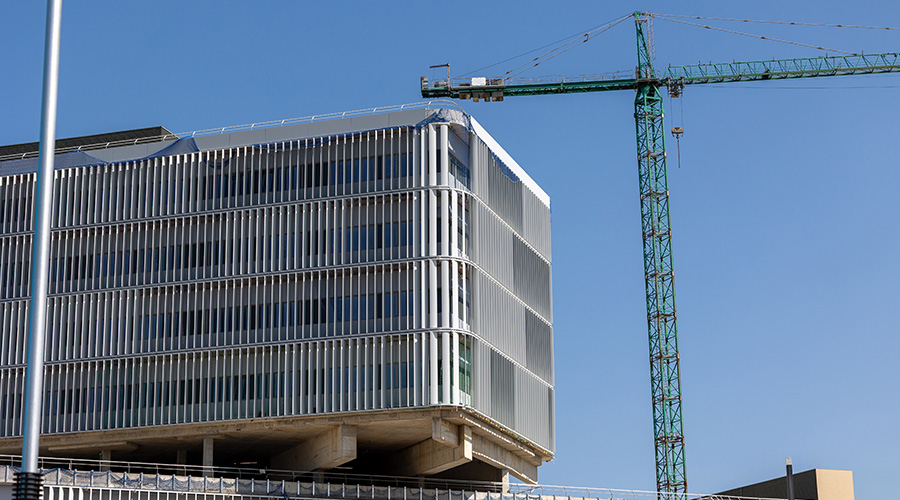
Demand for healthcare is rising fast, driven largely by aging populations. Older people typically need more frequent and complex care. This scenario puts added pressure on healthcare systems, funding and physical infrastructure.
At the same time, labor shortages and rising costs are making it harder to expand capacity. By 2030, one in six people globally will be over 60 years old. In the United States alone, that number will rise by 25 million between now and 2050.
Traditional responses — building more primary and secondary care facilities — are no longer sustainable. These buildings can take years to deliver, lock in long-term carbon emissions and strain already stretched budgets. Instead, a new approach is needed — one that uses data to plan better, focuses on actual patient needs and prioritizes long-term results.
Step 1: Align provision with real, clinical needs
Hospitals are expensive to run, slow to build and carbon-intensive to operate. While they are clearly vital to providing healthcare, they should not be the default answer to rising demand. Instead, healthcare leaders must start with a clear understanding of what care is needed, and where. That means using clinical, demographic and operational data to guide strategic decisions.
Often, this approach leads to a shift in investment toward community-based care, digital tools such as virtual care, and smaller and connected facilities. In Scotland, a so-called hospital at home approach has reduced bed demand for geriatric patients by nearly 25 percent, saving more than $73 million annually.
These approaches shift the focus away from centralized, hospital-based models and toward more flexible, patient-centered care delivered where and when it is needed most. Patients benefit from care closer to home. Systems benefit from lower costs, reduced travel emissions and fewer carbon impacts overall by avoiding the need to build, power and maintain large central hospitals.
Technology plays a key role. Virtual wards, remote monitoring and digital records allow care to move beyond clinic or hospital walls. But to have real impact, these tools must be integrated with purpose and designed into the care model from the start.
Step 2: Adapt what already exists
New construction comes with a heavy carbon cost. In order to meet projected healthcare demand in the United States, hundreds of new hospitals would need to be built traditionally, resulting in millions of tons of embodied carbon.
Healthcare leaders must ask a different question first: Can we repurpose what we already have? Across many systems, outdated or underused infrastructure inside and outside healthcare can be adapted. This reduces capital costs, shortens delivery time and avoids locking in future emissions.
Related Content: Contractor Questions for Successful Construction Projects
Strategic design also can help existing buildings last longer. Better energy use, passive heating and cooling, and more flexible layouts can improve performance without needing to rebuild. Without action, today’s outdated buildings can become tomorrow’s stranded assets that are costly to run, hard to adapt and misaligned with future care models.
Step 3: Build only when essential and for the long term
When new infrastructure becomes essential, healthcare organizations must build differently. This reality means designing hospitals and healthcare facilities that are flexible and low-energy and aligned with net zero goals from day one.
Technology plays an important role. Hospitals are starting to use systems that share scans, records and treatment plans instantly across care teams. This technology helps provide better care while reducing waste and delays.
Technology also can help manage buildings more efficiently. All-electric designs, passive heating and cooling and smart controls can cut energy use. Many hospitals are investing in sensors and meters that help detect problems early and track the way systems are performing. This kind of energy planning does not just lower running costs. It helps make healthcare infrastructure more useful to the wider community by reducing demand on power grids and supporting sustainability goals.
This approach is not theory. It already is happening:
- In the U.S., new all-electric hospital campuses are eliminating the use of fossil fuels. These sites are powered by integrated renewable energy and designed for long-term energy performance.
- In Australia, hospitals are being planned to handle future climate risks by placing critical systems above flood levels, integrating filtration and backup power and allowing re-entry after weather damage from climate events.
- In Peru, a $650 million program is expanding healthcare access in remote areas by using modular construction and community-based care models rather than building carbon-intensive hospitals in urban centers. This shift improves regional access while cutting emissions and costs.
- In the United Kingdom, recent major projects from general hospitals to specialist cancer centers have adopted net zero design principles, flexible layouts and embedded digital care.
These are not just construction projects. They are long-term investments in healthier populations and a healthier planet.
To global healthcare leaders, infrastructure owners and governments, the focus is clearly on not just what organizations build but how they plan. The way forward is not about doing more of the same. It is about matching investment with real need, reusing when possible, and only building where it adds real value for patients, providers and the planet.
The challenge is complex, but the opportunity is clear: to shape a healthcare system that serves people and the planet.
Roger McClean is U.S. healthcare director with Currie & Brown, a Sidara company.
 Achieving Better Treatment Spaces Through Co-Design
 Prisma Health to Acquire 36 Urgent Care Sites in South Carolina from Novant Health
 Modoc Medical Center Discloses Data Breach
 Creating Healthcare Campus Master Plans That Allow Movement and Respite
 Aspirus Health Celebrates Opening of Chippewa Falls Hospital and Clinic