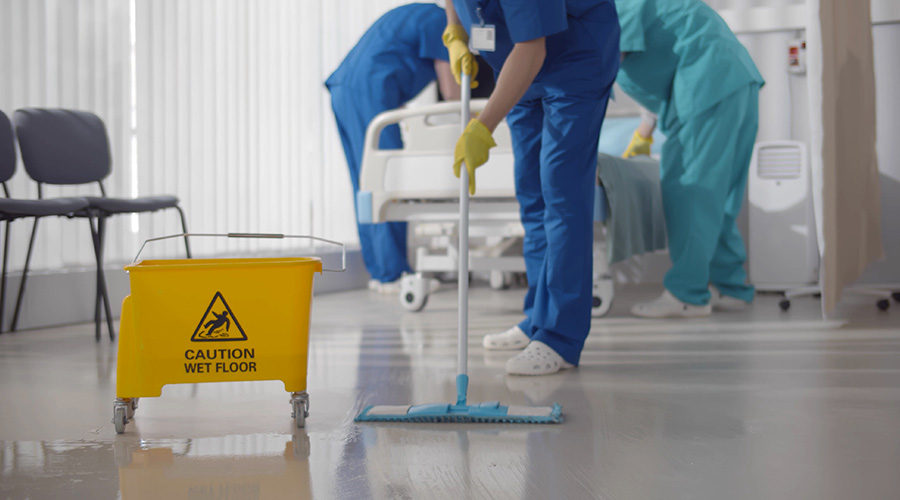
Hospital floor dust can harbor dangerous pathogens, including MRSA, Acinetobacter, Staphylococcus aureus, Enterococcus, E. coli and Klebsiella — all of which pose a risk of healthcare-associated infections if disturbed or transferred to other surfaces.
So-called dust bunnies contain dust particles that are the major source of the bacteria humans breathe. Just walking into a hospital room can stir up dust, releasing millions of bacteria into the air. Dust then settles on bed rails, tables and equipment, increasing the chance of contact transmission. Microbes in dust can survive for long periods and remain infectious.
Floors are often neglected or improperly cleaned, allowing pathogens to accumulate. Cleaning removes pollutants from the environment and puts them in their proper place. Cleaning is removing. Environmental services (EVS) technicians cannot hide, ignore or brush aside dust and say they are cleaning. They must remove and dispose of floor dust.
A single-use microfiber floor dusting sheet on a flat frame is the preferred way to collect dust from floors prior to damp mopping the floor. Dry mopping a floor should always precede damp mopping. But too often, EVS technicians err by combining these two steps into one step: damp mopping.
Related Content: 3 Essentials of A Floor Care Program
Rather than removing dust from floors, damp mopping wets the soil and dust, and the resulting mud is deposited in the corners and along baseboard edges. This dried material harbors the previously mentioned microorganisms. When this mud dries, a technician must use a general-purpose cleaner and a putty knife to remove the unsightly mess.
Patient room floors, including corners and edges, must be inspected for cleanliness. A search of literature pertaining to quality assurance inspections specifies using fluorescent markers or adenosine triphosphate test. While these two methods might be well-suited for bed rails, overbed tables and toilet seats, a different assessment of the floor must be used. Neither of these methods is effective because they are used on a very small area of a very large floor.
Alternatively, technicians activate a focused beam to examine floors for the presence of dust and debris. Why a focused beam? In a well-lit room where lighting is typically dispersed from the ceiling and shine from above the area being inspected, the light is not sufficient to notice small particulate matter.
Even if a bright light is directed straight down at a high-touch surface, the surface and the contaminants reflect the same bright light toward the user’s eyes, resulting in the inability to identify and view many small contaminants on floors.
An LED flashlight with 150 lumen output is very effective for identifying particulate matter on all hard surfaces but especially floor edges and corners. When shining a bright, focused beam at a level angle across the surface of the floor, a technician will be amazed at what they can see. At such an acute angle, particulate matter such as dirt, dust, water, grease, blood and bone fragments in an operating room are easier to see and identify for removal. With their removal goes the contamination that poses a threat to patients and staff.
J. Darrel Hicks, BA, MESRE, CHESP, Certificate of Mastery in Infection Prevention, is the past president of the Healthcare Surfaces Institute. Hicks is nationally recognized as a subject matter expert in infection prevention and control as it relates to cleaning. He is the owner and principal of Safe, Clean and Disinfected. His enterprise specializes in B2B consulting, webinar presentations, seminars and facility consulting services related to cleaning and disinfection. He can be reached at darrel@darrelhicks.com, or learn more at www.darrelhicks.com.
 5 Reasons Engineering is the Edge in Healthcare Master Planning
 Building an AI-Ready Healthcare Facility
  Family Medical Associates of Raleigh Reports April 2026 Data Breach
 Every Detail Matters: A Patient's Story of Healing, Hope and Healthcare Facilities
 Geisinger Wyoming Valley Medical Center Tops Off New 11-Story Tower