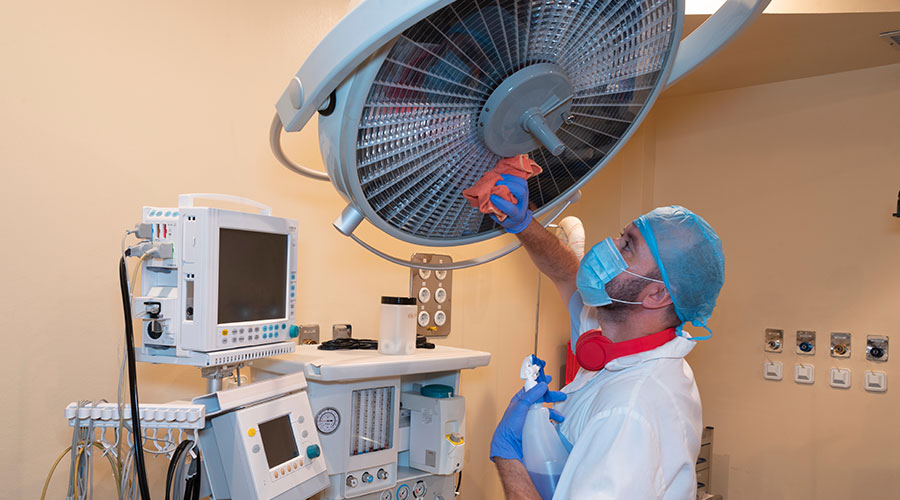
Infection prevention begins in the C-suite. Healthcare facility leaders and regulatory partners should prioritize the expectation that infection prevention and control (IPC) programs address all infectious risks and harm as a core requirement. In turn, IPC program managers should have direct access to senior facility executives who can provide prompt support for IPC initiatives. Both parties should recognize that cleaning professionals are essential partners in preventing and controlling infectious diseases.
There is enough evidence that cleaning hospitals helps prevent infections. Yet, cleaning professionals in environmental services (EVS) departments are relatively untrained, unmotivated, underpaid and underappreciated by other hospital staff. Coupled with under-staffed EVS departments, this creates lasting issues regarding patient and healthcare worker safety.
More research is needed to measure the effects that cleaning methods and chemistry have on healthcare-associated infections (HAI). Since improved cleaning of the patient-care environment measures is always bundled with other interventions during outbreaks, it is difficult to measure their real impacts.
The best disinfectant in the world is useless if it is not applied correctly, and the best trained personnel are useless if the product they are using is not effective against dry-surface biofilm, spores and fungi.
Too often, EVS workers are not properly educated about their roles in preventing the transmission of infectious disease, and they tend to be poorly trained — usually by another employee rather than a leader — in cleaning from high to low, from the cleanest part of the room to the dirtiest. Subsequently, workers often do not believe they can make a difference in preventing infections. Beyond that, the amount of work they are expected to do is not always in accordance with the time assigned to the task.
EVS workers are on one of the lowest rungs in the hospital hierarchy, and they often do not receive credit, especially considering the importance of their work. Few hospitals have sufficient systems in place to educate and certify EVS professionals, and without certification, advancement is unstructured and can be limited, since there is no way to gauge the quality of a staff member.
Often, there also is a high turnover rate among EVS workers, which makes the C-suite question the expense of certifying their frontline cleaners. They might say, “If I certify them, I’ll have to pay them more money. Then what if they leave? I’ve just wasted my money.”
The corollary to that response is, “What if you don’t educate and certify them and they stay?”
As an EVS leader for more than 34 years, I would hold monthly staff meetings where I would emphasize the fact that disease prevention is always better and less expensive than a cure, especially when we are running out of antibiotics.
At one monthly meeting, I told my staff that their role is very important. In effect, they are infection preventionists. That comment elicited this response from an employee: “Then why don’t we get the respect and pay like we are important?” I was speechless for a moment and then replied, “Please keep doing what you are doing. The life you save is the accident that never happened.”
J. Darrel Hicks, BA, MESRE, CHESP, Certificate of Mastery in Infection Prevention, is the past president of the Healthcare Surfaces Institute. Hicks is nationally recognized as a subject matter expert in infection prevention and control as it relates to cleaning. He is the owner and principal of Safe, Clean and Disinfected. His enterprise specializes in B2B consulting, webinar presentations, seminars and facility consulting services related to cleaning and disinfection. He can be reached at darrel@darrelhicks.com, or learn more at www.darrelhicks.com.
 AI Adoption on the Rise Among Leaders
 TriasMD Officially Opens DISC Surgery Center at Tarzana
 Goshen Health Announces Partnership with Parkview Health
 Severe Winter Weather: What Healthcare Facilities Must Prioritize
 Recovery Centers of America Opens New Facility in Florida