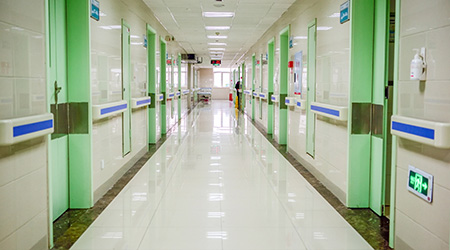
Just as healthcare facilities managers need to consider the most appropriate light fixtures for their homes, they also need to consider their options when it comes to upgrading lighting systems for their buildings. Hospitals generally rely on three types of lighting: security, general purpose and task lighting. Each of these serves a different purpose and deserves a certain level of analysis when it is time to upgrade.
Too often, however, managers make mistakes when updating their systems. A closer look at three common mistakes can help managers develop strategies to avoid them.
Overlooking safety outdoors
Typically, energy efficiency is top of mind for managers because their facilities use roughly two and a half times more energy than traditional corporate buildings. But managers need to shift this priority to safety when upgrading the lighting for outside structures, such as parking lots and garages.
It is important to have the appropriate outdoor light ratio so occupants’ eyes can appropriately adjust from high-light to low-light as they walk. This ratio typically should be no more than 15:1 in surface lots and parking structures in order to limit how much a person’s eyes need to adjust
Managers ran into this problem several years ago when there was a push to upgrade lighting fixtures to be more energy efficient. But focusing on energy efficiency outdoors sacrificed industry design standards and the appropriate high-to-low light ratios, which posed a safety risk. Now, many facilities are backtracking and installing new fixtures to address those safety concerns.
Indoor lighting does not present the same challenge. Managers should choose the most appropriate product for indoor spaces to ensure they are not overlit because LED lamps typically produce more light than traditional bulbs. Managers might want to consider a product that is field adjustable for lumens and color temperature.
Not consulting experts
People visit a dentist to examine their teeth, so why wouldn’t managers consult with someone who is equipped with the expertise to design and install the appropriate lighting when planning upgrades? Healthcare facilities are complex and require a certain level of specialization to appropriately and effectively address lighting system issues.
For these reasons, it is important to consult with an installer who has experience with fixtures and a strong understanding of the way systems work and who can explain why and how the fixtures fit into the facility’s overall needs. For example, facility lighting experts can help with lighting designs, installation and retrofits, as well as with removing legacy systems so a hospital is not saddled with a retired system in the ceiling.
Working with a specialist also can create cost savings. In one instance, an in-house facility electrician cost $380,000 for installation while a specialized lighting company only charged $170,000 for a similar scope of services. This is a significant cost reduction, and such savings help build a better business case for an upgrade, which will pay off in the long run.
Choosing the wrong product
It is no secret that updating lighting systems is a significant investment. With the major shift to LED lighting, many products are more energy efficient, produce less heat and last longer than traditional incandescent bulbs. A lighting retrofit used to offer a two- to three-year payback but now comes with a payback of as much as three to five years.
To protect the organization’s investment, products should come with a 10-year warranty from the manufacturer, and managers must ensure they understand the warranty process for the product in order to protect their investment.
Lighting upgrades are not as simple as running to the hardware store to buy a light bulb. Each area within a hospital requires a certain type of light fixture to meet the purpose of that space. An engineered systems approach and elements of finesse are required to upgrade a facility’s lighting. Avoiding these common mistakes will ensure the safety, comfort and energy efficiency needed to elevate facilities and the level of care they provide to patients.
Scott Czubkowski, P.E., CHC, is the national director for energy and facility performance at Medxcel.
 Making Multi-Site Lighting Upgrades Work
 Designing a Positive Care Destination for Children
 Blackbird Health Opens 10th Clinic in Pennsylvania
 Healthcare Construction Infection Control: Essential CDC Guidelines for Active Facilities
 Protecting the Most Vulnerable: Inside the NICU