
Healthcare facility managers face significant challenges in addressing indoor air quality (IAQ) concerns that directly affect patient safety, worker health and the overall care experience when core building systems reflect earlier design standards rather than today’s clinical and infection control requirements.
Well over one-half of hospital and health system facilities’ leaders report overseeing at least one facility that is more than 50 years old, according to the 2024 ASHE Hospital Operations Survey, highlighting the widespread challenge of aging healthcare infrastructure.
As these facilities age, managers face increasing challenges maintaining building systems critical to IAQ. These challenges can contribute to elevated risks related to patient safety, staff comfort and retention, and heightened regulatory and accreditation scrutiny.
The problem punchlist
Water intrusion is a literal blind spot. Roofs, window systems and facades reaching the end of their lifespans can be vulnerable to moisture migrating into wall and ceiling assemblies where it might remain undetected. Persistent dampness can promote microbial growth along perimeter and headwalls, behind vinyl wall coverings, inside mechanical rooms and in other unseen spaces.
By the time moisture damage or microbial growth becomes visible or odorous, the underlying conditions might have been present for weeks or months, increasing the scope and costs of remediation and operational disruption.
Legacy HVAC systems often fail to meet modern filtration, humidity control and pressure requirements and create another blind spot. Many older air-handling systems were not originally engineered to meet the filtration efficiencies, pressure differentials, air distribution requirements or environmental control needs associated with modern patient acuity.
These systems often were designed for different occupancy patterns and thermal and moisture loads generated by occupants, lighting and operational equipment present in modern healthcare facilities. Over time, expansions and renovations layer new demands onto systems that were never designed for the resultant increased performance challenges.
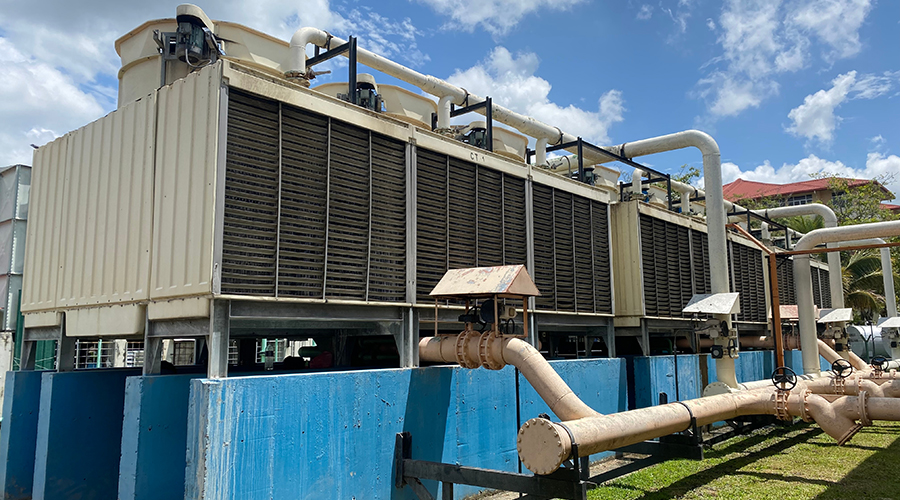
Building water systems also can create parallel blind spots. As plumbing networks age and become more complex through renovations, conditions that support opportunistic waterborne pathogens – including Legionella – can increase if not adequately managed. Legionella growth is driven by factors such as stagnation in little used or dead-end sections of piping, insufficient disinfectant residual, sediment and biofilm accumulation and inadequate water temperature control, which can be exacerbated in large or underused sections of building water systems.
Even when HVAC and water systems remain operational through ongoing repair and maintenance, small performance gaps can emerge and compound. Air exchange rates might decline, designed pressure relationships can drift out of tolerance, and humidity control can become increasingly unstable – often without a single obvious failure point. These issues allow underlying system limitations to remain hidden until patient care and staff comfort are adversely affected or compliance with regulatory requirements is challenged.
Continuous occupancy, not just by patients, but by professional and medical staff and tenants of building leased spaces, poses ongoing operational challenges in healthcare facilities. Deferred maintenance and degraded building systems can contribute to poor IAQ, which is associated with adverse patient outcomes and can negatively affect staff and occupant well-being, productivity and satisfaction.
Renovation and maintenance activities in occupied facilities amplify these challenges. Construction and renovation work can generate dust and airborne contaminants, and if they are not properly controlled, they can carry fungal spores, such as Aspergillus, along with bacteria and construction debris. Depending on building age and the types of materials disturbed, additional hazards such as asbestos, lead, crystalline silica and residual chemicals also might be present. Approximately 5,000 secondary patient infections occur annually in U.S. healthcare facilities in association with construction, renovation and maintenance activities, according to ASHE.
Regulatory scrutiny from The Joint Commission intensified in the late 1980s and became firmly established during the 1990s as accreditation expectations evolved from basically structure- and policy-focused surveys to requiring an ongoing, healthcare-systemwide initiative to monitor care and improve performance.
The transition — from a focus on organizational structure to organizational performance; from assessing if policies were in place to directly measuring clinical outcomes; and from episodic evaluation to ongoing improvement in infection control, quality assurance, and medical staff oversight — placed new and sustained demands on the physical environment of care. In many organizations, these expectations highlighted the limitations of aging facilities, where legacy infrastructure made it more difficult to support modern standards for environmental control, monitoring and patient safety.
Technology innovation in healthcare facilities is an opportunity and a challenge. Advances such as AI-driven predictive maintenance, smart building automation and Internet of Things-enabled asset tracking are game changing for data gathering and documentation, plans and budgets, superior system performance and improved IAQ. They also help facilities’ teams clearly demonstrate operational and financial value to leadership.
Even so, technology investments in facility systems is a tough sell when balanced against investing in medical innovations that can advance patient recovery and overall clinical outcomes. Compounding this challenge, many newer digital platforms are not easily compatible with aging mechanical and electrical systems, limiting their effectiveness and increasing integration costs in older facilities.
Staff and budget shortfalls
About 40 percent of current facilities managers will have retired by the end of 2026, according to the International Facility Management Association. The healthcare sector is affected as much or more than other industries by this demographic shift. The resulting loss of specialized institutional knowledge, along with recruiting and retention struggles rooted in compensation gaps compared to other industries, compound an already well-established trend of staffing shortages.
Another well-established trend is the low priority given to facilities departments in the capital budgets of healthcare organizations. Facility spending ranked fourth among capital priorities, trailing investments in: clinical service lines; medical devices; information systems and analytics technology; and local and new market expansion and development, according to a 2024 survey by The Advisory Board, an independent healthcare research firm.
With trained staff and adequate resources to proactively extend the life of aging healthcare facility systems, maintenance backlogs and unplanned failures can accelerate, creating operational disruption and increasing risk associated with unresolved or undetected indoor environmental quality problems.
As one respondent in the ASHE 2024 Hospital Operations Survey said, “Budget restrictions have limited equipment upgrades and replacements, creating more equipment failures that require more labor.”
All of these factors combine to hamper technicians efforts to identify and mitigate IAQ and environmental hazards that compromise patient safety, worker health and occupant satisfaction.
The good news is that practical, achievable measures are available to facility management leadership. By taking a more strategic and forward-looking approach to planning, organizations can improve environmental risk management and better position aging facilities to support patient safety and operational performance over time.
Amanda McKenney, CIH, VP, is senior principal and national manager of building environmental sciences with Terracon, a consulting engineering firm.
 Cooling Towers at NYC Health + Hospitals/Lincoln Test Positive for Legionella
 Prefabricated Wall Panels Accelerate UCF Lake Nona Medical Center Construction
 University of Rhode Island Adds Clinical Space
 How Retail Design Principles Can Improve Healthcare Wayfinding
 Flexible Design Strategies Help OhioHealth Maximize Clinical Space