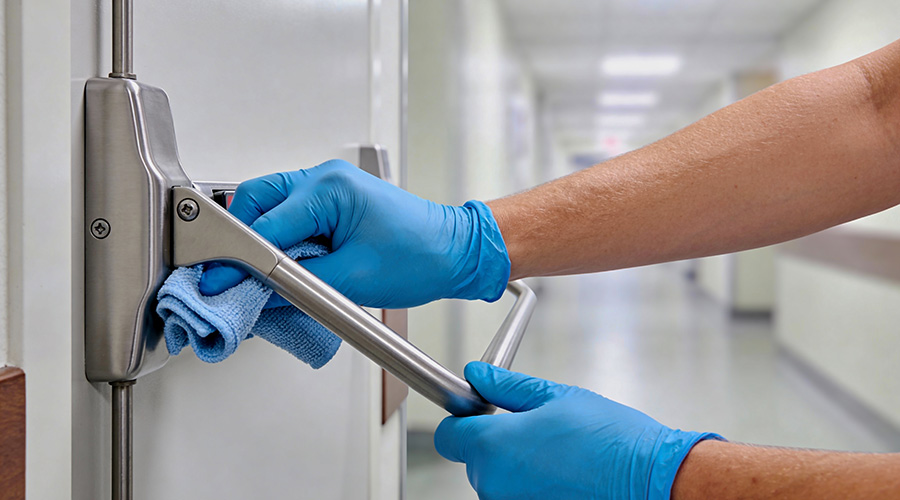
Many healthcare facilities have turned to microfiber cloths and mops in recent years. Proven to enhance microbial removal, microfibers are better at preventing the spread of infection, including healthcare-associated infections (HAIs). They are also lighter, use less harsh chemicals, and are overall more cost-effective than other cleaning textiles.
While experts agree on the importance of microfiber, research is split on whether to reuse and recycle. Microfiber is available as single-use or durable and/or launderable, and both options have their benefits and drawbacks. Because microfibers are so key in infection control programs, it is important to consider which type is best for individual facilities.
The Case for Disposable Products
According to a survey of infection control studies, single-use microfiber cloths and mops may be better at preventing cross-contamination. As they are only used on a single surface or patient room, the chance of spreading bacteria between patient areas is very low. This is especially beneficial in high-risk areas such as operating rooms and emergency departments, where a single-use product is guaranteed to be sterile every time.
Contrary to their name, disposable products may also be more sustainable. The US Environmental Protection Agency (EPA) states that laundry sites are some of the largest water consumers in healthcare facilities. Single-use cloths will substantially cut down on water and energy usage. Meanwhile, facilities that outsource laundry are creating more transportation emissions.
Related Content: Cleanology: The Need for a Study of Cleaning
Researchers have even greater concerns about outsourced laundry. The Centers for Disease Control and Prevention (CDC) and Occupational Safety and Health Administration (OSHA) have strict regulations on wash temperature, chemical concentrations, and decontamination procedures. Certain laundry vendors may not be certified to meet these restrictions. Even if they are, it can be difficult to maintain quality control.
Disposable microfibers have operational benefits as well. They are faster and easier, so that environmental services (EVS) staff can simply toss soiled products and swap in new ones without waiting on clean inventory. Supply chain and training are streamlined as there is less need to track laundry inventory or train staff on proper procedures.
The Benefits of Durability
While some researchers argue that single-use products save water and energy, others say that reusable microfibers are ultimately the most environmentally friendly option. They create significantly less solid waste and only make up a portion of the materials in facilities with in-house laundry.
Most importantly, multiple studies have found that reusable microfibers are just as effective at removing microbial after multiple washes. A 2022 study found that microfibers were just as efficient at the end of their purported lifespan when laundered following CDC guidelines.
Another study found that reusable microfibers’ performance improved after 75 washes and declined after 150. Although performances were typically still better after 150 washes than at first wash. Meanwhile, the disposable cloths’ performance steadily decreased with every repeated use.
The Choice is Individual
Ultimately, science is undecided on which microfiber is best. The availability of in-house laundry facilities is, naturally, a major factor. Facilities with large laundry sites and slower patient turnover may prefer durable materials, while those with high-risk areas and staffing issues may find it easier to use disposable products.
Elisa Miller is an assistant editor for CleanLink.com, Contracting Profits, Facility Cleaning Decisions, and Sanitary Maintenance.
 Rethinking Carpeting's Role in Senior Care Facilities
 Parkview Health Breaks Ground on New Hospital in West Lafayette, IN
 Loma Linda University Health Experiences Data Breach via AI Tool
 Inside One of Healthcare's Most Ambitious Hospital Projects
  Turning Condensate Loss into a Systemwide Steam Efficiency Opportunity