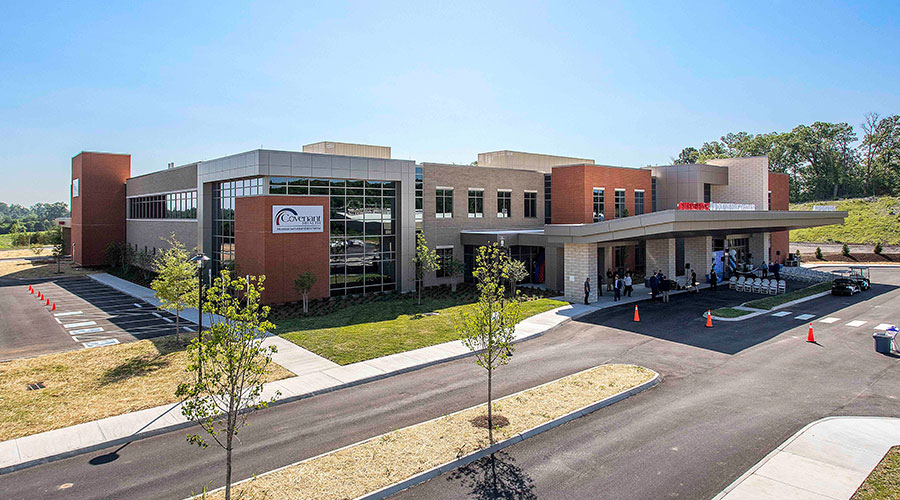
Healthcare facilities are constructed with the utmost care and consideration, given that any potential issues could disrupt the care they provide.
The construction of Morristown-Hamblen West, a 67,000-square-foot extension of Covenant Health and Morristown-Hamblen Healthcare System in Morristown, Tennessee, would prove to have some unique geological issues that challenged the builders.
Repurposing an obstacle
For starters, the site was littered with an overabundance of rocks. Moving it all would be time consuming and expensive, says Andy Westbrook, P.E., senior project manager at The Christman Company. To be exact, it would require moving about 150,000 cubic yards of material, which is enough to fill close to 57 Olympic-sized pools.
“As we have seen in the construction industry, labor shortages are challenging,” says Westbrook. “Finding certified drivers can be challenging with the market right now. Also, diesel prices are very expensive. Those are the two things that we were fighting.”
That is, until one of the directors shared a unique idea: Instead of blasting the rock away, the firm set up some material handlers and ciphers to make the rock into useable on-site material. Ultimately, that prevented having to haul the tons of rock away or having to source materials from the local area and ship them in.
The project now had a clear site to work on with the added benefit of extra cost savings. However, there was another issue right below the site itself.
Getting on solid ground
The land the facility was set to be built on was known for sinkholes, says Westbrook. This area was geologically challenging due to the formation containing a lot of limestone, which is vulnerable to being dissolved by groundwater. When that happens, the areas the limestone once occupied become empty voids, making any foundation built upon them unsteady.
Related: How to Minimize Patient Interference During Construction Projects
“Working with those geological challenges and trying to build a firm foundation for this building was key,” says Westbrook. “Part of what we had to do early on was remediate any kind of sinkholes that we saw that might have occurred in the past. We are working on a site that we knew had active sinkholes, and while our building may not have been on a sinkhole, there is always the risk that something may happen.”
This required what Westbrook calls a “belt-and-suspenders" mentality. That ultimately translated into the firm using micropiles, which are deep foundations anchored into bedrock. With the foundations drilled into a sturdy layer of rock, a strong base of support was formed for the hospital.
Strategizing early for long-term benefits
The work that was performed ended up paving the way for avoiding complications later, such as blasting away leftover rock for further facility expansions. Westbrook adds that it would pose a risk to patient care and building integrity if they had to go back to the site to remove more rock.
“Pre-blasting for future growth just allowed us to remediate the site and work on the site in advance of construction,” says Westbrook. “So, it is just helping us be efficient earlier on rather than having to meticulously hammer out rock later when it is occupied.”
Ultimately, the Morristown-Hamblen West facility opened in 2023, and The Christman Company won two awards for their solutions for the project.
Jeff Wardon, Jr. is the assistant editor for the facilities market.
 Cleanliness Is a Measurable Outcome
 Workplace Safety and the Role of Access Control
 Henry Ford Hospital Celebrates Construction Milestone for Expansion Project
 How EVS Leaders Can Support Staff for Better Cleaning
 Addressing Infection Prevention Staffing Gaps in Ambulatory and Procedural Care