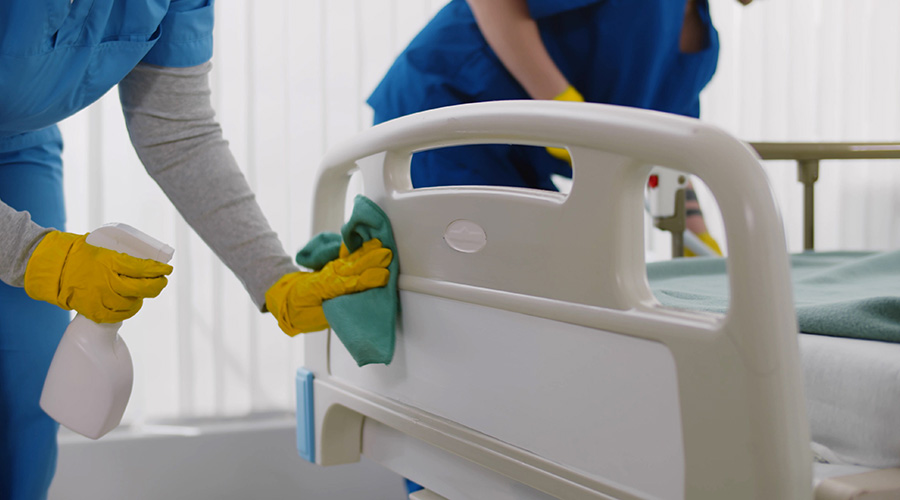
Dr. Stephanie Dancer is well-known for challenging the longstanding assumption that the hospital environment plays only a minor role in infection transmission. Her work has pushed healthcare systems to recognize that cleaning is a clinical intervention, not merely a cosmetic task.
She has written more than 150 peer reviewed papers and influential reviews, including landmark work on the role of the environment in healthcare-associated infections (HAI) and proposals for microbiological standards for surface hygiene.
Dancer argues that hospitals continue to underestimate the fundamental difference between cleaning — the physical removal of soil — and cleanliness, the amount of soil that remains on a surface after cleaning. She says this distinction is routinely overlooked in healthcare settings and that the consequences directly affect patient safety. Her work highlights the way environmental hygiene has long been undervalued, misunderstood or treated as an aesthetic concern rather than a clinical one.
Why the distinction matters
Dancer says cleaning is an active process. It requires friction, technique and time to remove organic material, dust and microbial bioburden. By contrast, cleanliness is the measurable outcome — the amount of soil that remains. Hospitals often assume that if a surface looks clean, it is clean.
But Dancer says that visual inspection is an unreliable indicator of microbial safety. The absence of visible dirt does not mean the absence of pathogens. This gap between appearance and reality has contributed to years of underestimating the role of environmental reservoirs in HAIs.
Historical Blind Spots
The healthcare system’s slow recognition of environmental cleaning as a critical infection prevention measure stems from several historical biases, Dancer says. Cleaning has been associated with gendered labor and low-status work, which contributed to its marginalization in clinical decision-making.
HFT Recommends: The Difference Between Cleaning, Sanitizing and Disinfecting
Also, early infection control efforts focused heavily on endogenous infections — those arising from patients’ own flora — while environmental sources were dismissed as innocent bystanders. This led to disproportionate attention on patient screening and decolonization, with far less investment in understanding or managing surface contamination.
The measurement problem
One of Dancer’s central critiques is that hospitals lack universal standards for measuring cleaning processes and cleanliness outcomes. Without benchmarks for environmental services, it becomes difficult to compare methods, evaluate performance or link environmental hygiene to infection rates.
She says modeling HAIs against arbitrary cleanliness measurements is inherently flawed because the field has not agreed on what constitutes clean enough. This absence of standards perpetuates the oversight of the cleaning-cleanliness distinction and leaves hospitals without reliable tools to assess risk.
Implications for Infection Prevention
Dancer says renewed attention is needed on the removal and monitoring of surface bioburden, adding that hospitals and environmental services departments must move beyond cosmetic cleaning and adopt risk-based practices that prioritize soil removal as a clinical intervention. This move includes:
- developing tangible benchmarks for cleaning methods and surface types
- training staff to understand that cleaning is not merely wiping but physically removing microbial reservoirs
- monitoring outcomes using microbiological or objective tools rather than visual inspection alone.
By restoring the distinction between cleaning and cleanliness, environmental services managers and staffs can better protect patients from environmental pathogens and strengthen their infection prevention strategies.
J. Darrel Hicks, BA, MESRE, CHESP, Certificate of Mastery in Infection Prevention, is the past president of the Healthcare Surfaces Institute. Hicks is nationally recognized as a subject matter expert in infection prevention and control as it relates to cleaning. He is the owner and principal of Safe, Clean and Disinfected. His enterprise specializes in B2B consulting, webinar presentations, seminars and facility consulting services related to cleaning and disinfection. He can be reached at darrel@darrelhicks.com, or learn more at www.darrelhicks.com.
 Hospitals Are Energy Super-Users. Why Is It So Hard to Modernize Them?
 Encompass Health Rehabilitation Hospital of Bangor Officially Opens
 Early Entry: Manager's Critical Role in Construction Planning
 The Evolution of Lighting in Patient Care
 HealthPartners and Essentia Health to Combine Organizations