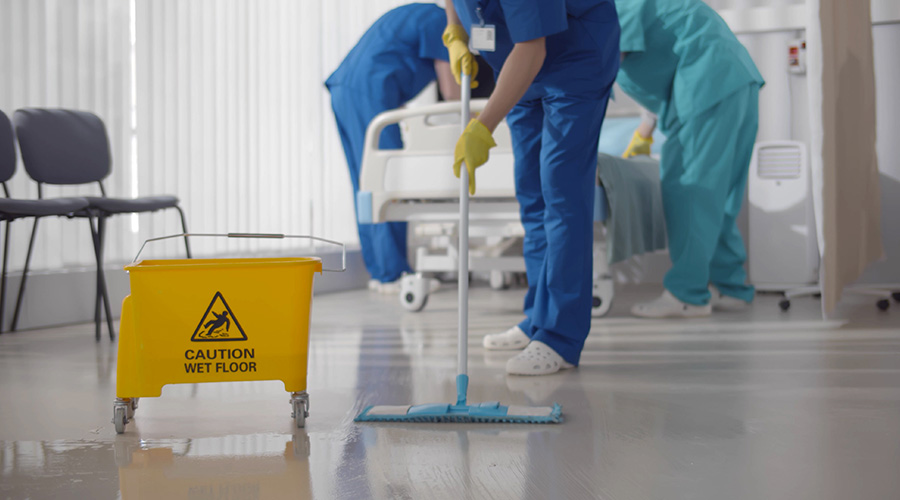
With healthcare-associated infections (HAI) on the rise, environmental services (EVS) teams are more important than ever in controlling the spread of pathogens. Yet, the department is often overlooked and overworked. EVS leadership faces pressure to clean and prepare rooms quickly, while dealing with high staff turnover and a general lack of standard industry practices.
These struggles are apparent, and even dangerous to patients and visitors. Multiple studies, including this 2015 one from Cambridge University Press, show that less than 50 percent of healthcare room surfaces are adequately cleaned and disinfected. According to a study from Open Forum Infectious Diseases reveals that 72 percent of healthcare floors tested positive for C. difficile.
To maintain safe, hygienic facilities for visitors and staff alike, EVS leadership must establish clear guidelines and procedures. The Centers for Disease Control and Prevention (CDC) has a set of recommendations for environmental cleaning and disinfection.
Core Components
The CDC has established the following six Core Components of operating an EVS department:
- Incorporate EVS into the facility’s overall safety culture.
- Train and educate EVS staff to ensure they understand the importance of their duties, as well as correct product use and best cleaning practices.
- Choose appropriate cleaning and disinfecting products and technologies.
- Standardize cleaning and disinfection protocols in each distinct area.
- Observe adherence to protocols and overall effectiveness.
- Offer feedback to staff and stakeholders.
HFT Recommends: What Every EVS Leader Needs To Know
These Core Components are for noncritical surfaces that come in contact with only intact skin, including beds, handrails, over-bed tables, floors, walls, and tables. The CDC notes that while these are standard for all healthcare facilities, those with sensitive populations, such as long-term care and out-patient facilities, should take special considerations.
Implementing and Improving
Medline suggests that, in general, EVS directors should utilize protocols and products that are evidence-based, designed for healthcare use and safe for EVS workers. Ongoing training is crucial to maintain high standards of cleanliness and ensure that every member of the team has the same knowledge.
Building on the CDC’s Core Components, Medline developed their own set of recommendations to support EVS teams. First, leadership should follow the tell, show, do, review formula: tell staff what protocol to follow, show them the facility's expectations, have them do the task to these expectations, and review their work against the expectations.
Leaders should consider the seven-step process for disinfecting surfaces and the high-touch surfaces recognized by the CDC to create cleaning and disinfecting guidelines. Creating posters for these can drive better protocol adherence. Place them wherever EVS staff regularly spend their time and create miniature versions for cleaning carts. Utilizing pictures of words will help navigate language barriers and communicate more efficiently.
Most importantly, EVS directors should show their appreciation for their teams and validate their efforts. Offering them up-to-date, safe tools and uniforms keeps them protected in the workplace. Establishing a rewards and recognition program boosts motivation and demonstrates gratitude. Be sure to share HAI performance measurements and other data with supervisors to emphasize the importance of EVS staff role in infection prevention and communicate any concerns.
Elisa Miller is an assistant editor for CleanLink.com, Contracting Profits, Facility Cleaning Decisions, and Sanitary Maintenance.
 Hospitals Are Energy Super-Users. Why Is It So Hard to Modernize Them?
 Encompass Health Rehabilitation Hospital of Bangor Officially Opens
 Early Entry: Manager's Critical Role in Construction Planning
 The Evolution of Lighting in Patient Care
 HealthPartners and Essentia Health to Combine Organizations