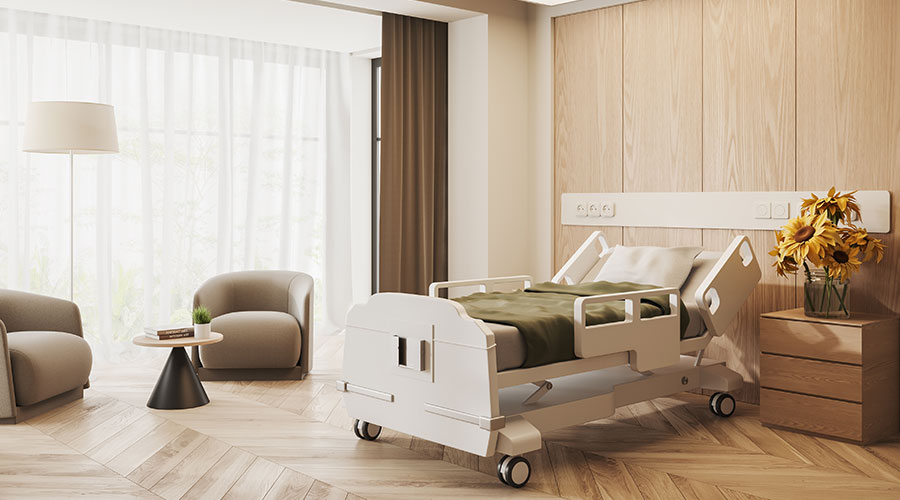
Healthcare is evolving, as are the expectations of patients, families and staff in hospitals and other healthcare facilities. Included in these changing expectations are design and construction issues that facility managers must make that will affect the look, feel and performance of facilities.
In this Q&A, Heena Santry, M.D. and principal for healthcare at Arcadis, discusses considerations for healthcare organizations and managers seeking to incorporate hospitality-driven design.
HFT: What does hospitality-led design look like in a healthcare facility?
Santry: In healthcare facilities, elements like private rooms with thoughtful finishes, inviting communal areas and on-site amenities that feel more like a wellness retreat than a medical unit. This design approach extends to operations, as well, where staff roles shift from delivering hourly care to guiding families and patients through transitions, much like the service provided in hospitality spaces. This creates a supportive experience rather than a transactional one, with a sense of partnership during the recovery journey.
HFT: What is the role of flexibility in designing future-ready care spaces?
Santry: Flexibility is foundational, especially when merging hospitality and healthcare. We aim to design with modular components and adaptable layouts so a facility can serve various needs over time. For example, a rehab suite might later support memory care or independent living. Similarly, a consultation room may double as a family lounge. This adaptability, combined with hospitality principles, ensures that people always feel at home, regardless of the level of care they need.
HFT: How can facilities seamlessly integrate advanced technologies without compromising comfort?
Santry: Technology works best when it’s hidden in plain sight. In hospitality-informed care environments, we build in tech like telemedicine hubs, medication management systems and smart home controls but embed them into the design so they don’t feel intrusive, such as a wireless charging countertop.
Artificial intelligence can be seamlessly integrated into various communication systems — for example, the bed alarm, the cardiac monitor, IV pumps and patient call lights. The system can send a single alert that goes to a nurse’s portable comms unit where the nurse can address the alarm or communicate to a colleague for assistance. This bypasses the need for a unit clerk to relay alarm and call messages, and it frees up the clerk to act more like a concierge for patients and visitors seeking to access other hospitality-like amenities.
HFT: How does blending hospitality and healthcare in facility design create long-term value for communities?
Santry: When you merge the comfort and familiarity of hospitality with the functionality of healthcare, you create spaces that people can trust. These hybrid environments are designed to ease transitions from hospitals and into supportive settings that promote wellness, independence and dignity.
Through personal experience and word of mouth, hospitals will become less feared. No longer seen as cold and sterile, they’ll encourage patients to seek care without delay when symptoms arise. The long-term impact is lower acuity for unplanned hospitalization, fewer readmissions, better recovery outcomes and more sustainable care models.
By making healthcare environments feel more like home and less like institutions, we also address broader societal challenges like the aging population, housing flexibility and workforce shortages. It’s about building a framework that supports people throughout every stage of life, not just when they’re sick.
Editor’s note: This is the second part of a two-part article on hospitality in healthcare. Read part one here.
 Design Standards as Strategic Assets
 Rising Violence is Exposing Gaps in Hospital Security
 Murray County Medical Center Reports Data Security Incident
 Probiotic Cleaning: A Complementary Strategy for Safer Hospital Floors
 VITAS Healthcare Breaks Ground on New Inpatient Hospice Center in Florida