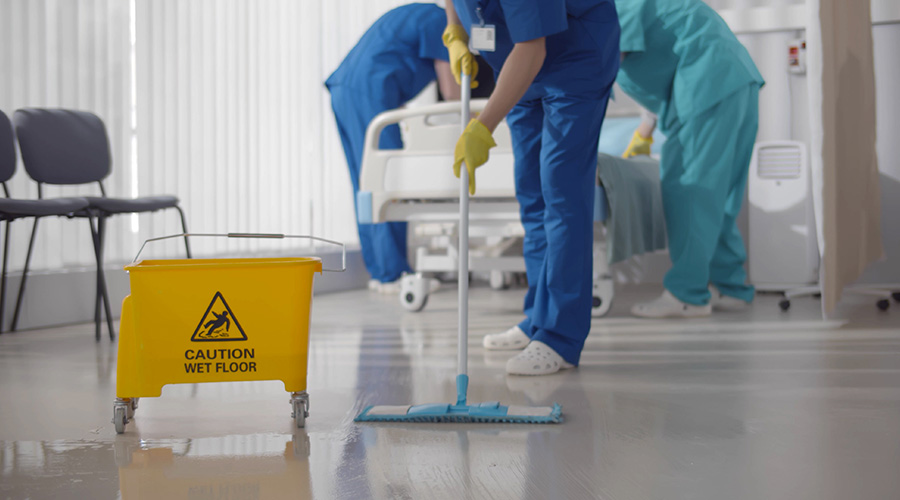
Hospital floors have long been recognized as reservoirs for microbial contamination, but their role in transmission often is underestimated. Floors accumulate organic debris, dust-bound microbes, skin cells and droplets from patient care activities. Items that fall to the floor — including stethoscopes, blood pressure cuffs and personal devices — are frequently picked up and handled without hand hygiene, creating a subtle but significant pathway for pathogen transfer.
As environmental services managers seek more resilient, evidence-based approaches to environmental hygiene, interest has grown in the use of probiotic cleaning systems as a supplement to traditional disinfection. Understanding the way these two approaches differ — and how they can work together — can help managers strengthen their infection-prevention strategies.
Traditional disinfection remains the backbone of environmental hygiene. EPA-registered disinfectants provide rapid, reliable kill of pathogens on contact, making them essential for daily room turnover, terminal cleaning and outbreak response. Their speed and regulatory validation make them indispensable.
But disinfectants have limitations. Once the chemical dries, its effect ends. Surfaces are quickly recolonized by organisms shed from patients, staff and equipment. Dry-surface biofilms — now known to be widespread on hospital floors — also can shield pathogens from chemical penetration, allowing them to persist despite routine disinfection.
Related Content: Probiotic Cleaners: The Start of a Cleaning Revolution?
Probiotic cleaning offers a different, ecological approach. Probiotic products use Bacillus spores that germinate on surfaces and establish a stable, benign microbial community. Rather than killing pathogens directly, they compete with them and consume organic residues, occupy ecological space and gradually disrupt biofilms.
Studies in European hospitals have shown reductions of 50-89 percent in environmental pathogens and significant decreases in antimicrobial-resistance genes when probiotic cleaners are used consistently. Their activity continues for days after application, providing a level of persistence that chemical disinfectants cannot.
For hospital floors, this distinction is particularly important. Floors are not high-touch surfaces, but they are high-transfer surfaces. Pathogens on floors can move to hands, equipment and patient-care items through indirect contact. Probiotic cleaners help reduce the microbial food supply and create a surface environment that is less hospitable to harmful organisms. Over time, this process can reduce the microbial burden that accumulates between disinfection cycles.
But probiotic cleaning is not a replacement for traditional disinfection. It does not provide rapid kill, does not meet regulatory requirements for pathogen inactivation and should not be used in isolation during outbreaks or in rooms housing patients with known transmissible infections. Instead, probiotic cleaning should be viewed as a maintenance strategy — a way to stabilize the surface microbiome and reduce recolonization after disinfection has done its work.
The most effective approach is a dual-strategy model: Disinfectants clear the battlefield, and probiotics occupy the territory. This combination addresses the immediate need for pathogen reduction and the long-term need for ecological stability on hospital surfaces.
For managers seeking to strengthen environmental hygiene, probiotic cleaning offers a promising, evidence-supported tool. When integrated thoughtfully with traditional disinfection, it can help create cleaner, safer floors and ultimately contribute to a more resilient infection-prevention program.
J. Darrel Hicks, BA, MESRE, CHESP, Certificate of Mastery in Infection Prevention, is the past president of the Healthcare Surfaces Institute. Hicks is nationally recognized as a subject matter expert in infection prevention and control as it relates to cleaning. He is the owner and principal of Safe, Clean and Disinfected. His enterprise specializes in B2B consulting, webinar presentations, seminars and facility consulting services related to cleaning and disinfection. He can be reached at darrel@darrelhicks.com, or learn more at www.darrelhicks.com.
 Preparing Healthcare Facilities for Wildfire Air Quality Events
 UW Health Set to Open Expansion at East Madison Hospital
 Central Ohio Primary Care Physicians Falls Victim to Cyberattack
 The Role of Biophilic Design in Healthcare Facilities
 TriStar Centennial Medical Center Invests $90M in Women, Children's Hospital Expansions