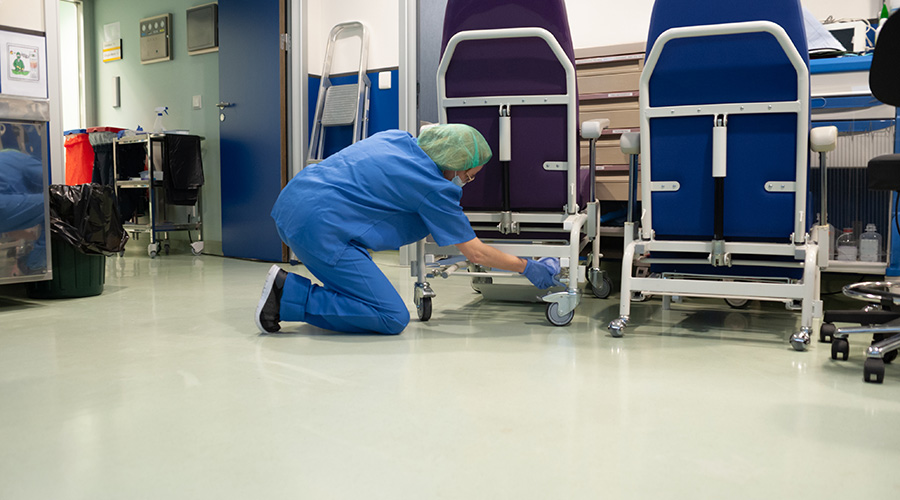
Anybody who doubts that biofilms exist on dry hospital surfaces needs to read this study and its findings: Biofilms exist, they are complex, they are common, and they can survive for four years.
EPA List P contains 46 chemical disinfectants that can eliminate Candida auris (C. auris). But disinfectants are not specifically designed to kill C. auris in mature biofilm. Biofilms are known to resist most chemical disinfectants, and C. auris is well-known to thrive in biofilm.
There is no biofilm list for EPA disinfectants, and claims can only be found on chemical master labels. So, it is essential for environmental services (EVS) workers to use disinfectants that have been tested and proven to kill C. auris in biofilm conditions.
Candida auris does not just sit on dry hospital surfaces. It builds a microscopic survival structure — a dry surface biofilm (DSB) — that functions very much like a so-called life raft, protecting it from disinfectants and helping it persist in the environment for long periods.
Why ‘life raft’ changes risk picture
The DSB life raft does things that EVS managers need to appreciate. It:
Turns clean surfaces into reservoirs. Even after a surface looks clean and has been wiped with bleach, viable C. auris cells can remain embedded in the dry surface biofilm, ready to transfer to hands, gloves and devices. Routine disinfection that is effective against free cells might be insufficient for biofilm-protected cells.
Related Infection Control Content: C. auris: A Growing Threat to Healthcare Facilities
Supports long-term environmental persistence. A DSB allows C. auris to persist for extended periods on inanimate surfaces, contributing to outbreaks that seem to keep coming back, even after aggressive cleaning campaigns.
Undermines standard protocols. Because C. auris in DSBs shows tolerance to widely used sodium hypochlorite concentrations and contact times, hospitals that are doing all the right things on paper still can fail to eradicate environmental contamination if they don’t account for biofilm biology.
The role of ‘elbow grease’
Victoria Hornbeck, RN, BSN, CNOR, was put in charge of reimagining the between-case cleaning of orthopedic operating rooms at Northside Hospital Forsyth in Cumming, Georgia. She used adenosine triphosphate (ATP) testing of high-touch surfaces to identify gaps in the process.
The gap she discovered in the hospital’s cleaning protocol had nothing to do with allowing enough time for surface disinfectants to dry. It did not involve staff forgetting to clean certain surfaces. Believe it or not, it was about the amount of elbow grease applied while wiping down rooms between cases.
“The testing of high-touch surfaces revealed staff had to go over some areas two or three times to get them clean,” says Hornbeck, the hospital’s quality improvement and nurse clinician of surgical services. “They don’t often think about how much friction they’re applying during cleaning. That’s certainly not something we would have considered without the testing.”
This growing threat of C. auris in DSBs demands not just more frequent cleaning but a fundamental overhaul of patient room and patient equipment cleaning protocols that include elbow grease. The same nontoxic, noncorrosive disinfectant that is on List P and can penetrate biofilms without harming respiratory health should be implemented throughout hospitals.
J. Darrel Hicks, BA, MESRE, CHESP, Certificate of Mastery in Infection Prevention, is the past president of the Healthcare Surfaces Institute. Hicks is nationally recognized as a subject matter expert in infection prevention and control as it relates to cleaning. He is the owner and principal of Safe, Clean and Disinfected. His enterprise specializes in B2B consulting, webinar presentations, seminars and facility consulting services related to cleaning and disinfection. He can be reached at darrel@darrelhicks.com, or learn more at www.darrelhicks.com.
 Extreme Weather: The Maintenance-Resilience Link
 Encompass Health Lower Providence Opens in Pennsylvania
 Intermountain Health Acquires Fairbourne Building for Healthcare Hub and Medical Campus Conversion
 Cooling Towers at NYC Health + Hospitals/Lincoln Test Positive for Legionella
 Prefabricated Wall Panels Accelerate UCF Lake Nona Medical Center Construction