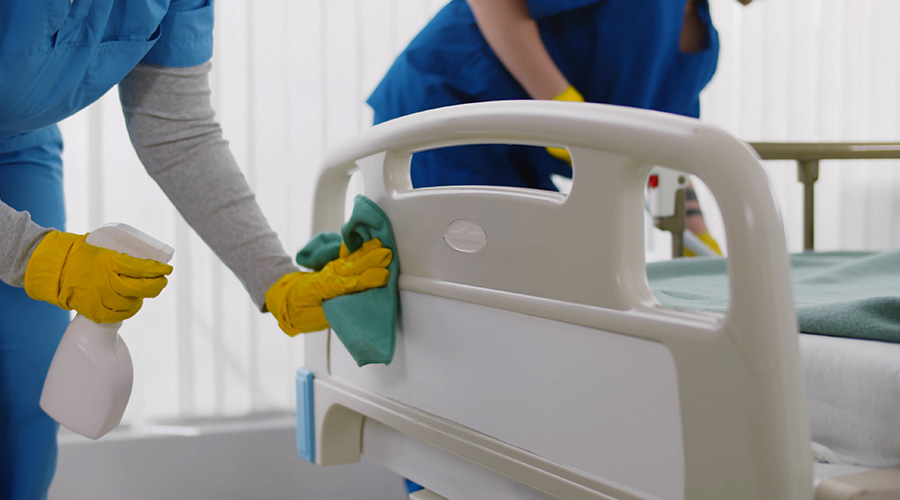
Cleaning is one of the most crucial practices to manage and prevent the spread of germs in healthcare facilities. With hospital-acquired infections (HAIs) affecting one out of every 31 patients, every step matters. However, cleaning isn’t enough on its own. It is simply the surface level of a multi-step process.
While often treated interchangeably, cleaning, sanitizing and disinfecting are three distinct processes. Cleaning removes soils and foreign objects from a surface. Sanitizing reduces the number of bacteria to a safe level determined by the Official Detergent Sanitizer Test. Disinfecting, then, is the only method that eliminates germs and bacteria.
None of these methods can be done alone. An area must be properly cleaned before it can be disinfected or sanitized. While an all-purpose cleaner won’t make a surface safe, it can still lessen the number of germs. Cleaning reveals bacteria that are hidden beneath debris — and often invisible to the human eye — for disinfectants and sanitizers to then remove effectively.
Disinfecting and sanitizing must also be carefully differentiated. While they both reduce germ levels and prevent spreading, they do not have identical uses. The U.S. Environmental Protection Agency (EPA) mandates sanitizers to reduce microorganisms on a surface by 99.9 percent within 30 seconds. To qualify as a disinfectant, the EPA requires that the solution reduces the levels of pathogens by 99.999 percent in five to 10 minutes.
Every chemical must be tested and certified by the EPA before it can be labeled as either a sanitizer or disinfectant. It is possible for a product to be both simultaneously, so long as it meets the proper requirements for both methods. Products must also have proper labels with strict instructions and accurate kill claims, which identifies the specific germs it is effective against.
The most notable difference between the two is the fact that sanitizers can only kill bacteria and are not intended to kill viruses. Disinfectants can kill viruses, bacteria, mold and fungi.
Disinfectants are typically used in areas that have come into contact with blood, urine, waste or other bodily fluids. They are necessary in critical-care units during outbreaks of communicable diseases.
Additionally, disinfectants cannot be used in food prep or food contact areas while some sanitizers can. Sanitizing products must be labeled as "food contact” or “food grade” to be used in food contact areas.
These products must also be utilized correctly. Most important is dwell time: the amount of time a product needs to remain wet on a surface to effectively disinfect or sanitize the surface. Dwell times vary based on virus or bacteria type and are certified by the EPA. If a product is wiped too early, bacteria will be left behind.
Staff should be trained on the differences between cleaners, sanitizers and disinfectants. It is not enough for them to know when to use a certain product; they must also know why they are using it. That kind of understanding leads to fewer mistakes, efficient cleaning and could even save lives.
Elisa Miller is an assistant editor for CleanLink.com, Contracting Profits, Facility Cleaning Decisions, and Sanitary Maintenance.
 Cooling Towers at NYC Health + Hospitals/Lincoln Test Positive for Legionella
 Prefabricated Wall Panels Accelerate UCF Lake Nona Medical Center Construction
 University of Rhode Island Adds Clinical Space
 How Retail Design Principles Can Improve Healthcare Wayfinding
 Flexible Design Strategies Help OhioHealth Maximize Clinical Space