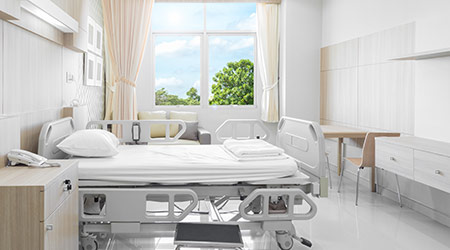
Healthcare design has evolved in recent years in ways that attempt to offer patients a greater say in their experiences in hospitals. One key goal of this evolution is to create facilities that release a patient’s anxiety and provide an environment of safety.
Now, a new set of interior design principles are emerging to help foster a healthy mindset in healthcare settings, according to Architectural Digest. Healthcare executives and managers are slowly warming to the idea of prioritizing a patient’s emotional responses to stimuli over old paradigms of medical efficiency and plastic-coated durability. Scientific research has provided back up, from an early experiment which revealed that a patient’s hospital room view could affect their recovery to a new study finding that exposure to the blues and green of the natural world influenced mental health during this year’s pandemic lockdowns.
In response, designers have filled new hospitals with elements such private nooks, lounges, and outdoor spaces, far more daylight, moveable furniture, and a meditation room adorned with bamboo flooring and wall-sized fractal glass art that depicts a much beloved local oak tree. Patients, families, and staff can choose to recover in bright play areas or less stimulating zones, like a terrace with two old-fashioned wood porch swings.
Click here to read the article.
 Cleanliness in Hospitals: Clinical Priority and Community Perception
 Dana-Farber Receives $50M Gift for Planned Cancer Hospital
 Clarinda Regional Health Center Reports Data Security Incident
 Gaps in Nurses' Environmental Cleaning Knowledge Grow Amid Rising EVS Pressures
 Ground Broken on the Southern Nevada Forensic Facility