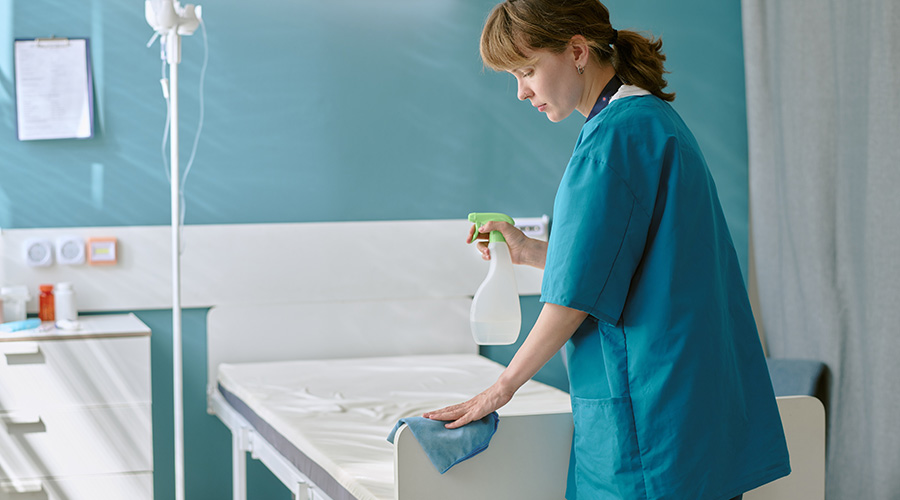
Healthcare environmental hygiene has long relied on disinfectant contact time as the central metric for surface safety. EPA-registered disinfectants list organism-specific contact times derived from AOAC and ASTM carrier tests, and these times have become embedded in hospital policies, training programs, and regulatory expectations.
But modern evidence shows that contact time, while essential for compliance, does not reliably predict microbial reduction on actual healthcare surfaces. The gap between laboratory conditions and bedside reality is now too large to ignore.
EPA carrier tests are intentionally designed to isolate chemical efficacy. They use smooth, nonporous carriers, fixed soil load, controlled drying, standardized water hardness and no mechanical action. These conditions ensure consistency for regulatory approval, but they do not resemble the textured, variable, patient-contact surfaces found in hospitals.
Bedrails, overbed tables and call buttons accumulate skin oils, sweat, dust and invisible micro-soil that often exceed the 5 percent soil load used in EPA validation. Because soil load is not visually detectable, environmental services (EVS) staff cannot determine whether a surface is within the parameters under which disinfectant efficacy was established.
Dry-surface biofilm (DSB) further complicates the picture. Formed through repeated cycles of contamination and desiccation, DSB creates a thin, invisible matrix that protects embedded bacteria from dehydration and chemical exposure. Mature DSB shows marked tolerance to quaternary ammonium compounds, chlorine, hydrogen peroxide and other common hospital disinfectants.
Even when contact time is fully met, disinfectants cannot reliably penetrate the matrix. As a result, surviving organisms repopulate the surface quickly — often within hours — returning microbial levels toward precleaning conditions. This rebound phenomenon exposes patients and caregivers to persistent pathogens despite apparent compliance.
HFT Recommends: Choosing a Disinfectant That Kills Biofilm
Water hardness adds another layer of complexity. EPA methods tightly control water hardness during disinfectant validation, but hospitals do not. Hard water reduces the efficacy of quaternary ammonium compounds by binding active molecules, and it destabilizes chlorine, alters pH and strengthens biofilm matrices through calcium and magnesium ions. These interactions directly affect kill kinetics and surface wetness duration, meaning real-world disinfectant performance might differ significantly from label expectations. When soil load, biofilm and water hardness combine, disinfectant chemistry alone cannot guarantee a safe surface.
As a result, mechanical action and microfiber are the true drivers of microbial reduction. Cleaning alone removes one to three log10 of organisms — often more than the chemical kill achieved under EPA test conditions. Microfiber’s split fibers, capillary wicking and friction disrupt early biofilm layers and physically remove soil, allowing disinfectants to reach exposed organisms. In practice, the disinfectant plays a secondary role: It finishes what cleaning already has begun.
The evidence is clear. Contact time remains essential for regulatory compliance, but it is not a reliable predictor of real-world microbial reduction. The only defensible workflow is soil removal, biofilm disruption, mechanical action, full disinfectant coverage and adherence to the longest relevant contact time.
Environmental hygiene must shift from chemistry-centric assumptions to cleaning-centric realities if hospitals are to protect patients and caregivers from persistent surface contamination
J. Darrel Hicks, BA, MESRE, CHESP, Certificate of Mastery in Infection Prevention, is the past president of the Healthcare Surfaces Institute. Hicks is nationally recognized as a subject matter expert in infection prevention and control as it relates to cleaning. He is the owner and principal of Safe, Clean and Disinfected. His enterprise specializes in B2B consulting, webinar presentations, seminars and facility consulting services related to cleaning and disinfection. He can be reached at darrel@darrelhicks.com, or learn more at www.darrelhicks.com.
 Extreme Weather: The Maintenance-Resilience Link
 Encompass Health Lower Providence Opens in Pennsylvania
 Intermountain Health Acquires Fairbourne Building for Healthcare Hub and Medical Campus Conversion
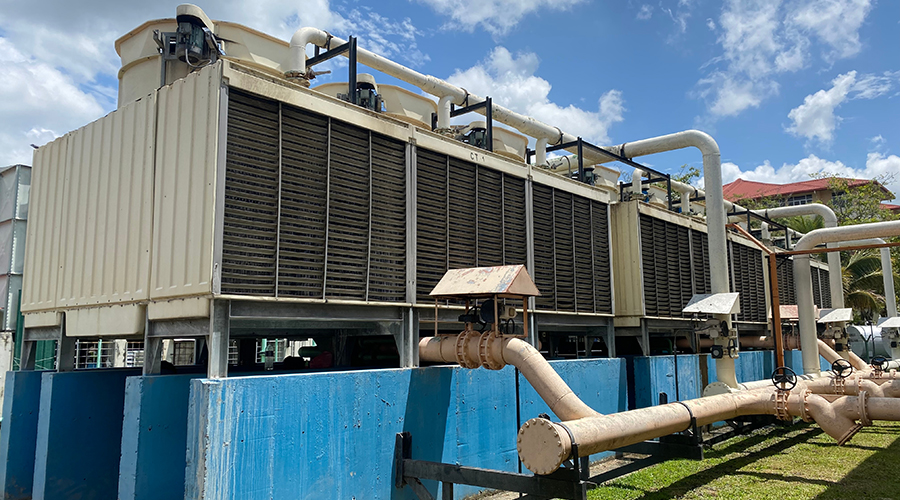 Cooling Towers at NYC Health + Hospitals/Lincoln Test Positive for Legionella
 Prefabricated Wall Panels Accelerate UCF Lake Nona Medical Center Construction