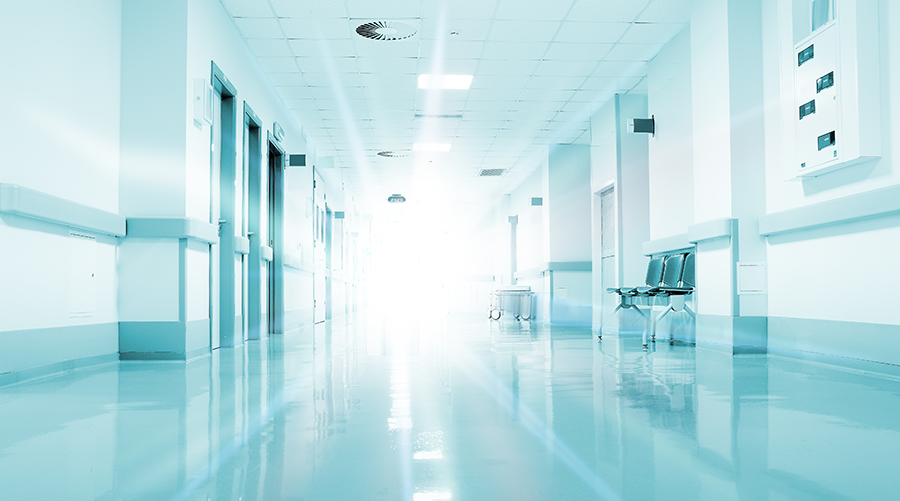
Placement of acoustics is key to them working as intended. Additionally, different areas within a healthcare facility may have different needs. In this manufacturer roundtable, Healthcare Facilities Today speaks with acoustics manufacturers about what the different needs are among the different parts of a facility,
Are there different acoustic needs in different parts of the facility?
“Acoustics can create private environments and comfortable environments. Speech privacy is vital for providing for HIPAA guidelines and should be used in any area where personal aural communication occurs such as a reception area. Solutions, like sound masking, can improve the overall comfort of a recovery area. Where other areas, such as corridors and cafeterias, may not require the ABCs (Absorbing, Blocking and Covering) of acoustical control.”
— David Smith, chief operating officer, Lencore
“Many areas within healthcare facilities have common acoustical requirements. Speech privacy is legally required wherever anyone discusses a patient’s personal information; therefore, it must be addressed in nearly all environments—from reception, to corridors, patient rooms, exam rooms, administration offices, nursing stations, emergency rooms and more. Acoustical comfort is also broadly required across various environments, but particularly important in those spaces where staff and patients spend longer periods of time.
A need that’s more specific to hospital patient rooms is a comfortable sleeping environment. There’s an unfortunate misconception that sleep is best in spaces with nearly silent background sound levels. However, the potential peace of such a space is easily and frequently broken by the myriad of necessary activities that occur in a hospital; while noise can be reduced ‘at the source,’ it’s impossible to eliminate all sounds in a 24-hour care facility. Sleep is best in an environment with the fewest and smallest noise intrusions—conditions that are achieved best in a busy space by elevating and controlling background sound levels with a sound masking system.”
— Niklas Moeller, vice president, LogiSon Acoustic Network
“According to the Facilities Guidelines Institute (FGI), all normally occupied rooms and spaces should have sound-absorptive surfaces for the purposes of noise control, comfort, privacy and safety. This includes patient rooms, nurses’ stations, corridors in patient care areas and exam/treatment rooms. Even public spaces such as waiting areas and atriums, as well as administrative areas such as offices, are required to have sound-absorptive surfaces. Patient care areas and medication safety zones may have slightly higher sound absorption requirements than public and administrative areas, but they are all required to contain sound absorption.”
— Gary Madaras, PhD, acoustic specialist, Rockfon
“Common spaces like reception areas understandably have different acoustic needs from private rooms used for doctor/patient interactions and private meetings. Lobbies, for instance, are likely outward facing to a street and subject to telephone calls, PA announcements, elevator and street noise, and passing conversations from the rooms’ many visitors and passersby. The presumption for privacy in a room such as this is not guaranteed and acoustic measures to improve noise levels and occupant comfort would need to primarily focus on mitigating continuous background and operational sounds.
Patient areas, however, do need to guarantee a level of privacy and a greater level of occupant comfort. In addition to installing acoustic seals around doors and windows and adjusting internal systems including HVAC and announcement systems to lower volume outputs into private areas, ceiling and wall treatments can be applied to improve a room’s acoustics by interrupting reverberation off hard, clinical surfaces.”
— Michael Ackelbein, vice president of sales, Fräsch
“Yes, different spaces have different acoustical requirements to be high functioning. For example, a patient room has a recommended 55 STC which can be addressed with Modernfold’s industry-leading 56STC wall; whereas a reception area typically has a lower STC required or expected. Beyond just the performance of an operable or fixed wall, the design needs to consider background noise levels generated by all building mechanical-electrical-plumbing systems, air distribution systems and other facility noise sources that may impact patients or staff. Many factors play into the acoustical nature of a space and Modernfold is available to consult on the strongest, safest design possible. For example, adding porous materials such as drapery, upholstered furniture, carpet, sound-absorbing ceiling and wall materials, and of course, operable walls can increase both the comfort end-users experience and the acoustical performance of a space.”
— Bryan Welch, managing director, Modernfold
Jeff Wardon, Jr. is the assistant editor for the facilities market.
 Cleanliness in Hospitals: Clinical Priority and Community Perception
 Dana-Farber Receives $50M Gift for Planned Cancer Hospital
 Clarinda Regional Health Center Reports Data Security Incident
 Gaps in Nurses' Environmental Cleaning Knowledge Grow Amid Rising EVS Pressures
 Ground Broken on the Southern Nevada Forensic Facility