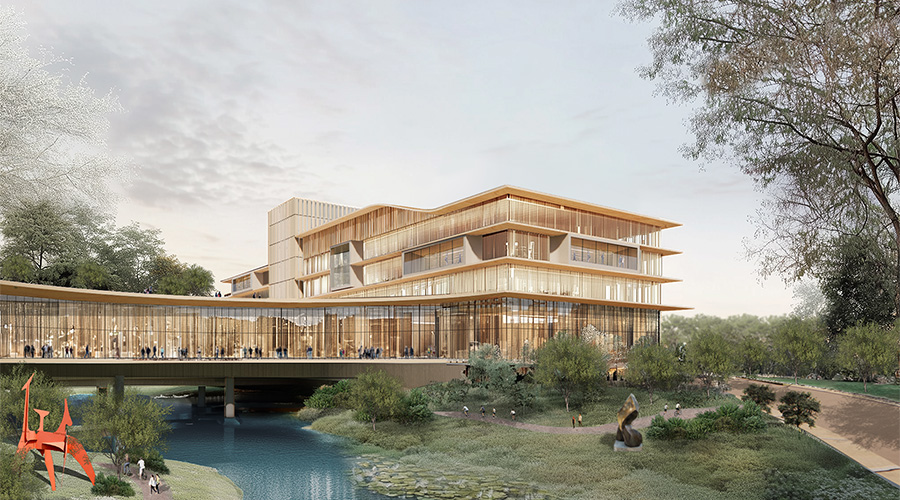
Healthcare facilities across the U.S. are evolving beyond their traditional design — that function only in times of emergency — toward a more holistic layout that focuses on prevention and wellness as an integrated part of daily life. The Alice L. Walton Healthcare Campus in Bentonville, Arkansas will represent this shift by encouraging people to be proactive with their health.
“This campus is not meant to feel like a hospital or an institution. It’s designed as a place you’d want to visit regularly, supporting your well-being before any concerns arise. The idea is to stay ahead of your health, rather than reacting to it,” says Gregg Sutton, principal at EDSA, the design firm in charge of master planning this project.
A key feature of the campus is its departure from normal institutional design aspects. The site is organized more like a small city than a medical complex, with a network of interconnected paths, open spaces and program areas that encourage movement and exploration. Rather than a single front door leading into the building, the campus offers multiple points to enter and gather, supporting a more welcoming atmosphere.
Nature and the landscape are central to this holistic model. Large-scale features such as a central lake, gardens and plants are integrated into the master plan to create an immersive setting that reflects the surrounding region.
“The goal was to create something that feels carved out of the Ozarks, not a designed or ornamental landscape. The lake, for example, serves a functional purpose for stormwater and irrigation, but it’s also the visual and experiential heart of the campus,” Sutton says. “Everything is integrated — architecture, landscape and infrastructure working together — so the environment feels authentic and grounded in its setting.”
Related Content: Designing for Holistic Healing in Healthcare
Equally important is the intentional concealment of operational infrastructure.
“There’s a tremendous amount of infrastructure required to support a facility like this, but the goal is to make sure the public never experiences that complexity. We’ve buried and concealed most of those systems - service areas, deliveries, utilities - so what people interact with is a calm, seamless environment,” Sutton says.
The absence of visible surface parking further distinguishes the campus from traditional hospital settings, where large parking fields often dominate the exterior.
The campus also emphasizes openness and public accessibility.
“There are no gates or restricted hours. It functions more like a park than a traditional healthcare facility, which required a lot of thought around circulation, safety, lighting and overall visitor experience,” Sutton says.
Elements such as large-scale art installations are placed intentionally within the landscape to create moments of reflection and mental engagement, playing into the emotional experience.
“A big part of the exterior design was addressing the anxiety people associate with healthcare. Instead of designing around appointments and procedures, we focused on creating a place people would feel comfortable visiting regularly,” Sutton says.
The first phase of the 100-acre campus is set to open in December 2028.
Elaina Myers is the assistant editor of the facilities market.
 Preparing Healthcare Facilities for Wildfire Air Quality Events
 UW Health Set to Open Expansion at East Madison Hospital
 Central Ohio Primary Care Physicians Falls Victim to Cyberattack
 The Role of Biophilic Design in Healthcare Facilities
 TriStar Centennial Medical Center Invests $90M in Women, Children's Hospital Expansions