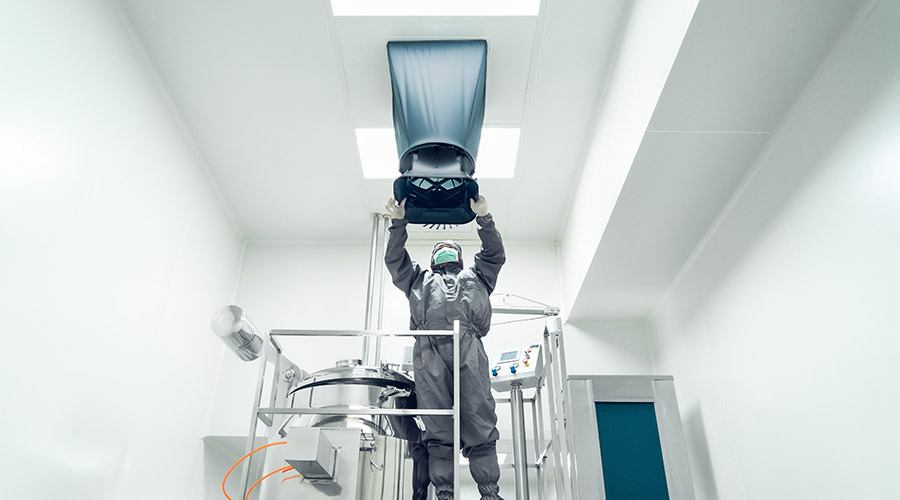
According to the World Health Organization (WHO), 3.8 million people die every year from indoor air pollution. Poor indoor air quality (IAQ) is even more deadly in healthcare facilities, where pollutants can induce and expedite the spread of infection. While air disinfection should be a routine and integral part of environmental cleaning, there are additional precautions environmental services (EVS) teams must take into account.
A 2024 study published in Heliyon Journal reviews air conditioning/filtering methods in healthcare facilities and how they can be optimized for disinfection.
The Four Classes of Infection Control
The Healthcare Infection Control Practices Advisory Committee (HICPAC) denotes four distinct aspects of infection control:
- Standard precautions involve common hygiene practices to avoid contact with body fluids, secretions, blood and nonintact skin.
- Droplet precautions focus on preventing coughing and sneezing droplet exposure from infected patients. These droplets usually only travel three feet in the air, so face masks and private rooms are recommended.
- Contact precautions involve skin-to-skin contact.
- Airborne precautions tackle air handling and ventilation practices. Infected patients' rooms should have negative air pressure, six to 12 air changes per hour and no air recirculated to other areas without significant filtration. Staff and visitors should wear personal protective equipment (PPE), such as N95 masks, when entering.
HFT Recommends: IAQ and Infection Mitigation: Plans Into Actions
Researchers recommend keeping these in mind when developing airborne infection control protocols. While the study focuses on droplet and airborne precautions, direct contact and bodily fluids must be considered when handling patients.
Ventilation Strategies
Increased ventilation, whether natural or mechanized, is effective at reducing airborne pathogen transmission. Each area, however, requires different air flow, pressure and temperature.
Patient rooms should be kept between 70 and 73 degrees, 30 to 60 percent humidity, and a minimum of six air changes an hour. General areas, including waiting rooms and corridors, should remain under 75 degrees, 30 to 60 percent humidity, and a minimum of four air changes per hour. ICUs should be between 70 and 75 degrees, 30 to 60 percent humidity, a minimum of six air changes per hour and maintain neutral air pressure.
Minimum efficiency reporting values (MERV) report an air filter’s ability to capture particles between 0.3 and 10 microns. Researchers state that facilities must use filters with MERV 14 to 16 ratings. High-efficiency particulate air filters (HEPA) have MERV 17 or greater ratings. These are highly effective but require regular monitoring every six months.
Air Filtration Strategies
IAQ can be affected by external air pollutants such as smoke, diesel exhaust and waste gasses, so air filter systems must properly remove these toxins. Researchers also recommend that carbon dioxide concentrations remain under 600 ppm, which indicates proper IAQ levels.
Portable air filters and purifiers can also improve IAQ in healthcare facilities. They should be equipped with a combination of pre-filters, HEPA filters and four-cylinder gas filter cartridges. While they are effective, they should be supplementary to a strong HVAC system. If the HVAC goes down, portable filters can temporarily stand in.
Elisa Miller is an assistant editor for CleanLink.com, Contracting Profits, Facility Cleaning Decisions, and Sanitary Maintenance.
 Elevating EVS Professionals: The Case for Certified Hygiene Specialists
 Global Handwashing Day and the Importance of Well-Maintained Restrooms
 Duke Health and CaroMont Health Partner to Develop Two New Hospitals
 Designing for the Psychology of Waiting
 UT Health Sciences Breaks Ground on College of Medicine Interdisciplinary Building