
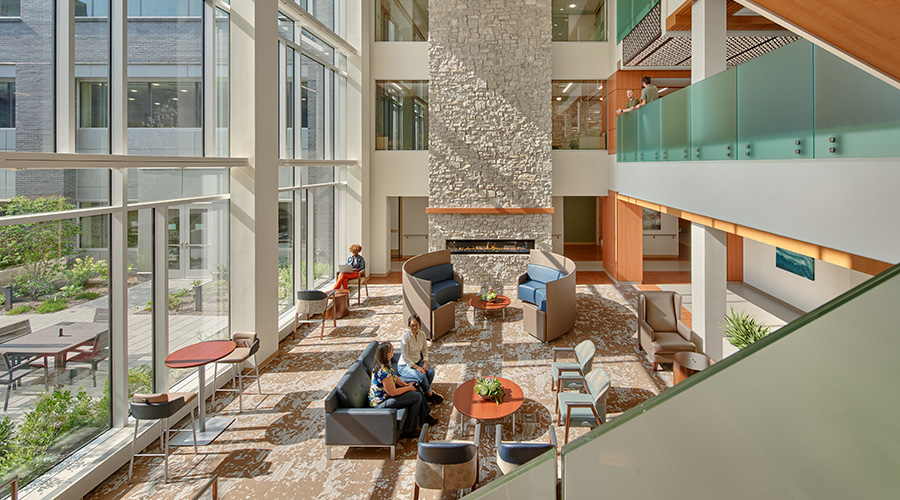
As hospitals seek to differentiate themselves in an ever more competitive market, many are looking to their lobbies to start the patient experience off on the right foot. An article in Building Design + Construction discusses four recent lobby projects which show how the hospital lobbies were tuned to patient needs while also branding the facility.
In hospitals, visitors can be anxious or stressed, which can diminish their concentration and ability to pick up on wayfinding cues. In addition, they might have physical impairments that further complicate wayfinding for them. The hospitals cited in the article addressed this challenge in several ways.
The Massachusetts Eye and Ear Infirmary in Boston has a lobby that is well-lit and free of obstacles, with handrails and lines on the floor indicating the path of travel. Also in Boston, the Carl J. and Ruth Shapiro Ambulatory Care Center has the patient elevator, main circulation corridor and waiting rooms situated along a curtainwall to help visitors better navigate the space.
In addition to boosting wayfinding, allaying visitor anxiety just makes sense from a patient wellbeing standpoint. At the University of Minnesota Amplatz Children’s Hospital, children and their families gave input on the lobby's design, resulting in a space that's filled with bright, saturated colors and lots of opportunity to wiggle out nervous energy. For example, there are interactive monitors for digital coloring or where patients can take and upload their photo to a big-screen display.
At the other end of the spectrum, in Durham, N.C., the lobby of the Duke Cancer Center at the Duke Cancer Institute strikes a more contemplative yet still cheerful note, with a five-story atrium featuring a soaring wood screen with overlapping arches, reminiscent of cathedral windows. Adjacent to the atrium is a two-story lobby, which brings a "human scale" and conveys a more homelike feel, according to the article.
Read the article.
 Elevating EVS Professionals: The Case for Certified Hygiene Specialists
 Global Handwashing Day and the Importance of Well-Maintained Restrooms
 Duke Health and CaroMont Health Partner to Develop Two New Hospitals
 Designing for the Psychology of Waiting
 UT Health Sciences Breaks Ground on College of Medicine Interdisciplinary Building