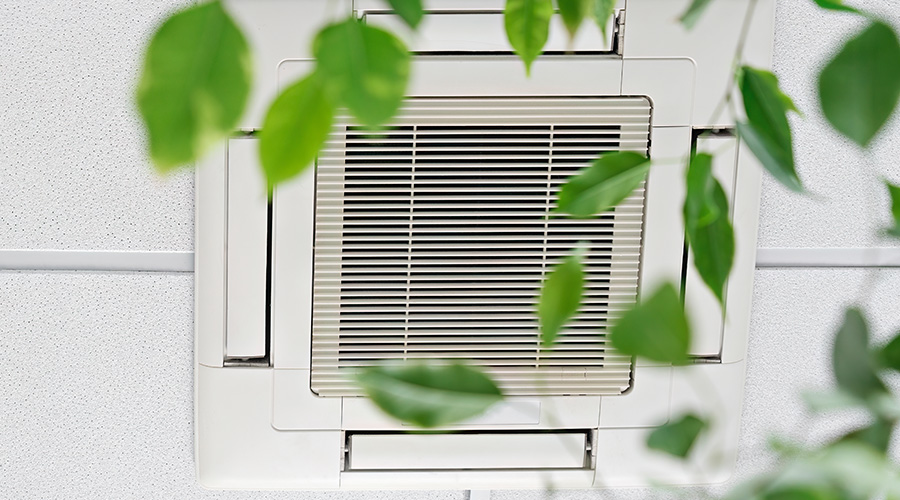
Healthcare facility managers face a series of blind spots and challenges — water intrusion, legacy HVAC and building water systems, continuous occupancy, regulatory scrutiny, incompatible technologies, and staff and budget shortfalls — when ensuring indoor air quality (IAQ) and preventing infection in aging facilities.
To support uninterrupted, high-quality patient care while ensuring compliance with accrediting organizations, managers must stay ahead of environmental and IAQ risks. In older hospitals, that task becomes more complex.
Facility health and patient care
Infection prevention is central to patient care, yet the role of the physical environment in shaping infection and exposure risk remains underrecognized. Healthcare buildings often are treated as passive infrastructure rather than active determinants of patient and worker health.
Degraded indoor environmental quality can materially increase the risk of infection and illness risk through fungal growth, chemical and particulate exposures, and aerosolized water hazards such as Legionella. Contributing factors commonly include aging HVAC and plumbing systems, moisture intrusion, inadequate pressure control, insufficient ventilation, construction activities and off-gassing materials.
When these conditions go unrecognized or unmanaged, outcomes include compliance deficiencies, healthcare-associated — nosocomial — infections, occupational complaints, operational disruption, and legal or reputational risk. These issues demonstrate that facility health is a core patient safety function, not a secondary support service.
Building health is often undervalued because facility management is traditionally viewed as a non-clinical support function. The physical environment does not directly deliver care, so its influence on infection risk, recovery conditions and staff performance is less visible, even when it is substantial.
This invisibility is reinforced by the asymmetry between success and failure in the built environment. When facility systems function as intended, nothing happens. But when they fail, consequences can be sudden and severe and include outbreaks, unit closures, citations and operational disruptions. This dynamic fosters complacency and reactive responses, obscuring the cumulative nature of system degradation and limiting recognition of building health as a proactive, foundational element of patient safety.
Breaking the silo cycle
In most healthcare systems, responsibility for patient and worker health is siloed.
Clinicians own diagnosis and treatment. Infection prevention owns surveillance and response. Facilities owns buildings, systems and maintenance. Environmental health and safety (EHS) owns workplace hazard controls, exposure prevention and safety programs. Finance owns capital allocation. Administration owns enterprise strategy, prioritization, resourcing and organizational accountability.
Related Content: Gen Z and Millennial Workers Care More About IAQ
This fragmentation creates several problems. No single group is responsible for the health impact of the physical environment. Facilities issues might be seen as operational problems rather than patient or worker safety risks. Environmental contributors fall into the gaps between departments, especially where responsibility spans clinical quality, worker safety, operations and capital planning.
As a result, building conditions are often addressed reactively — after complaints, failures or citations — rather than proactively as a health determinant. Breaking this cycle requires formally recognizing the physical environment as a clinical and occupational risk factor and assigning an integrator role to connect facilities, infection prevention, EHS, administration and finance.
A certified industrial hygienist (CIH) is well suited to the role of translating building conditions into a shared understanding of patient and occupant health risks. The approach shifts organizations from episodic compliance to sustained, cross-functional prevention aligned with patient safety, worker health and regulatory readiness.
Shifting to sharing
Recognizing a healthcare facility as a managed exposure system is only the first step. To realize its value, organizations and managers need to move deliberately from shared understanding to shared action. That shift requires a coordinated, multidisciplinary approach that replaces reactive fixes with proactive operations, preventive maintenance (PM) and aligned decision making across departments. Managers can consider these six steps:
Formalize the multidisciplinary team. Establish a standing team on environmental risk and facilities health that includes:
- facilities leadership and key trades
- infection prevention
- environmental health and safety
- administration — finance as needed
- technical integrator, such as a CIH.
This team should meet monthly or quarterly with a clear charter to identify, prioritize and manage environmental risks that affect patient safety, worker health and regulatory readiness.
Develop a shared environmental risk profile. The team should jointly create a facility-wide environmental risk profile that answers three core questions:
- Where are the highest-risk areas based on patient acuity and building conditions?
- Which systems or conditions pose the greatest exposures or infection-prevention concerns?
- Which risks are chronic, hidden or likely to worsen if not addressed?
This risk profile also should consider: HVAC performance related to filtration, pressure, distribution and humidity control; water intrusion and moisture; building water system vulnerabilities; construction and renovation activity; and staffing capacity and knowledge gaps. The goal is a shared, integrated and documented understanding of risk instead of siloed issue lists.
Align PM and proactive planning. With a shared risk profile in place, facilities supported by the CIH and infection prevention can refocus planning for PM and operations and maintenance on risk reduction, not just task completion. Key actions include:
- prioritizing PM activities in high-risk areas
- adjusting inspection frequency based on exposure risk
- identifying early indicators of system drift
- documenting PM to support operations and regulatory review.
This approach improves reliability, extends asset life and reduces emergency repairs and disruptions.
Integrate planning for continuous occupancy and change. Because aging healthcare facilities rarely have downtime, planning should address continuous occupancy, phased renovations, deferred upgrades and temporary system configurations.
Team coordination ensures that controls for infection control risk assessment are right-sized and consistently verified, that temporary conditions do not become permanent risk drivers and that maintenance and construction activities are sequenced to minimize patient and staff exposure.
Establish clear escalation and decision pathways. To reduce delays and uncertainty, team members should define: the conditions that constitute an environmental risk escalation; the point at which issues move from facilities to infection prevention, EHS or administration; and the way findings inform capital planning and budget discussions. By grounding escalation in objective, informed risk criteria can reduce hesitation and reactive decision making.
Tie environmental risk to capital and resource planning. Shared risk data should directly inform capital planning and staffing decisions by:
- ranking projects by risk reduction and operational impact
- justifying PM investments with avoided disruption and compliance risk
- identifying staffing and skill gaps that increase exposure risk
- supporting phased modernization aligned with operational constraints.
This process ensures resources are allocated before failures occur, not in response to them.
Prove the ROI
In capital planning terms, the strongest return on investment (ROI) comes from preventing environmental failures through coordinated action rather than absorbing the cost of incidents after they occur. The persistent blind spots in aging facilities — water intrusion and dampness, poor HVAC performance and building water conditions — are rarely the result of one failure.
More often, they emerge when information, responsibility and decision-making are fragmented across departments. When these risks are layered onto continuous occupancy, legacy systems, and staffing and funding constraints, healthcare organizations frequently incur higher costs through disruptions, deferred maintenance escalation and compliance-driven emergency spending than they would through deliberate, collaborative planning.
When facilities, infection prevention, EHS, administration and finance work from a shared understanding of risk, planning PM and proactive operations and maintenance can deliver measurable ROI. Integrating a CIH strengthens this approach by providing a common, evidence-based framework for translating building conditions into exposure and infection risk, as well as helping teams align on the highest-impact controls and investments before conditions become incidents.
In practice, this collaboration reduces unplanned outages and emergency spending, improves regulatory readiness and preserves patient safety and workforce well-being, even in older facilities where modernization must be phased and resources are constrained.
Amanda McKenney, CIH, VP, is senior principal and national manager of building environmental sciences with Terracon, a consulting engineering firm.
Editor’s note: This is part two of a two-part article. Read part one here.
 Cooling Towers at NYC Health + Hospitals/Lincoln Test Positive for Legionella
 Prefabricated Wall Panels Accelerate UCF Lake Nona Medical Center Construction
 University of Rhode Island Adds Clinical Space
 How Retail Design Principles Can Improve Healthcare Wayfinding
 Flexible Design Strategies Help OhioHealth Maximize Clinical Space