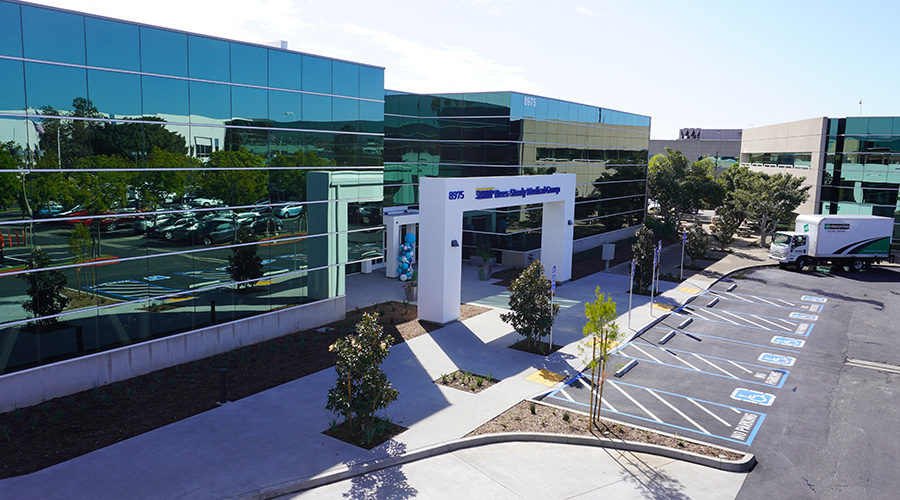
McCarthy Building Companies, Inc. (McCarthy), in partnership with Sharp HealthCare’s Sharp Rees-Stealy Medical Group and Cuningham Group Architecture, has completed the tenant improvement of Sharp Rees-Stealy's Kearny Mesa medical office building (MOB), delivering a comprehensive modernization of an existing two-building campus designed to improve patient experience and operational efficiency.
The completed tenant improvement includes approximately 100,000 square feet of improved space across two buildings and represents an investment of $65 million. The project brings together a new pharmacy, centralized imaging services such as MRI and CT, and a variety of departments — consistent with Sharp Rees-Stealy’s model of offering comprehensive services in one location.
The scope of work also included upgrades to a separate parking structure as well as landscape improvements and exterior enhancements. Construction began in June 2024, with Sharp Rees-Stealy opening the updated facility to patients in early February 2026. The upgraded MOB brings together services previously housed across multiple locations into a more efficient, centralized care environment for the Kearny Mesa area.
McCarthy served as the design-build contractor for the tenant improvement, coordinating phased completion and owner turnover while performing work within the active healthcare campus. During construction, the project team experienced challenges due to structural limitations that prevented placement of major mechanical equipment on the roof. To mitigate this, McCarthy developed an alternative systems approach that relocated equipment to a newly constructed canopy. This solution allowed systems to serve both buildings while reducing the rooftop loading and minimizing visual impacts to the site. The canopy also supports an elevated exterior area intended for patient use.
McCarthy self-performed seven scopes of work, including structural concrete, site concrete, build-out services such as metal framing and drywall, rough carpentry, owner-furnished/contractor-installed (OFCI) items and Unistrut to help maintain the project schedule and ensure consistent execution aligned with the client’s expectations. In addition, McCarthy self-performed select specialty elements, including the construction of a metal pergola, to maintain progress on the project.
McCarthy also leveraged its in-house Virtual Design & Construction (VDC) team to support coordination throughout the project, including the use of laser scanning following demolition to capture existing conditions and inform BIM coordination adjustments. The team also performed targeted destructive testing to reduce uncertainty associated with existing construction.
Designed by Cuningham Group Architecture, the project prioritizes patient access and ease of movement throughout the campus. Improvements include new pedestrian bridge connections that link the existing parking structure directly into one of the buildings across four floors, providing more direct access to care and reducing the need for patients to navigate exterior walkways. A connector bridge between the two buildings further enhances circulation and operational flow.
 Why New Era of Care Demands an Ambulatory Facilities Approach
 ClearSky Health Plans New Medical Rehabilitation Hospital in North Carolina
 Bacon County Health Services Reports Data Breach
 Building Around Care: Lessons in Modernizing Active Healthcare Environments
 St. Luke's Heart Hospital Opens at Anderson Campus in Pennsylvania