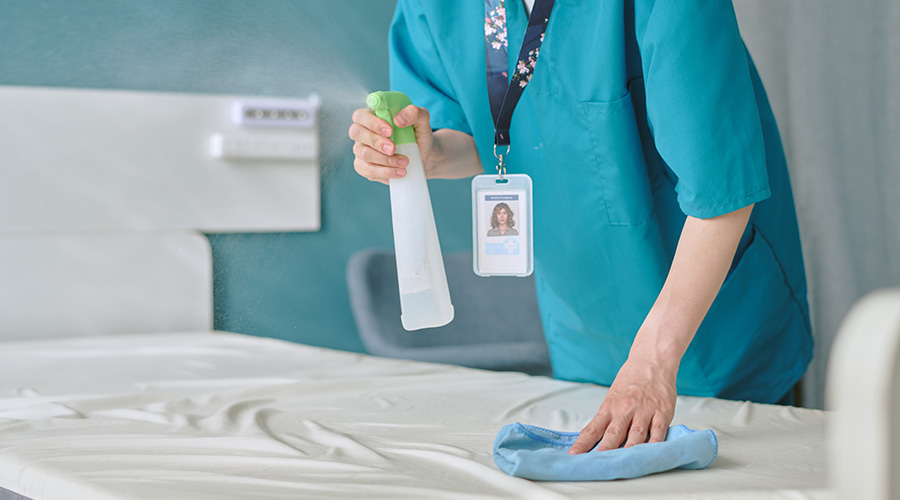
Hospitals across the country are confronting a difficult truth: even the most sophisticated C. auris playbooks that include enhanced screening, chlorhexidine gluconate bathing and iodine nasal decolonization cannot fully prevent colonization. Healthcare systems have publicly acknowledged there is no reliable method to decolonize a patient the way some regimens can for MRSA.
But an equally urgent question remains largely unaddressed: What happens when that colonized patient returns to a contaminated mattress?
Recent peer-reviewed research in the Journal of Hospital Infection found dry-surface biofilm harboring approximately 1.1×10⁵ bacteria per square centimeter on disinfected, decommissioned mattress covers in intensive care units. Scanning electron microscope imaging confirmed the presence of organisms embedded directly into the surface and protected from disinfectants, friction and contact time. Prior studies cited in the same paper showed multi-drug-resistant organisms cultured from 100 percent of biofilm-positive mattresses even after terminal chlorine cleaning.
These findings align with the white paper’s conclusion: Terminal cleaning of a patient’s bed and mattress is not terminal cleaning when it achieves only a 1-log reduction of C. auris. A 1-log reduction means 90 percent of organisms are removed. But 10 percent remain, and with C. auris, that residual contamination is enough to seed the next patient’s environment.
Why this matters for patient safety
C. auris is uniquely resilient. It survives for weeks on surfaces, persists in dry biofilms and withstands many disinfectants. When a colonized or infected patient is discharged, the bed becomes a potential reservoir. If the next patient is placed on a mattress that was terminally cleaned but still harbors embedded organisms, the hospital has unintentionally created a direct exposure pathway.
HFT Recommends: Mattresses Require Strict Care to Prevent Spread of Infections
This risk is not theoretical. Environmental contamination has been linked repeatedly to persistent colonization, room-to-room transmission, outbreaks that appear mysterious and increased morbidity and mortality.
The white paper’s data show that mattress contamination is widespread, often invisible and frequently internal — beyond the reach of surface disinfectants. Even when environmental services (EVS) teams follow protocols perfectly, the tools they use cannot overcome the structural limitations of permeable covers, aging surfaces and biofilm-protected organisms.
The evidence points to one clear conclusion: The bed deck and mattress must be protected from contamination in the first place. Hospitals need an approach that prevents pathogens from entering the surface, can be removed between patients and can be reprocessed to a validated, near-sterile state.
A reprocessable barrier system is available that provides that protection. The laundering process achieves a greater than 99.9999 percent reduction of bacteria and spores, including C. auris. The barrier prevents internal contamination, eliminates the biofilm reservoir and ensures each patient receives a clean, safe surface to lie on.
This approach transforms terminal cleaning from a hope into a guarantee. For infection preventionists and EVS directors, the path forward is clear: Protect the mattress, validate the cleaning, and break the chain of transmission.
Terminal cleaning alone cannot safeguard the next patient from C. auris. A reprocessable barrier could.
J. Darrel Hicks, BA, MESRE, CHESP, Certificate of Mastery in Infection Prevention, is the past president of the Healthcare Surfaces Institute. Hicks is nationally recognized as a subject matter expert in infection prevention and control as it relates to cleaning. He is the owner and principal of Safe, Clean and Disinfected. His enterprise specializes in B2B consulting, webinar presentations, seminars and facility consulting services related to cleaning and disinfection. He can be reached at darrel@darrelhicks.com, or learn more at www.darrelhicks.com.
 Elevating EVS Professionals: The Case for Certified Hygiene Specialists
 Global Handwashing Day and the Importance of Well-Maintained Restrooms
 Duke Health and CaroMont Health Partner to Develop Two New Hospitals
 Designing for the Psychology of Waiting
 UT Health Sciences Breaks Ground on College of Medicine Interdisciplinary Building