Key Takeaways:
- The single most consequential variable in environmental infection prevention — the environmental services professional standing at the door of a discharged patient room — is routinely set up to fail before they ever touch a surface.
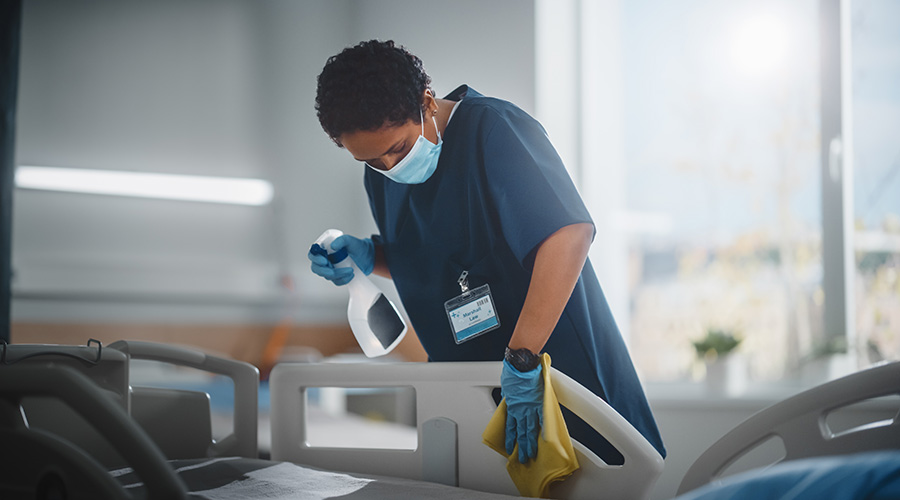
- What leaders must understand is this: The EVS professional is not support staff performing a custodial function. They are an infection prevention specialist executing a clinical protocol in a high-stakes biological environment.
- Healthcare leaders must make workers visible, invite them into safety conversations, share infection rate data with their teams, and publicize their contributions.
On any given day in a U.S. hospital, one in every 18 patients will acquire a healthcare-associated infection (HAI) they did not come in with. That number represents suffering, extended stays, enormous cost, and in too many cases, death.
Healthcare facility managers invest heavily in antimicrobial stewardship, hand hygiene campaigns and clinical protocols to address this crisis. Yet the single most consequential variable in environmental infection prevention — the environmental services (EVS) professional standing at the door of a discharged patient room — is routinely set up to fail before they ever touch a surface.
The math tells the story. At 25 patient rooms — including five discharges per eight-hour shift, a frontline EVS worker can spend approximately 19 minutes in each room. Research is unambiguous that effective terminal cleaning of a patient room requires 40-45 minutes. They are asked every shift to do a 45-minute job in less than one-half that time.
In those 19 minutes, the worker must remove soiled linens, break down and disinfect every surface of the bed, clean the bathroom, mop in a contamination-preventing sequence and wipe every high-touch surface — TV remote, call light, doorknob, thermostat, etc. — while respecting the required chemical dwell time of the disinfectant.
If the worker wipes a disinfectant before it has dwelt long enough to kill C. difficile spores or MRSA, the physical motion of cleaning has been completed without the microbiological result. That distinction — between appearing clean and being disinfected — is the gap where hospital-associated infections are born.
Compounding this time deficit is the differentiated cognitive load they carry silently. Isolation rooms demand different PPE and disinfectants and a different sequence. A C. diff room requires bleach-based chemistry — quaternary ammonium compounds cannot kill bacterial spores — yet they might have entered that room before isolation signage was posted because communication between the clinical and EVS teams broke down. They bear the consequence of a system failure that was never theirs to own.
The problem is not performance. It is structural, and it affects hospital leaders, EVS directors and infection preventionists who have the authority to address it and the obligation to do so.
What leaders must understand is this: The EVS professional is not support staff performing a custodial function. They are an infection prevention specialist executing a clinical protocol in a high-stakes biological environment. When the department is staffed adequately, trained in the science behind the protocols and not just the steps, equipped with the correct tools and welcomed into safety huddles as a clinical partner, the data changes. HAI rates fall. Patients survive discharges they otherwise would not.
The path forward requires three commitments from leadership. First, audit workload assignments against evidence-based time standards, particularly for isolation rooms. Second, invest in education that explains why, not just what, so workers understand the microbiology behind their methods and own the outcome. Third, make workers visible. Invite them into safety conversations, share infection rate data with their teams, and publicize their contributions.
Workers go home after every shift having touched more patient-care surfaces than any clinician on the unit. The question is whether healthcare organizations gave them any real chance to protect the next patient in that bed.
Managers know how to address the challenge. The decision is theirs.
J. Darrel Hicks, BA, MESRE, CHESP, Certificate of Mastery in Infection Prevention, is the past president of the Healthcare Surfaces Institute. Hicks is nationally recognized as a subject matter expert in infection prevention and control as it relates to cleaning. He is the owner and principal of Safe, Clean and Disinfected. His enterprise specializes in B2B consulting, webinar presentations, seminars and facility consulting services related to cleaning and disinfection. He can be reached at darrel@darrelhicks.com, or learn more at www.darrelhicks.com.
 Building Around Care: Lessons in Modernizing Active Healthcare Environments
 St. Luke's Heart Hospital Opens at Anderson Campus in Pennsylvania
 WindRose Health Network Ensnared in Vendor Data Breach
 How Efficiency Checklists Help Hospitals Save Energy, Water and Money
 Intermountain Healthcare Receives $50M Gift for Standalone Children's Hospital