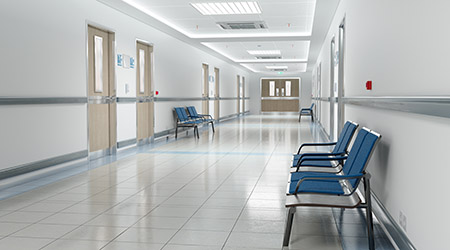
As the COVID-19 pandemic enters its third year, some industries are struggling to reboundbecause of skyrocketing costs, ongoing labor issues, and continuous supply shortages.Real estate is on everyone’s mind, and new projects could be delayed because of the pandemic. But as the saying goes, “Where there’s a will, there’s a way,” and all segments of the healthcare industry are continuing to persevere.
“The staffing, supply, and hospital-bed shortages that healthcare providers and real estate developers hoped were temporary are now long-term issues that will reshape hospital real estate and development projects well into 2022,” says Danielle Bergner, shareholder with Hall, Render, Killian, Heath & Lyman, a health law firm. “The construction industry is not immune to labor disruptions triggered by ongoing COVID-19 challenges, which is resulting in delays for new hospital and development projects as contractors work to find qualified workers. By one estimate, contractors will need to hire 430,000 more employees in 2022 and 1 million more in the next two years to keep up with the increased project demand. If contractors do not meet those metrics, health systems should expect and plan for delays to their upcoming projects. Health systems are paying close attention to the timing requirements in construction contracts, as wellas the remedies available for late delivery.”
Supply chain issues also areimpacting new projects. Between the lack of available staff and material shortages, construction projects will be delayed even though demand remains strong. As a result, health systems and developers are approaching delivery timelines and project cost estimates with an added level of caution.
“In response to ongoing supply chain challenges, some health systems have begun evaluating the use of a centralized service model using a consolidated service center (CSC) to manage certain supply chain needs,” Bergner says. “Although typically evaluated in the context of operational supply chain needs, the CSC model could be evaluated in the context of facilities planning, as well.”
One way to move forward with new projects is by usingalready vacant buildings. This approach can have positive effects on communities while also stimulating economic development, decreasing crime, and increasing property values. Some properties to consider are vacant big box stores and shopping malls.
Innovative and creative construction firms will find many benefits in repurposing an older building because it can be a cost-saving move, butchallenges remain.
“Repurposing buildings does, however, present some practical challenges,” Bergner says. “Not every vacant building is able to be repurposed in a cost-effective manner. As a result, hospitals looking to repurpose a vacant building should work with their construction and development team or advisor to consider the feasibility, structural challenges, patient experience, and sustainability of the project.”
As hospitals and other healthcare facilities continue to navigate the pandemic, real estate trends will start adjusting to demand. It is expected that there will be an expansion of development in states relaxing certificate of need requirements. And as telemedicine becomes more popular, designers will begin incorporating the service in future construction of healthcare facilities.
Bergner predicts the coming years will see an expansion of ambulatory surgery centers (ASC) as more services are being performed in lower-acuity settings as technology and treatment protocols advance.
“Over 200 ASCs were built or proposed in 2021, with that number trending up into 2022,” Bergner says. “The ASC market continues to attract significant private equity investment. However, we are seeing a growing convergence of payor, provider, and operator in that market. It will be a dynamic market to watch in 2022.”
Mackenna Moralez is assistant editor with Healthcare Facilities Today.
 Cleanliness in Hospitals: Clinical Priority and Community Perception
 Dana-Farber Receives $50M Gift for Planned Cancer Hospital
 Clarinda Regional Health Center Reports Data Security Incident
 Gaps in Nurses' Environmental Cleaning Knowledge Grow Amid Rising EVS Pressures
 Ground Broken on the Southern Nevada Forensic Facility