 |
|
In response to the COVID-19 pandemic and a wave of seemingly conflicting statements and opinions about the disinfection capabilities and safety of GUV, the Illuminating Engineering Society (IES, est. 1906) has issued a report by their Photobiology Committee explaining germicidal ultraviolet (GUV) disinfection and its potential to safely reduce the transmission of SARS-CoV-2, the virus that causes COVID-19. The authors of the report have provided answers to frequently asked questions about GUV, drawing from expertise from the Centers for Disease Control and Prevention (CDC), the Food and Drug Administration (FDA), Harvard Medical School, the Icahn School of Medicine at Mount Sinai Medical Center, and from germicidal UV manufacturing and research organizations. Written to help protect healthcare workers and patients, the free download is available on the IES website, [click here], with an accompanying tutorial video explaining germicidal UV technology, its application, and safety considerations. “The goal is to provide timely and objective information on a proven technology that can reduce the spread of this highly contagious virus,” said Brian Liebel, IES Director of Standards and Research. Germicidal UV can successfully and safely be deployed to disinfect air in occupied hospital spaces such as waiting rooms, intensive care units and operating rooms. In unoccupied controlled-access environments, germicidal UV can be used as a supplemental measure to disinfect room surfaces, to reduce the spread of healthcare associated infections. Germicidal UV is also being applied for disinfection of some personal protective equipment (PPE) for limited reuse during the pandemic. The FAQs emphasize the need for GUV to be applied correctly and monitored for output and safety, and that training on the operation and maintenance of the systems over time is also important. The IES report addresses these topics and recognizes that additional GUV technologies are in development, including efficacy and safety testing. The committee report also cautions that ultraviolet disinfecting “wands” or other ultraviolet products for residential use—as they are inadequately proven and unregulated—may pose a safety hazard and are unlikely to provide the protection expected. “The guidance included in this report should help medical professionals and consumers better understand germicidal UV products, and provides considerations for selecting and employing such technologies,” said Dr. David Sliney, chair of the IES Photobiology Committee. The report was approved through the same careful and rigorous ANSI-approved development process as an IES standard. |
 Cleanliness in Hospitals: Clinical Priority and Community Perception
 Dana-Farber Receives $50M Gift for Planned Cancer Hospital
 Clarinda Regional Health Center Reports Data Security Incident
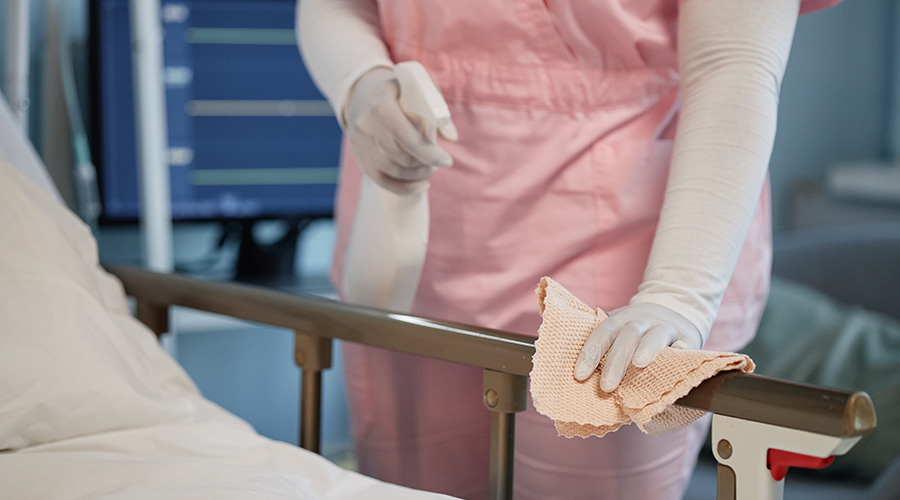 Gaps in Nurses' Environmental Cleaning Knowledge Grow Amid Rising EVS Pressures
 Ground Broken on the Southern Nevada Forensic Facility