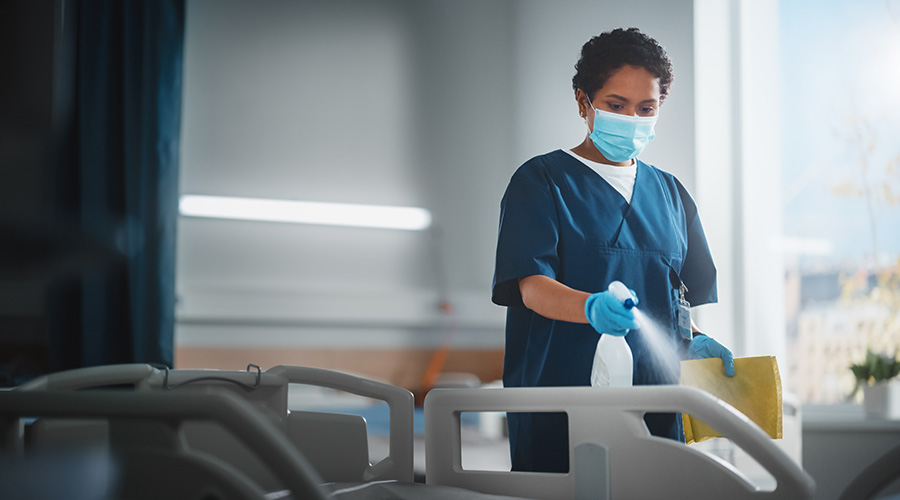
The patient’s bed and 36 inches around it is the most contaminated space in a hospital room. That is why the space is called the hot zone. A proven two-step strategy for disrupting dry-surface biofilm (DSB) in the hot zone begins with a simple premise: You cannot disinfect what you cannot reach.
In the patient’s bed space — where hands, devices and bodily fluids converge — biofilm forms a thin, invisible and tightly adhered layer that shields pathogens from even the strongest disinfectants. The most reliable approach is therefore a paired method: mechanical disruption first, disinfection second. When done correctly, this strategy protects surfaces, preserves finishes and dramatically improves the effectiveness of disinfectants used.
Mechanical disruption using controlled friction. The first step is not chemical. It is physical. Environmental services (EVS) workers use a damp microfiber cloth or pad to apply measured friction to high-touch surfaces — bed rails, over-bed tables, call buttons, IV poles, monitors and frequently handled equipment — within the 36-inch zone. Microfiber is ideal because its split fibers reach into microscopic surface irregularities without scratching finishes.
HFT Recommends: Biofilm Disruption: Core Strategy for Environmental Hygiene
This step removes dried organic soil, skin cells, lotions, body fluids and the desiccated matrix that forms the backbone of DSB. The goal is not to scrub hard but to break the matrix’s integrity so the disinfectant can reach the organisms it is meant to kill.
Targeted disinfection after soil removal. Once the biofilm layer is disrupted, the disinfectant finally can do its job. Applying the disinfectant after mechanical disruption ensures full contact with exposed microbes. This sequence — disrupt, then disinfect — is the only approach consistently shown to reduce microbial load on DSB-contaminated surfaces without damaging materials.
This method also protects finishes because it reduces the need for repeated, prolonged chemical exposure. When soil is removed first, disinfectants work faster and require fewer reapplications.
Implementing this strategy requires adjustments to workflow, training and mindset, not just more time:
- Shift from a spray-and-wipe strategy to wipe-then-spray. Many EVS workers have been trained to apply disinfectants first. Reversing the order is a cultural change.
- Use a damp microfiber for the first pass. This change might require carts to be stocked differently and cloth-management systems to be updated.
- Put an intentional focus on the hot zone. Instead of treating the room uniformly, workers should concentrate efforts where biofilm is most likely to form.
- Train on pressure, technique and dwell time. Staff must understand that friction is a clinical intervention, not a cosmetic one.
- Provide clear communication with nursing. Bed rails, tables and equipment must be accessible, not buried under personal items or medical supplies.
- These changes are realistic, but they require leadership support, coaching and reinforcement.
Fewer healthcare associated infections are a powerful benefit for EVS workers confronted with these changes. When DSB is disrupted consistently, environmental reservoirs shrink. Fewer reservoirs mean fewer opportunities for pathogens to transfer to hands, devices and ultimately patients. Hospitals that adopt mechanical-disruption-first strategies often see lower bioburden on high-touch surfaces, fewer persistent contamination problems, reduced transmission of multi-drug-resistant organisms and stronger alignment between EVS and infection prevention.
For EVS workers, the benefit is not only fewer HAIs. It is recognition. This strategy elevates their work from housekeeping to clinical infection prevention, and it reframes cleaning as a frontline patient-safety intervention, which is exactly what it is.
J. Darrel Hicks, BA, MESRE, CHESP, Certificate of Mastery in Infection Prevention, is the past president of the Healthcare Surfaces Institute. Hicks is nationally recognized as a subject matter expert in infection prevention and control as it relates to cleaning. He is the owner and principal of Safe, Clean and Disinfected. His enterprise specializes in B2B consulting, webinar presentations, seminars and facility consulting services related to cleaning and disinfection. He can be reached at darrel@darrelhicks.com, or learn more at www.darrelhicks.com.
 Making Multi-Site Lighting Upgrades Work
 Designing a Positive Care Destination for Children
 Blackbird Health Opens 10th Clinic in Pennsylvania
 Healthcare Construction Infection Control: Essential CDC Guidelines for Active Facilities
 Protecting the Most Vulnerable: Inside the NICU