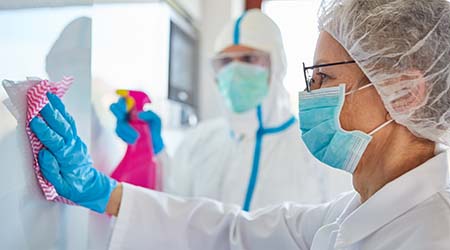
Ultraviolet light (UV-C) has come under intense scrutiny since the start of the pandemic for its ability to destroy more than 90 percent of all pathogen variants, including COVID-19, especially as applied in HVAC systems and facility airstreams. Now, evidence is emerging that the technology might have other applications in battling the coronavirus.
UV-C light could improve the efficacy of 400 common disinfectants against COVID-19, and it could make them safer for people, according to Health Europa. Benzalkonium chloride (BAK) is the most common active ingredient in many disinfectants and protects against a range of viruses and bacteria, including SARS-CoV-2, which causes COVID-19.
But the ingredient’s toxicity means it cannot be used in high concentrations, and products containing BAK are harmful to humans. BAK is used in hospitals and is a severe human skin and eye irritant. Its high toxicity limits the ability to use products with a high concentration.
A new study has shown that using UVC could fully neutralize the chemical’s toxicity. Researchers have found that BAK solutions were completely neutralized by UVC and that a disinfecting procedure using BAK followed by UVC radiation can minimize the harmful effect of BAK residues on humans and the environment.
 Sustainability as a Baseline in Healthcare Facilities
 Penobscot Valley Hospital Reports Data Security Incident
 Ballad Health Acquires Land for Future Unicoi County Hospital
 Why Healthcare Facilities Management Is Critical to Patient Safety
  Brookdale Senior Living Announces Acquisition of the Brookdale Galleria Community