The specialty workforce shortage in healthcare is widely understood as a human resources crisis. Healthcare organizations are likely to face a shortage of more than 141,000 physicians across all specialties by 2038, according to the Health Resources and Services Administration, and nearly 40 percent of nurses intend to leave the workforce within five years, according to AAG/H.
What receives far less attention is the role the built environment plays in driving and solving that crisis. The design of a healthcare facility is not a backdrop to clinical operations. It is infrastructure for the way care is delivered.
When staff is stretched thin, every inefficiency in the physical environment is amplified. Nurses walk unnecessary distances to retrieve supplies. Clinicians navigate poorly organized floors to reach critical functions. Staff go without a quiet place to decompress during long, demanding shifts. More than just minor inconveniences, these situations contribute to burnout, turnover and, ultimately, vacancies that hospitals struggle to fill.
Recruitment and retention impact
In a tight labor market, healthcare professionals have options. They choose where to work based not only on compensation and culture but on the quality of the environment in which they are expected to deliver care. A well-organized, efficient and beautifully designed facility signals institutional investment in its staff. A dated, congested or poorly organized facility signals the opposite.
For academic medical centers and teaching hospitals, this scenario is especially pronounced. These institutions compete to attract the best clinicians and residents, and the facility itself is part of the offer.
Are spaces sized appropriately for the complexity of care delivered? Is there infrastructure for simulation, research and teaching, or are those functions treated as afterthoughts? The physical environment either reinforces or undermines the institution's reputation.
Optimizing patient flow
One of the most consequential and overlooked levers in facility planning is the physical relationship between departments and functions. Reducing the distance between critical care areas has a direct, measurable impact on the way staff spend their time and energy. Locating interventional radiology adjacent to the emergency department is a clear example.
At Yale New Haven Hospital’s St. Raphael Campus, we renovated and expanded the heart and vascular center and emergency department with exactly this goal in mind — expanding interventional labs and a dedicated radiology suite with CT, X-ray and ultrasound directly at the point of care. For stroke patients, where time to treatment is directly correlated with outcome, that proximity can be lifesaving. But it also reduces the physical and mental load on clinical and transport staff who otherwise would be navigating patients across a campus in an emergency situation.
HFT Recommends: What Caregivers Want from Their Workspaces
Arriving at those layout decisions requires deep clinical engagement, not assumptions. Tools like spaghetti diagrams that map out patient scenarios across the floor plate reveal functions that genuinely need proximity and those that can be located remotely without operational consequence.
During this process, some of the most pressing questions that need to be considered are: How frequently does this scenario occur? Who bears the cost when these functions are far apart? Answering these questions with clinical staff, supply chain personnel and leadership in the room produces layouts that are grounded in reality rather than default approaches.
Standardization within the facility is another underused efficiency tool. When every patient room is mirrored and when medication rooms and clean supply rooms are configured consistently across the floor, staff are not spending mental energy reorienting themselves in every new space. That consistency matters more than it might appear, especially on busy inpatient floors where staff are managing complex, overlapping demands.
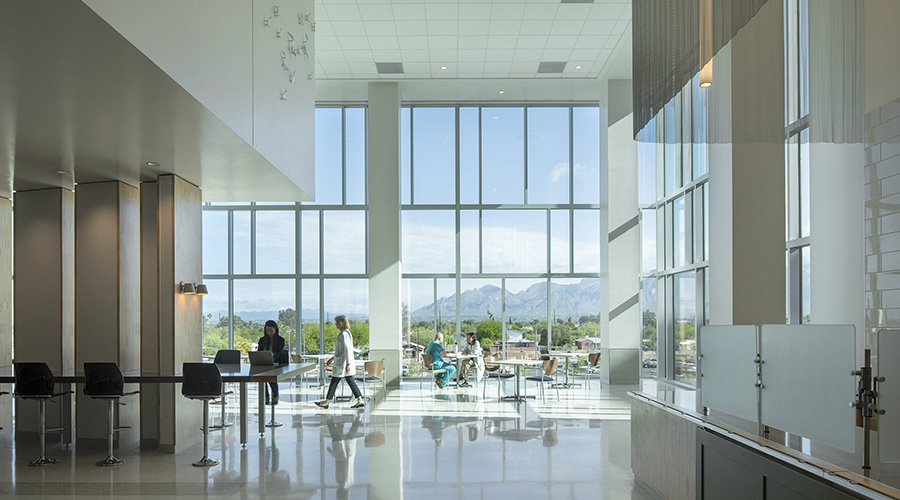
The same logic applies to the way shared resources are structured. At Banner University Medical Center in Tucson, we designed a large Level 2 shared prep and recovery space that supports imaging, interventional and endodontic radiology rather than each having its own dedicated prep and recovery area and staff.
Staff flex across service lines depending on the way the volume is running that day. The result is a more resilient staffing model that requires less total headcount to maintain coverage and creates cross-training opportunities that make the workforce more adaptable over time.
Support spaces beyond break rooms
Burnout in healthcare has been around long before 2020, but it became impossible to ignore post-pandemic. Rather than just accommodating it incidentally, facility managers and designers are being asked to create environments that actively support clinician wellbeing.
The most effective staff support spaces share a few characteristics. They are usually removed from the care environment so staff can fully disconnect, not just physically step away while remaining visually and acoustically present to the unit.
They provide access to natural light, something many clinical staff, particularly those working in surgical suites or interior departments, go entire shifts without. They offer a range of options — lounge areas for informal decompression, quiet respite rooms for staff who need a moment alone, mothers rooms, and one- or two-person spaces where someone can take a personal call without leaving the building.
Life continues for clinical staff during a 12-hour shift. Being able to step away to briefly handle something personal in a dignified space is a practical and moral consideration. Some of the most forward-thinking institutions now offer access to outdoor spaces, patios and gardens dedicated to staff. These investments are becoming part of the way hospitals differentiate themselves as employers.
The long-term view
The most significant missed opportunity in healthcare facility planning is the failure to maintain a long-term perspective. Under the pressure of a specific pain point, the instinct among managers is often to renovate quickly and move on. But expedient solutions frequently create constraints that compromise the next decision and the long-term vision for the campus. Slowing down at the beginning of a project to truly understand a campus’s challenges, map its long-term operational goals and build a master plan that accommodates future flexibility is work that pays off for decades.
The specialty workforce shortage is not going away, but healthcare facilities managers have more influence over it than most realize. The way spaces function for clinicians, how efficiently they work and whether they support moments of recovery is not an amenity. It is operational infrastructure. Designing them with the same rigor applied to clinical programming is the way facilities become places where exceptional clinicians want to stay.
Michelle Amberson, AIA, ACHA, EDAC, Principal with Shepley Bulfinch, an architecture firm. Jason Costello, AIA, ACHA, LEED AP, is principal with the firm.
 Hospitals Are Energy Super-Users. Why Is It So Hard to Modernize Them?
 Encompass Health Rehabilitation Hospital of Bangor Officially Opens
 Early Entry: Manager's Critical Role in Construction Planning
 The Evolution of Lighting in Patient Care
 HealthPartners and Essentia Health to Combine Organizations