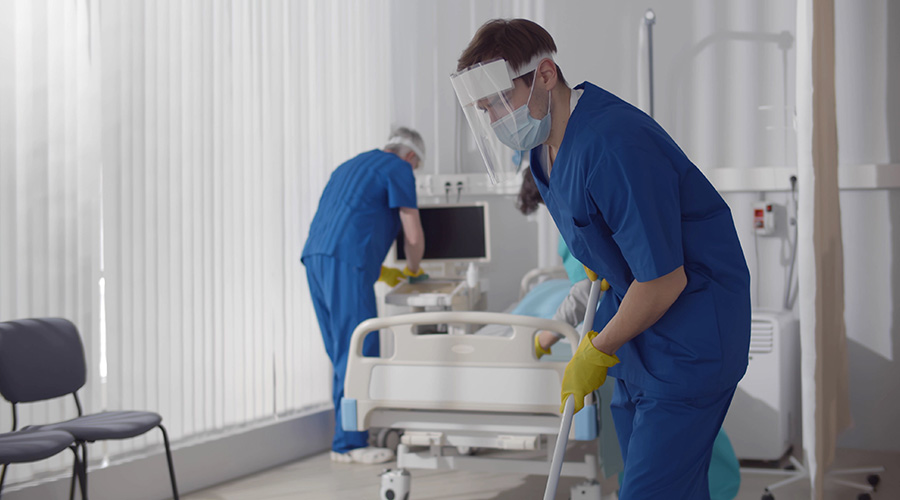
Recently, the Center for Disease Control and Prevention (CDC) announced a shocking increase in carbapenem-resistant Enterobacteriaceae (CRE) infections, which tripled from 2019 to 2023 and caused an estimated 1,100 deaths. The ugly truth behind this finding is that dirty hospitals are contributing to these deaths.
Saying a hospital or other healthcare facility is clean leads the public to infer it is safe for patient care. But for too long, clean has been a subjective term determined by a simple visual assessment. Two people inspecting the same room or the same piece of patient care equipment might have a different opinion about whether it passes this test.
The CDC reports that superbug pathogens such as CRE can spread in hospitals because healthcare workers skip cleaning their hands between working with patients, and hospitals fail to properly clean rooms and medical equipment. These are the same reasons that more common infections also spread from patient to patient in hospitals, causing more than 100,000 deaths a year. The problem is far bigger than one bacterium.
Many more common hospital infections are becoming drug-resistant. As a result, going into a hospital will be too unsafe unless hospitals clean up. Cleanliness is the first line of defense to protect patients from killer pathogens, but many hospitals refuse to make it a priority.
Related Content: Addressing a Months-Long CPE Outbreak
Shockingly, the leading predictor of which patient gets a hospital acquired infection (HAI) is the room or bed they are admitted to — not their age or the illness that caused them to come to the hospital. If a patient is put in a room where the preceding patient was isolated with a bacterial infection, the risk of getting infected goes up almost fivefold, according to some research.
The previous patient was discharged, but germs — all invisibly lurking to infect the next patient — were left behind on surfaces that were close to the patient, including bedrails, overbed tables, privacy curtains and bed mattresses. Mattresses in particular are a Petri dish of infection-causing germs. Patients with clostridium difficile (C. Diff) have lots of watery diarrhea that can contaminate a mattress, which is a porous surface that is impossible to disinfect. C. diff is the most prevalent HAI and kills nearly 30,000 Americans a year — mostly hospital patients.
Miniscule particles of one patient’s feces can get into another patient’s mouth through fecal-oral transmission. How could such a gross thing happen in a hospital? It’s easy, and placing a patient in a bed with an improperly cleaned mattress doubles their risk of getting C. diff.
Emory University scientists tracked the fate of patients placed in a bed where a previous patient — even 90 days ago — contracted C. diff. Scientists conclude that being put in a bed after a C. diff patient, even after three months, is “significantly associated” with being infected.
A well-trained staff, given adequate time, equipped with the best-in-class tools, products and processes, will likely deliver a clean, sanitized or disinfected room. But to be certain, it is essential to be able to demonstrate through measurement that the cleaning process is producing the desired results.
J. Darrel Hicks, BA, MESRE, CHESP, Certificate of Mastery in Infection Prevention, is the past president of the Healthcare Surfaces Institute. Hicks is nationally recognized as a subject matter expert in infection prevention and control as it relates to cleaning. He is the owner and principal of Safe, Clean and Disinfected. His enterprise specializes in B2B consulting, webinar presentations, seminars and facility consulting services related to cleaning and disinfection. He can be reached at darrel@darrelhicks.com, or learn more at www.darrelhicks.com.
 Cleanliness in Hospitals: Clinical Priority and Community Perception
 Dana-Farber Receives $50M Gift for Planned Cancer Hospital
 Clarinda Regional Health Center Reports Data Security Incident
 Gaps in Nurses' Environmental Cleaning Knowledge Grow Amid Rising EVS Pressures
 Ground Broken on the Southern Nevada Forensic Facility