Key Takeaways:
- The U.S. Centers for Disease Control and Prevention has issued an urgent threat alert for Carbapenem-resistant Acinetobacter baumannii (CRAB).
- Clinical strains of CRAB survive on dry, inanimate hospital surfaces for about one month under normal conditions. Some strains have survived beyond 100 days in laboratory studies.
- EVS directors need to build a real-time communication system with workers to inform workers of the threat before they enter a room where CRAB is present.
The U.S. Centers for Disease Control and Prevention (CDC) does not use the word urgent lightly. Its urgent threat classification, the highest tier in its antimicrobial resistance hierarchy, is reserved for organisms demanding immediate, aggressive action. Carbapenem-resistant Acinetobacter baumannii (CRAB) holds that designation.
For hospital executives and environmental services (EVS) directors who have not yet made this organism a centerpiece of their environmental cleaning training, the science offers a compelling argument to start today.
CRAB is a Gram-negative bacterium that causes bloodstream infections, ventilator-associated pneumonia, surgical wound infections and meningitis in hospitalized patients. What elevates it from a serious pathogen to a crisis-level threat is its intersection of two lethal traits: extraordinary antimicrobial resistance and extraordinary environmental persistence.
CRAB bloodstream infections carry mortality rates of 40-60 percent in intensive care unit (ICU) populations. When clinicians reach for carbapenems — the antibiotics reserved for resistant infections — and find them ineffective, some patients have no remaining treatment options. The infection progresses to sepsis, organs fail, and patients die.
HFT Recommends: Better, More Thorough Cleaning Saves Lives
The organism that started this cascade might have been waiting on a dry bedrail for three weeks. Every EVS professional in a facility must understand this fact: CRAB does not behave like most hospital pathogens. Clinical strains survive on dry, inanimate hospital surfaces for about one month under normal conditions. Some strains, particularly those isolated from hospitals, have demonstrated survival beyond 100 days in laboratory studies.
It has been recovered from bed rails, overbed tables, ventilator surfaces, pillow covers, mattress seams, IV poles and call lights — the precise inventory of surfaces an EVS worker is responsible for cleaning at every discharge.
The disinfectant question compounds the challenge. Hospitals use an evidence-based process to eliminate CRAB from environmental surfaces — especially when dealing with its notorious dry-surface survival and biofilm formation.
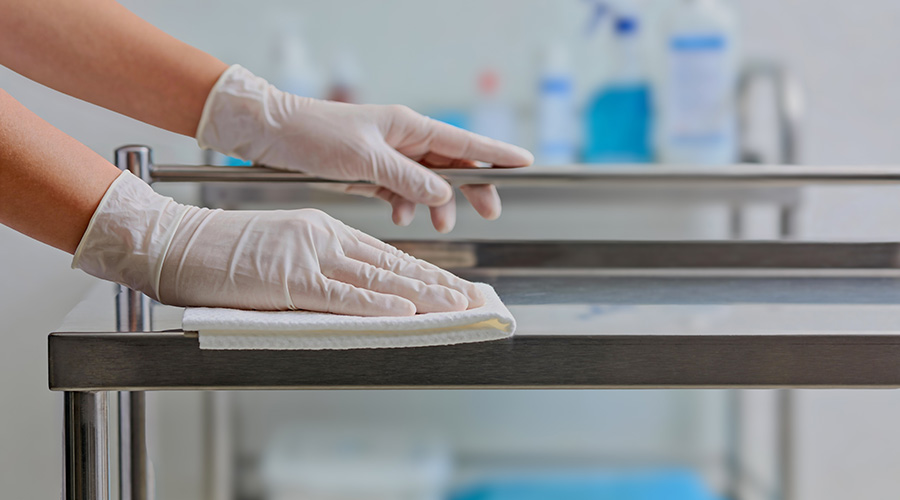
The core principle is to clean, then disinfect. CRAB can survive for weeks on dry surfaces and resists many quaternary ammonium compounds, so mechanical removal of biofilm and soil must precede disinfection. Here is the step-by-step process:
Physical cleaning:
- Use detergent or enzymatic cleaner with firm friction — microfiber, scrub pad or dual-texture wipe.
- Focus on high-touch surfaces, including bed rails, call buttons, IV pumps, keyboards and wheelchairs.
- If the matrix is not broken, the organism will remain protected.
- Disinfection:
- Apply an EPA-registered hospital disinfectant with proven efficacy against CRAB or other gram-negative multiple-drug-resistant organisms.
- Maintain full wet contact time. Do not just spray and walk away.
- Re-wipe if the surface dries prematurely.
That gap between appearing clean and being disinfected is where CRAB survives and where the next patient faces risk.
EVS directors need to educate technicians by using the organism's name and consequences. Generic contact precautions training does not convey urgency. When EVS workers understand that this specific bacterium can live on a dry surface for one month, can cause sepsis and can resist the drugs meant to treat it, protocol adherence changes.
Directors also need to build a real-time communication system. EVS workers must be informed before they enter a room where CRAB is present. Every moment of delay between clinical identification and EVS notification is a moment of preventable exposure risk.
EVS technicians cleaning ICU rooms are not performing a custodial function. They are executing a biological intervention against one of the most resistant, persistent and lethal organisms in a facility. They deserve to know exactly what they are facing and exactly what their work prevents when done correctly.
The organism waits, and technicians are the reason the next patient does not encounter it.
J. Darrel Hicks, BA, MESRE, CHESP, Certificate of Mastery in Infection Prevention, is the past president of the Healthcare Surfaces Institute. Hicks is nationally recognized as a subject matter expert in infection prevention and control as it relates to cleaning. He is the owner and principal of Safe, Clean and Disinfected. His enterprise specializes in B2B consulting, webinar presentations, seminars and facility consulting services related to cleaning and disinfection. He can be reached at darrel@darrelhicks.com, or learn more at www.darrelhicks.com.
 Preparing Healthcare Facilities for Wildfire Air Quality Events
 UW Health Set to Open Expansion at East Madison Hospital
 Central Ohio Primary Care Physicians Falls Victim to Cyberattack
 The Role of Biophilic Design in Healthcare Facilities
 TriStar Centennial Medical Center Invests $90M in Women, Children's Hospital Expansions