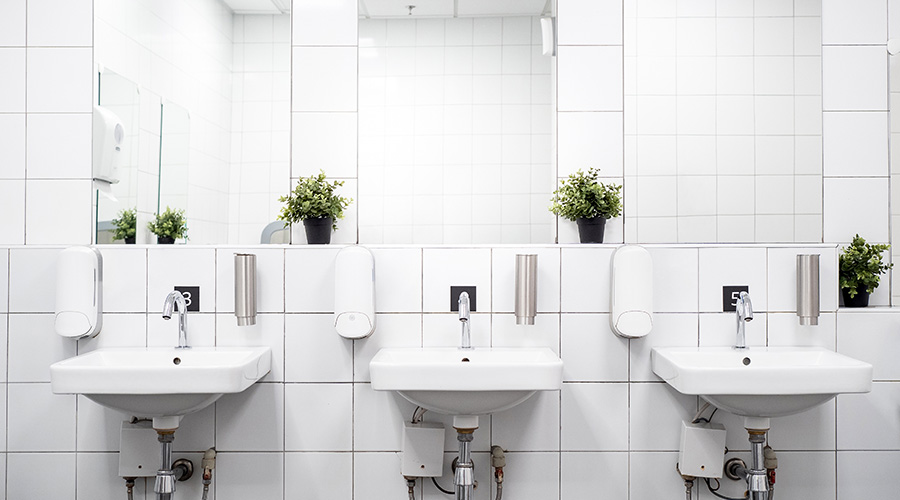
In healthcare facilities, restrooms are no longer viewed as purely functional spaces. Facility managers are increasingly treating them as critical infrastructure that directly supports infection prevention, operational resilience and patient experience. Expectations are shifting toward integrated, high-performing restroom environments.
In this manufacturer roundtable, Healthcare Facilities Today spoke with restroom fixture manufacturers about how every component works together to reduce risk, support staff workflows and reinforce trust in the care environment.
Healthcare facilities have unique demands around hygiene, durability and patient experience. What shifts in design priorities or performance expectations are you seeing from facility managers today?
“Facility managers are placing greater emphasis on restroom design as a frontline component of infection prevention and patient experience and confidence. Hygiene expectations now go beyond cleanliness to include minimizing touchpoints, improving handwashing compliance and supporting faster, more effective cleaning routines. Our research reinforces this shift: roughly 80 percent of Americans say touchless fixtures are important in public restrooms, underscoring how strongly users associate hands-free environments with hygiene and safety.
Durability expectations are also evolving. The fixtures used in healthcare restrooms must withstand near-constant use and rigorous cleaning protocols while maintaining consistent performance and appearance. For example:
- Seamless, nonporous surfaces to reduce microbial contamination and withstand hospital-grade disinfectants.
- Hands-free fixtures (touchless faucets, soap dispensers, flush valves and doors) to minimize contact points.
- Improved ventilation strategies to reduce airborne pathogens.
- Clear separation of clean and dirty workflows in staff restrooms and decontamination areas.
At the same time, patient and staff experience is influencing layout and design decisions, with increased attention to privacy, accessibility and intuitive use. Studies continue to show that clean, well-designed restrooms have a direct impact on how people perceive the quality and professionalism of a healthcare facility, making performance expectations both operational and experiential.”
— Cassie Keeler, product manager of handwashing products, Bradley Company
“Facility managers are increasingly prioritizing risk reduction and system performance over aesthetics alone. Hygiene expectations now extend beyond surface cleanliness to include how water behaves within the plumbing system — particularly flushing at distal points such as faucets and showers.
There is growing awareness that waterborne pathogens associated with biofilm formation can drive severe outcomes. This has elevated expectations around consistency, reliability and how restroom systems perform during real-world conditions, including low occupancy, unit shutdowns or fluctuating demand.
At the same time, patient and staff experience continues to matter. Quiet operation, intuitive use and confidence that fixtures will perform as expected are increasingly viewed as contributors to safety and quality of care, not just convenience.”
— Greg Hunt, commercial product manager, Chicago Faucets
“Healthcare facilities constantly need to balance the need for high-performance plumbing systems with growing expectations around hygiene, reliability and user experience. Hospitals will always prioritize patient safety above all else, and that is never going to change.
One of the more frequently discussed design trends is “anti-splash” handwashing sinks, due to the Facility Guidelines Institute (FGI) hand washing recommendations that outline the placement of sinks, along with recommended faucet and sink dimensions to minimize splashing.
This is accomplished by optimizing the internal geometry to minimize stagnant water that reduces opportunities for microbial growth. Materials and mechanisms like this that simplify the water pathway, eliminate unnecessary moving parts and support infection-control strategies are becoming baseline requirements.
One of the other most notable shifts is the emphasis on durability within harsh water environments, as many hospitals operate with aggressive disinfection protocols, high-temp line flush protocols, and higher levels of chemical treatment. Facility managers are prioritizing fixtures and components that can withstand repeated thermal flushing, resist degradation from chloramines and support long-term operational stability.
Which isn’t to say that aesthetics isn't important. Public-facing areas strive for clean looking designs and no-touch surfaces to elevate our perception of cleanliness. Patient care rooms are also working hard to balance creating an “at home” feel for their patients, while utilizing commercial-grade fixtures that meet the durability required for intensive healthcare use, ensuring they not only look great but also contribute to a safer water environment.”
— Dan Danowski, product manager, Zurn Elkay
“Facility managers are shifting from specifying individual products to demanding holistic restroom systems that actively enhance patient safety. The expectation is now for an integrated environment where touch-free fixtures, antimicrobial surfaces and easy-to-clean designs work together to reduce infection risks.
Performance is no longer just about durability; it’s measured by how effectively the restroom contributes to a facility's overall health and operational efficiency goals. We are also seeing a greater emphasis on creating a less institutional, more comfortable patient experience through modern aesthetics and user-centric features.”
— Morgan Kish, director of product management, Sloan
Jeff Wardon, Jr., is the assistant editor of the facilities market.
 Preparing Healthcare Facilities for Wildfire Air Quality Events
 UW Health Set to Open Expansion at East Madison Hospital
 Central Ohio Primary Care Physicians Falls Victim to Cyberattack
 The Role of Biophilic Design in Healthcare Facilities
 TriStar Centennial Medical Center Invests $90M in Women, Children's Hospital Expansions