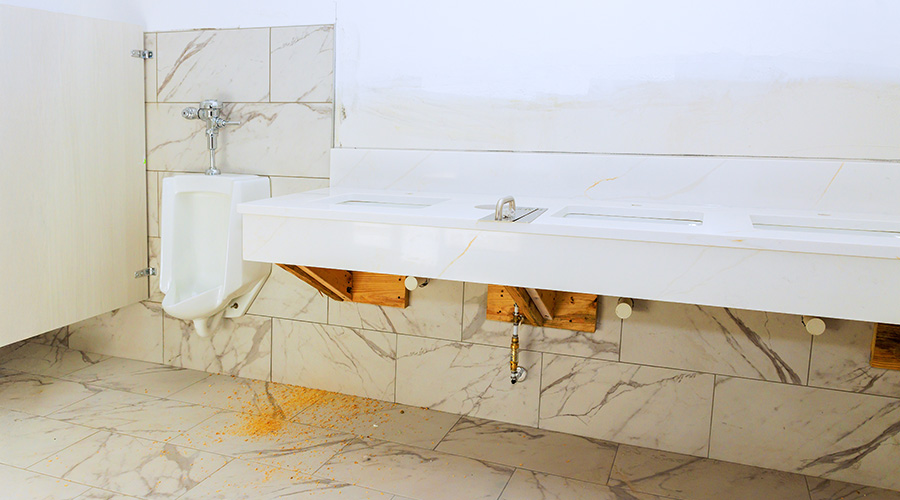
Water efficiency remains a critical sustainability goal for healthcare facilities, but restroom design decisions are becoming more complex than simply reducing flow rates. Facility managers have to balance conservation with infection control, system reliability, maintenance realities and patient perception.
In this manufacturer roundtable, Healthcare Facilities Today spoke with manufacturers about what design strategies are gaining traction and how healthcare facilities can pursue water efficiency without creating unintended trade-offs for users or operations.
From your perspective, what strategies or design approaches are gaining traction to help facilities balance water efficiency, environmental goals and user needs?
“Healthcare systems are increasingly looking for restroom design strategies that support sustainability without compromising hygiene or user confidence. Water efficiency remains important, but can also impact performance, reliability and patient perception. Facilities recognize that sustainable solutions must still reinforce proper handwashing behavior and support a sense of cleanliness.
Design approaches that optimize water use while maintaining consistent flow and performance are gaining traction, as are layouts that reduce waste and support easier maintenance. There is also increased interest in data-driven insights to help facilities monitor usage patterns and identify opportunities for conservation without negatively impacting the user experience. Ultimately, sustainability efforts are most successful when they are integrated seamlessly into restroom design rather than perceived as trade-offs.”
— Cassie Keeler, product manager of handwashing products, Bradley Company
“Sustainability discussions in healthcare are becoming more nuanced, particularly as organizations recognize the relationship between water efficiency and water quality. Facilities are moving beyond simple flow-rate reductions toward more intentional water use strategies that account for usage patterns, turnover and system health.
Sustainability in healthcare is becoming less about using less water at all costs and more about using water intentionally. Facilities are balancing efficiency with safety, reliability and long-term system performance. The most successful approaches evaluate sustainability through a lifecycle lens, considering not only environmental impact but also maintenance burden, operational resilience and patient safety.”
— Greg Hunt, commercial product manager, Chicago Faucets
“Technologies like hydropower are gaining traction not just for their environmental benefits but because they reduce manual maintenance tasks that, if delayed, could affect fixture performance and water circulation — two factors that directly influence water safety. The ability to eliminate the cost of changing batteries and the sustainable aspect of keeping batteries out of landfills is a trend that I am excited to see growing in commercial restrooms. The improved efficiency and availability of hydropower systems have increased dramatically over the past 3-5 years, giving facility managers plenty of options to meet their needs of their commercial restrooms.
Water-efficient fixture designs are also evolving to better support user needs without compromising performance. There is growing interest in systems that maintain consistent flow rates despite fluctuating building pressure, as well as those that support data-driven insights to verify that conservation targets are being met. Overall, we are seeing that sustainable design features are most successful when they integrate seamlessly into healthcare environments where facility teams often focus first on maintaining water quality and system resilience.”
— Dan Danowski, product manager, Zurn Elkay
“The most effective strategy is the adoption of a "total ecosystem" approach to water management. This moves beyond simply installing low-flow fixtures and focuses on optimizing the entire system for efficiency without compromising hygiene. Design approaches gaining traction include using connected systems that monitor real-time consumption to identify leaks and provide data for sustainability reporting. Additionally, integrated, all-in-one handwashing stations are becoming popular because they manage water use effectively while also contributing to facility cleanliness and safety by keeping floors dry.”
— Morgan Kish, director of product management, Sloan
Jeff Wardon, Jr., is the assistant editor of the facilities market.
 Cooling Towers at NYC Health + Hospitals/Lincoln Test Positive for Legionella
 Prefabricated Wall Panels Accelerate UCF Lake Nona Medical Center Construction
 University of Rhode Island Adds Clinical Space
 How Retail Design Principles Can Improve Healthcare Wayfinding
 Flexible Design Strategies Help OhioHealth Maximize Clinical Space