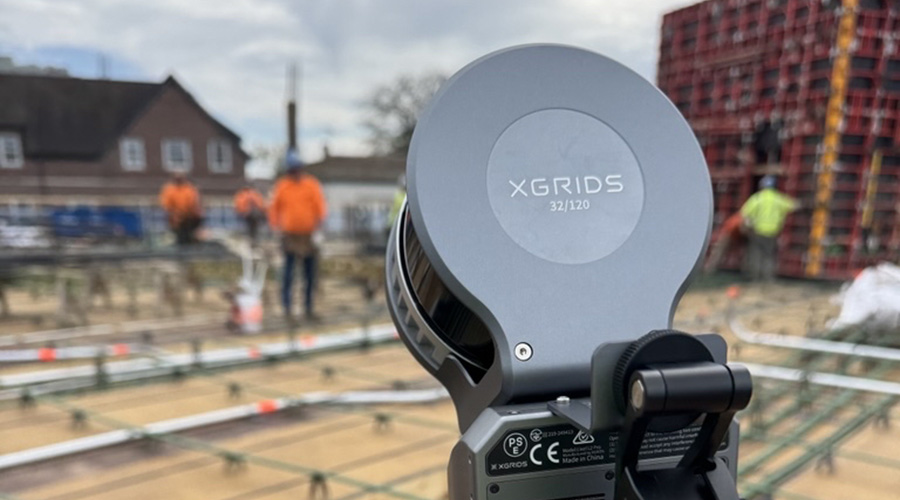
In 24/7 healthcare environments where operations drive revenue, uncertainty in interior construction projects means risk, especially for renovations where conditions behind walls and ceilings are unknown.
Most projects in healthcare facilities are targeted upgrades, not ground-up new construction, but even small misses can delay work, force shutdowns and disrupt adjacent spaces. The right technology can help healthcare facility managers protect patients, uptime and budgets.
Reducing the unknown
Every building has unknowns, but sensitive medical environments have less room for error. Active operations, limited shutdown windows, poor documentation and critical system risks all add complexity.
Over time, modifications made under pressure are not always well documented, so drawings can diverge significantly from reality, creating safety risks that include unplanned shutdowns that disrupt essential spaces.
These issues are most common in hidden areas where coordination is most difficult — above ceilings, below floors and inside walls. Teams must navigate medical gas, electrical systems and other sensitive infrastructure where even minor disruptions can impact patient care. Tight schedules amplify the challenge, as delays quickly compress timelines.
How laser scanning works in practice
Laser scanning, along with other virtual design and construction (VDC) technologies, provides a structured way for healthcare facility managers to identify risks before construction begins. Managers can start the process with these three steps:
Capture reality. Laser scanning is the entry point and creates a point cloud — a dimensionally accurate capture of existing conditions. There are two approaches.
For high-precision, tolerance-sensitive work, such as flatness analysis or exact locations, a tripod-mounted terrestrial scanner captures data within about one-eighth of an inch.
For faster-moving projects in active spaces, handheld simultaneous localization and mapping (SLAM) scanners cover large areas quickly with slightly less precision — closer to 1 inch — which is often sufficient to understand routing, obstacles and clearances, as well as to validate the overall layout.
Related Content: Maintaining Safety in Healthcare Construction Projects
Integrate and collaborate. Scanned data is uploaded to a cloud-based platform shared by architects, engineers and contractors, enabling teams to work from the same verified baseline. This step reduces time-intensive site visits, providing real-time drawing and model updates and generally eliminating the back and forth that tends to slow down projects.
Model what matters. For fast-paced interior healthcare projects, modeling focuses on critical elements — major ducts, conduit runs, beams and mains — rather than on every detail. The point cloud remains as a live reference, with only essential components modeled on top to highlight conflicts, constraints and required adjustments.
Reducing risk, shortening timelines
On a recent imaging equipment replacement project, the scope was relatively contained — replacing a CT machine on an upper floor — but the work was within an active hospital environment with a limited work window and no tolerance for disruptions.
The primary risk was not the installation, but the unknown conditions above the ceiling on the floor below. The team elected to use in-house scanning and modeling capabilities to create a visual representation to assist with early project planning.
They scanned the space before work began. Select ceiling tiles were removed after hours to scan above-ceiling conditions. That data was used to build a focused model of the critical zones, including major ducts, conduit, piping and new steel beams.
Because congested ceiling spaces are difficult to capture in full, they can be difficult to interpret, especially for teams less familiar with point clouds. The team used a hybrid building information modeling (BIM) approach, modeling key elements while keeping the point cloud active for improved clarity by focusing only on what mattered. This approach allowed the team to simulate installation in advance, identifying impacts, avoiding conflicts and determining what needed to be relocated.
A six-week schedule shrunk to roughly four weeks by reducing uncertainty and downtime, providing important schedule flexibility.
Predictable results, fewer delays
The same approach applies even in recently delivered spaces. In one outpatient facility, a floor built as a core and shell was scheduled for a pharmacy buildout shortly after completion. Despite prior coordination, the team verified field conditions rather than assuming alignment with the model. With only a two-week coordination window, there was little room for surprises.
They re-scanned the space and confirmed that installed conditions closely matched the model. With coordination grounded in verified data, trades mobilized with the right materials, reduced waste, limited rerouting and improved overall efficiency with fewer field adjustments.
Laser scanning allows teams to define scope based on verified conditions rather than on assumptions, reducing change orders and schedule delays that can impact operations. It improves visibility into existing systems, supports better shutdown planning and minimizes unintended disruptions. In healthcare facilities, it also helps reduce noise, dust and prolonged timelines that affect daily operations.
Clarity drives better outcomes. Understanding constraints before work begins enables managers to use more precise planning and execution with fewer disruptions. The VDC approach helps teams move forward with confidence by revealing existing conditions and enabling smarter decisions early.
Owen Huisenga is senior virtual design and construction manager at Skender, a construction management firm.
 Extreme Weather: The Maintenance-Resilience Link
 Encompass Health Lower Providence Opens in Pennsylvania
 Intermountain Health Acquires Fairbourne Building for Healthcare Hub and Medical Campus Conversion
 Cooling Towers at NYC Health + Hospitals/Lincoln Test Positive for Legionella
 Prefabricated Wall Panels Accelerate UCF Lake Nona Medical Center Construction