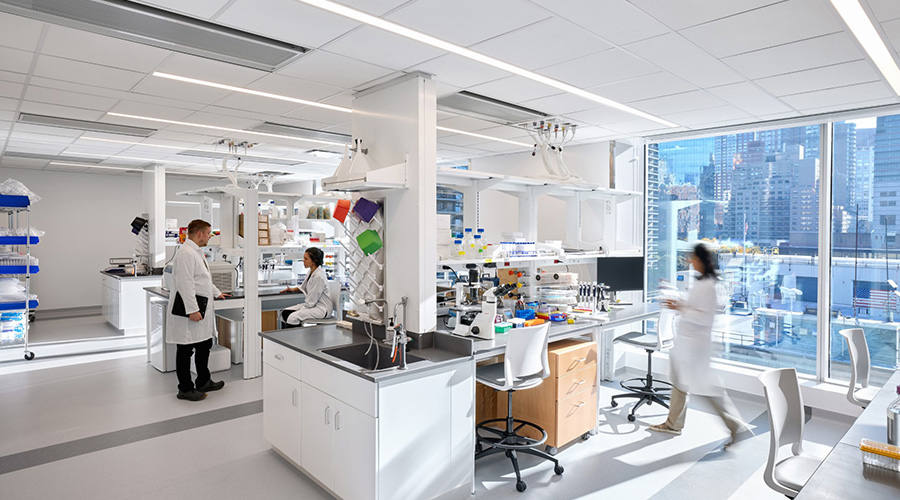
The pressures on teams responsible for institutional design have never been higher. Previously separate in purpose and culture, healthcare and life sciences now face overlapping challenges, including cost uncertainty, changing policies and an evolving regulatory landscape.
Addressing these challenges requires that healthcare facility managers, planners, designers and builders embrace greater degrees of collaboration and resilience. Institutions also must provide more with fewer resources.
Hospitals seeking to upgrade outdated infrastructure and life sciences developers aiming for a competitive edge share a goal: building cost-efficient, future-proof facilities. Achieving this objective relies on enhanced collaborations and more creative service methods.
By examining the way healthcare and life sciences leaders can address the increased pressures and prolonged project timelines — as well as the way decisive project teams are developing integrated, proactive strategies in response — it is possible to understand best practices and delivery models, including the evolution of design-build, early contractor involvement and fabrication-ready detailing as tools to enhance cost certainty and reduce risk. By sharing real project challenges and design decisions made to overcome them, it will provide strategies that enhance cost certainty while reducing project risk.
Economic and regulatory issues
Current healthcare projects reflect a high level of complexity. Economic instability resulting from reimbursement delays, insurance reforms and evolving state regulations intensifies risk, expense and concern for new constructions and strategic upgrades.
With so many stakeholders, from environmental health representatives to surgeons, design teams must juggle conflicting priorities while managing an approval process that can extend for months.
Traditionally, preconstruction has been treated as a discrete phase that follows design, often limiting opportunities for collaboration and real-time cost insight. An alternate approach is to formalize preconstruction as an integrated, structured process that begins as early as schematic design. By bringing contractors, engineers and estimators to the table early, project teams can systematically conduct real-time cost modeling, scope reviews and benchmark against comparable projects, leading to more informed decisions and greater project predictability.
This proactive strategy changes preconstruction from a simple budget review to an engaging partnership where ongoing pricing, early value engineering and open scope alignment help owners and designers avoid surprises later.
The emerging use of digital twins early in design, further promises to reinforce and accelerate this shifting in planning. By utilizing digital twins these integrated teams can work from a shared, data-rich model that mirrors the evolving design in real time, allowing stakeholders to visualize operational impacts, clinical workflows and future flexibility before anything is built.
By linking the digital twin with cost, schedule and facility performance data, project teams can test scenarios, validate investment decisions, and refine phasing strategies, ultimately enhancing delivery certainty in an environment where clinical priorities and regulations are constantly shifting.
Related Content: 9 Steps to a Successful Healthcare Capital Project
Although having institutional experience with comparable projects offers a solid basis for cost assurance, the practice of reevaluating assumptions at every milestone guarantees feasibility stays realistic, even as market conditions and needs inevitably change.
Organized preconstruction reduces the likelihood of late redesign while enabling more creative sequencing, quicker financing approval and, ultimately, more reliable project outcomes.
Excess capacity and funding instability
The life sciences sector faces distinct challenges. A rapid surge in speculative lab and research and development (R&D) partnered with a shift in funding to later stage research has created an oversupply of similar spaces in major markets, leaving many without tenants. As the market begins to correct, tenant priorities are shifting from amenity wars to operational factors — including flexibility for future growth, access to specialized infrastructure like vivariums and efficient loading and logistics — that better support evolving research needs.
The conventional emphasis on anchor tenants and amenities no longer ensures tenant retention. Instead, the emphasis is on flexibility: laboratory spaces and systems that can switch between incubator suites and existing leases, preventing excessive customization that restricts backfill opportunities during downturns.
Boston’s 2 Harbor Street Life Sciences Center exemplifies this new generation of adaptive R&D environments. The 13-story, 585,000-square-foot development transforms a formerly industrial waterfront parcel in the Seaport District into a vertically stacked, high-performance research hub. Its concrete structural system provides clean ceilings and unobstructed views to the waterfront while supporting flexible floorplates that can shift between wet and dry lab configurations as tenants evolve.
Responding to Boston’s tightening regulatory and zoning limits, the design team prioritized a modular planning framework that future-proofs infrastructure and maximizes daylight access — an uncommon feature in dense, urban lab environments. A sculpted façade of terra-cotta fins and glass provides solar shading and visual continuity with the harbor context while concealing extensive rooftop mechanical systems. Beneath its technical sophistication, the project’s integrated approach underscores the growing intersection of design, construction and operational strategy in life sciences development.
By creating a flexible, efficient and sustainable platform for discovery, 2 Harbor Street demonstrates the way forward-thinking design can reconcile regulatory constraints, sustainability goals and evolving market demand, all while positioning institutional developers for long-term viability in an unpredictable funding landscape.
Architects and engineers collaborated to ensure adaptable infrastructure and flexible designs. The team chose cast-in-place concrete to accommodate an additional level within the stringent height restrictions imposed by the site's proximity to Boston's Logan Airport, reconciling regulatory constraints with design aspirations. The outcome is a highly flexible facility designed to adapt to tenant changes and uses.
With its waterfront location and future-focused infrastructure, the 2 Harbor Life Science Center illustrates the way technical agility and thoughtful planning can mitigate the impacts of policy and funding changes in life sciences real estate.
Similarly, adaptive reuse is emerging as a practical strategy for market stability. In New York City, West End Labs reimagines an existing 380,000-square-foot building into a modern life sciences facility. The project exemplifies the way developers are leveraging existing structures to meet laboratory demand while avoiding the financial and environmental costs of ground-up construction.
Upgrades to the building’s infrastructure allow for robust lab operations, with connection points on every floor and the flexibility to pre-build individual levels for tenants. This scalable approach not only accelerates occupancy but also reduces speculative risk, providing a turnkey path for emerging biotech companies seeking ready-to-use research space.
By converting a former industrial asset into a purpose-built research hub, West End Labs demonstrates the way adaptive reuse can mitigate market volatility, drastically reduce embodied carbon and deliver high-performance life sciences environments in dense urban markets.
Jarret Johnson, P.E., is principal with DeSimone, a consulting engineering firm. Tuna Yelkikanat, P.E., is associate principal with the firm.
Editor’s note: This is part one of a two-part article. Read part two here.
 The Evolution of Lighting in Patient Care
 HealthPartners and Essentia Health to Combine Organizations
 Three Oaks Hospice Reports Email Breach
 Achieving Better Treatment Spaces Through Co-Design
 Prisma Health to Acquire 36 Urgent Care Sites in South Carolina from Novant Health