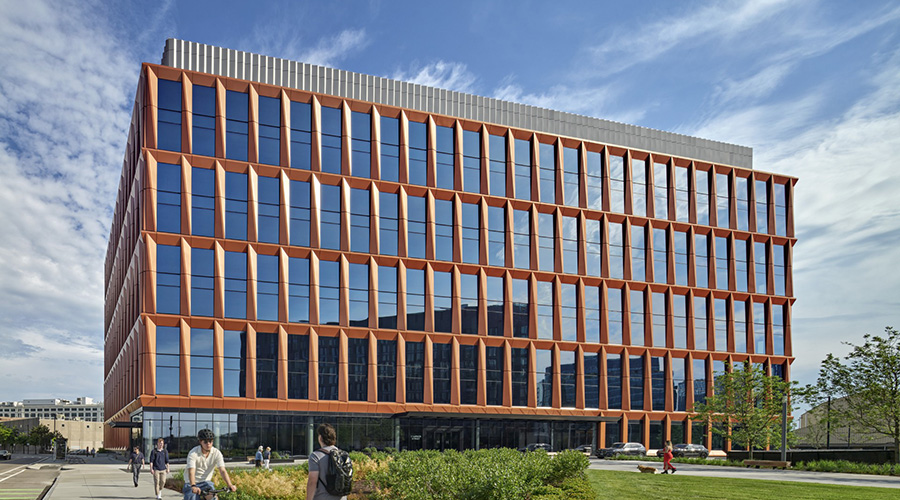
Healthcare facility managers, planners, designers and builders face overlapping challenges when developing healthcare and life sciences projects. These issues include cost uncertainty, changing policies and an evolving regulatory landscape. Such projects also bring together clinicians, researchers, administrators and facilities teams, and each group has distinct goals and priorities.
This complexity is heightened in projects that integrate medical education, research and community programs. Maintaining close coordination across these groups is essential to align needs, manage evolving requirements and navigate extended timelines influenced by market and procurement conditions.
To improve cost certainty and speed while reducing redesign risk, managers are leveraging early contractor engagement and design-build-style collaboration, allowing pricing, logistics and long-lead procurement to inform significant decisions starting with the schematic design phase.
Case study
The Helix H-1 project in New Brunswick, N.J., is a versatile innovation zone that brings together academic, research, clinical, and incubator facilities. Its scope and aspirations mirror the variety of programming, extended delivery schedules and intricate stakeholder dynamics that are becoming more prevalent in healthcare and life sciences initiatives.
Developed and constructed over a seven-year span, the initiative brings together medical school resources, translational research laboratories, maker space areas and clinical spaces all in one location. This combination necessitated extremely long structural spans and flexible frameworks to accommodate present and future requirements.
A thoroughly integrated approach bringing together contractors, engineers and institutional leaders from the beginning of the process was crucial. By providing real-time cost and constructability feedback early, the team expedited procurement for long-lead items and locked in material and labor pricing during the bidding phase.
Early senior-level involvement enhanced decision-making and maintained momentum during intricate design obstacles. Consistent benchmarking and adaptive design enabled budget-friendly solutions and prepared the campus for evolving academic and institutional goals.
Related Content: Renovation Needs for Life Sciences Facilities
This project demonstrates the way careful alignment of structural, architectural and operational expertise can resolve challenges such as long-span requirements, intricate massing and diverse program adjacencies.
Bridging gaps in engineering
One persistent challenge in building design and construction is the presence of gaps in detailed engineering — areas left ambiguous or insufficiently defined in design documents. This issue is especially common in traditional delivery methods where key elements, such as structural connections and custom components, are delegated to subcontractors after bidding. Without clear direction, these ambiguities can lead to costly change orders, schedule impacts and disputes as contractors seek compensation for unforeseen scope or complexity.
When details are not fully clarified in the original documents, contractors frequently exploit this uncertainty to request additional compensation for unanticipated labor, materials, or complexity, often resulting in change orders, requests for information and delays.
To address the issue, project teams increasingly adopt integrated detailing services and fabrication-ready modeling before projects are put out to bid. By advancing models to the shop-fabrication level — with precise quantities, connection details and assembly logic — teams reduce ambiguity and provide contractors with a far clearer foundation for pricing and coordination.
This higher level of modeling precision also strengthens the practical value of digital twins. When fabrication-ready detailing is incorporated earlier in the process, the digital model becomes more than a conceptual coordination tool. It evolves into a constructible, data-rich representation of the building.
Structural connections, mechanical systems, and component interfaces are modeled with the level of specificity required for installation, allowing teams to identify clashes, sequencing challenges and constructability concerns well before mobilization.
Rather than serving as a futuristic add-on, the digital twin in this context becomes an extension of disciplined preconstruction — an environment where detailed engineering, cost modeling and logistical planning converge. The results are fewer post-bid surprises, improved collaboration with fabricators and greater cost certainty, which shift the emphasis from reactive problem solving to predictable, efficient project execution.
Strategies for success
While every healthcare and life sciences project presents unique challenges, specific strategies consistently help owners and managers avoid common pitfalls and manage costs effectively. Recent project experience revealed several practical insights that project teams can apply immediately. The following takeaways highlight practical techniques and insights that can help teams navigate challenges and build for the future.
- Institutional design in healthcare and life sciences demands a nuanced understanding of funding sources, regulations and market shifts.
- Strategic early engagement with builders and fabricators is no longer optional. It is essential for reducing costs and risk.
- Existing building reuse and adaptive renovation are emerging as cost-effective alternatives to ground-up construction in urban settings.
- Design teams that leverage in-house expertise and historical data can provide critical value in benchmarking, phasing and material procurement planning.
- Reducing ambiguity through advanced detailing, models can prevent change orders and save millions in downstream costs.
With the increasing complexity, cost and regulations in the built environment, firms must go beyond design and focus on delivering more innovative solutions. Facility managers in the healthcare and life sciences are increasingly seeking partners who not only understand the complexities of their sectors but also can offer accuracy, vision and adaptability.
By adopting collaborative delivery approaches, leveraging institutional knowledge and connecting ideas with implementation, decisive managers and project teams are transforming possibilities and reshaping the realization of these vital facilities.
Jarret Johnson, P.E., is principal with DeSimone, a consulting engineering firm. Tuna Yelkikanat, P.E., is associate principal with the firm.
Editor’s note: This is part two of a two-part article. Read part one here.
 Elevating EVS Professionals: The Case for Certified Hygiene Specialists
 Global Handwashing Day and the Importance of Well-Maintained Restrooms
 Duke Health and CaroMont Health Partner to Develop Two New Hospitals
 Designing for the Psychology of Waiting
 UT Health Sciences Breaks Ground on College of Medicine Interdisciplinary Building