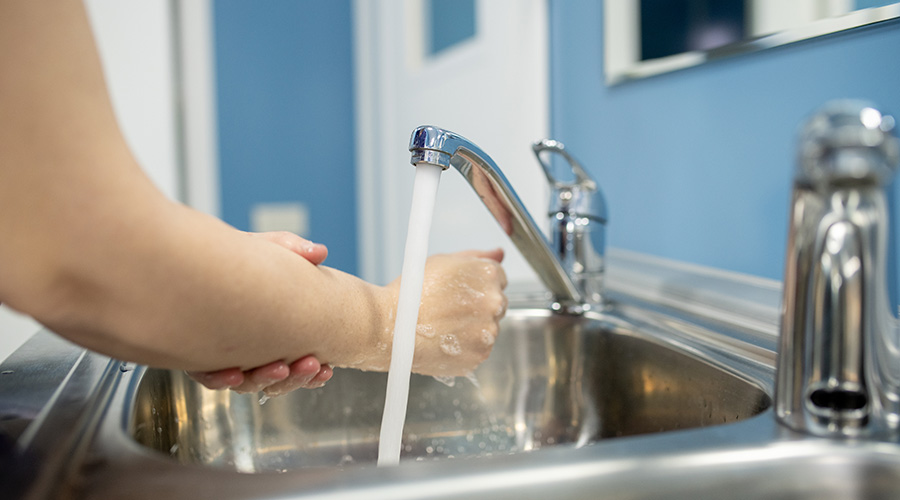
Environmental services managers in hospitals and other healthcare facilities increasingly recognize that infection prevention is not limited to hands, medical devices and patient rooms. It also includes the infrastructure that supports patient care.
Drains sit at the intersection of infection prevention, environmental services (EVS), and facilities — largely invisible, hard to sample and often outside routine cleaning frameworks. But evidence and outbreak investigations increasingly point to drains as persistent reservoirs. Their complex pipework provides ideal wet, nutrient-rich conditions for multispecies biofilms that can seed contamination back into clinical spaces.
Biofilms change the disinfection equation. Organisms embedded in an extracellular matrix, with metabolic heterogeneity and persister cells, can be dramatically less susceptible to antimicrobial agents than planktonic organisms used in standard efficacy testing.
Operationally, this means a product or process that works in the lab might underperform in real drains, especially when combined with organic load, complex geometry and inconsistent contact times. The risk extends beyond the drain itself. Splash-back and aerosolization from the sink splash zone can contaminate nearby surfaces and patient-care equipment, turning a plumbing component into an active interface with patient safety.
HFT Recommends: Addressing a Months-Long CPE Outbreak
Frontline infection prevention sentiment is shifting accordingly. In live polling at a recent infection prevention and control session, respondents ranked drains as a leading transmission concern, second only to hands. Respondents also showed strong consensus that drains matter as reservoirs.
But the way organizations manage the risk varies widely. Chemical approaches were most common, while thermal approaches and physical drain removal were used far less, and some sites reported no defined strategy at all.
For managers, this combination of high perceived risk with inconsistent mitigation signals a governance gap that can be closed with clear ownership, standards and resourcing. This includes:
- Assign accountable ownership. Name an executive sponsor and an operational owner for drain risk, often a shared model across infection prevention, EVS and facilities. Define who decides, who executes, and who verifies.
- Map and prioritize high-risk locations. Start with areas where vulnerable patients and water sources overlap — including ICU, NICU and oncology units — and focus on handwash sinks and clinical sinks with frequent use and nearby equipment storage.
- Standardize sink and drain practices. Reinforce behaviors that reduce splash-zone contamination. These include keeping patient-care items out of the splash zone, avoiding disposal of nutrient-rich fluids in handwash sinks and aligning signage and workflows.
- Select interventions based on feasibility and risk. Thermal, chemical and physical approaches each have constraints. Chemical approaches are most common, but outcomes depend on formulation, delivery, contact time and organic load. Physical removal or redesign might be warranted for repeatedly implicated drains.
- Build verification into the program. Define what good looks like for process compliance, inspection checklists and maintenance logs, and agree when to escalate — repeat contamination, outbreaks, persistent biofilm indicators, etc.
Procurement and evaluation deserve special attention. Traditional disinfectant testing often based on planktonic endpoints might not predict performance against mature biofilms in real drain systems. When selecting products or services, EVS managers should ask for evidence that reflects drain conditions — biofilm-relevant methods, realistic geometry, organic load and independent validation where possible.
Finally, managers need to capitalize on capital projects. New construction and renovations are opportunities to engineer out risk through sink placement, splash control, drain design and maintenance access.
Drains might be out of sight, but a coordinated program that links infection prevention, EVS and facilities can keep them from becoming out of control.
J. Darrel Hicks, BA, MESRE, CHESP, Certificate of Mastery in Infection Prevention, is the past president of the Healthcare Surfaces Institute. Hicks is nationally recognized as a subject matter expert in infection prevention and control as it relates to cleaning. He is the owner and principal of Safe, Clean and Disinfected. His enterprise specializes in B2B consulting, webinar presentations, seminars and facility consulting services related to cleaning and disinfection. He can be reached at darrel@darrelhicks.com, or learn more at www.darrelhicks.com.
 Elevating EVS Professionals: The Case for Certified Hygiene Specialists
 Global Handwashing Day and the Importance of Well-Maintained Restrooms
 Duke Health and CaroMont Health Partner to Develop Two New Hospitals
 Designing for the Psychology of Waiting
 UT Health Sciences Breaks Ground on College of Medicine Interdisciplinary Building