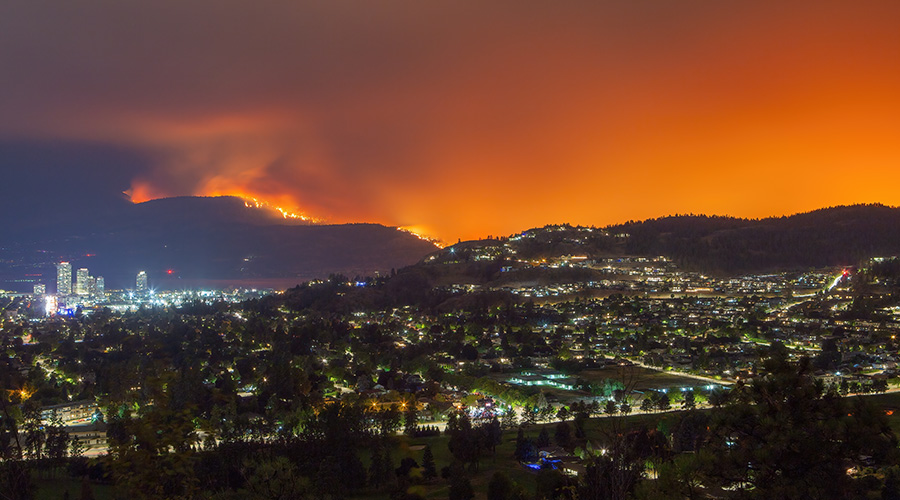
Over the past several summers, wildfire smoke events have become more frequent, more geographically widespread and more likely to overlap with other environmental stressors, including extreme heat.
For example, in mid-July of this year, the New York City Air Quality Index peaked at 289 — very unhealthy — in its worst smoke event since June 2023. The smoke stemmed from wildfires burning in Ontario, Canada, and it blanketed the city in the middle of an active heat emergency. For the first time, New York was forced to run its heat plan and its air quality response at full strength simultaneously.
In early August, emergency room visits in Oregon surpassed seasonal norms due to wildfire smoke, with adults 18-44 making up the largest share of patients. For hospitals, these demographics suggest that more recurrent smoke events also might impact patient volume in unexpected ways: People with chronic conditions already might be accustomed to taking precautions, while younger, otherwise healthy adults might not yet factor smoke exposure into their routines.
For healthcare facilities managers and their staffs, this convergence of conditions and factors puts mounting pressure on mechanical systems already working hard to maintain controlled indoor environments that doctors and patients depend on.
Standards supporting patient care
Much of the infrastructure for managing indoor air quality (IAQ) in healthcare facilities is already built into the code. Healthcare HVAC systems are governed by FGI guidelines and ASHRAE standards that set a high baseline for IAQ, with filtration requirements that scale with the clinical environment.
For spaces serving respiratory or cardiac patients, those requirements go even higher and for isolation rooms higher still. Filtration rates, air change needs and pressure relationships are well established and rigorously maintained.
Healthcare facilities also must have built-in redundancies, such as backup equipment, to ensure these systems do not fail when stretched beyond normal operating conditions.
But during a smoke event, that infrastructure comes under unique strain. Filtration is the most immediate failure point because filters rated for normal particulate loads clog significantly faster when outdoor air carries concentrated fine particulate matter from wildfire smoke. A filter expected to last one month might need replacement within a week, depending on the amount of time the conditions linger. Clogged filters restrict airflow, which affects the system performance that healthcare facilities depend on to maintain infection control sequences and life safety.
The difficulty in this scenario is that upgrading filtration is not as straightforward as installing a higher-rated filter. Higher-efficiency filters create more resistance. If the existing air handling equipment was not sized to accommodate that additional friction, the pressure relationships that rely on certain directional airflow — such as the difference between a positive-pressure clean environment and a negative-pressure containment zone — can be disrupted to the detriment of patient care.
HFT Recommends: IAQ and Infection Mitigation: Plans Into Actions
ASHRAE Guideline 44-2024, Protecting Building Occupants from Smoke During Wildfire and Prescribed Burn Events, addresses building preparedness, filtration, ventilation and air cleaning strategies across the full lifecycle of a smoke event.
That guidance, combined with the forthcoming 2026 FGI Facility Code, which separates enforceable minimum requirements from best practices for the first time, creates a timely opportunity for healthcare designers and facility managers to revisit the way early design decisions shape a facility's ability to respond when conditions exceed baseline assumptions.
The impact of design decisions
The most effective strategies for managing wildfire smoke in healthcare facilities often are determined during the schematic design phase, where decisions about mechanical infrastructure, building envelope and spatial planning set the ceiling for the way a facility can respond. These decisions also tend to be the least visible in practice.
A zoning strategy that allows different sections of the hospital to be managed independently gives operators more precise tools during an event than one building-wide response can provide –– such as the ability to adjust outdoor air ratios or activate supplemental filtration in high-acuity zones without disrupting the rest of the facility. That level of granularity requires intentional planning because it also needs to account for the way clinical staff move through the building, not just how air moves.
The building envelope deserves equal attention because smoke enters through the same pathways as any other infiltration: loading dock configurations, entrance vestibule design, gaps around piping and ductwork penetrations and any area where the envelope is not fully sealed.
The location and design of outdoor air intakes also plays a role. Intake placement relative to grade, prevailing wind exposure and proximity to vehicle traffic or loading areas all affect the amount of particulate that reaches the system before filtration even begins. Addressing these architectural decisions during design helps prevent them from ultimately becoming vulnerabilities during a smoke event.
At the equipment level, specifying air handling units with enough fan capacity to accommodate higher-rated filters gives facilities teams room to respond without sacrificing air change rates or pressure relationships. Designing ductwork with accessible filter housings that allow rapid changeover makes this process easier operationally.
Particularly for older hospitals, where the opportunities for capacity interventions might be more constrained, integrating IAQ monitoring into the building's automation system can help inform response priorities before conditions become noticeable to patients or clinicians, and it can create a data trail that supports clinical decision-making and long-term capital planning.
Wildfire smoke ultimately does not demand a fundamentally new approach to healthcare facility design. The filtration, ventilation and pressure management principles that govern these buildings are sound, and the standards that codify them are rigorous.
But what healthcare facility managers are learning is that as these events occur more frequently, those systems will be tested under conditions they were not designed to anticipate originally. The consequences of being caught without a plan fall on patients, staff and the clinical operations that depend on those environments.
The facility managers who manage these events most effectively are the ones that treat them as an operational likelihood during design and planning rather than a rare emergency.
Al Thompson is managing executive at TPG Architecture, an interior design firm. Jerry Stramowski is senior associate with the firm.
 UW Health Set to Open Expansion at East Madison Hospital
 Central Ohio Primary Care Physicians Falls Victim to Cyberattack
 The Role of Biophilic Design in Healthcare Facilities
 TriStar Centennial Medical Center Invests $90M in Women, Children's Hospital Expansions