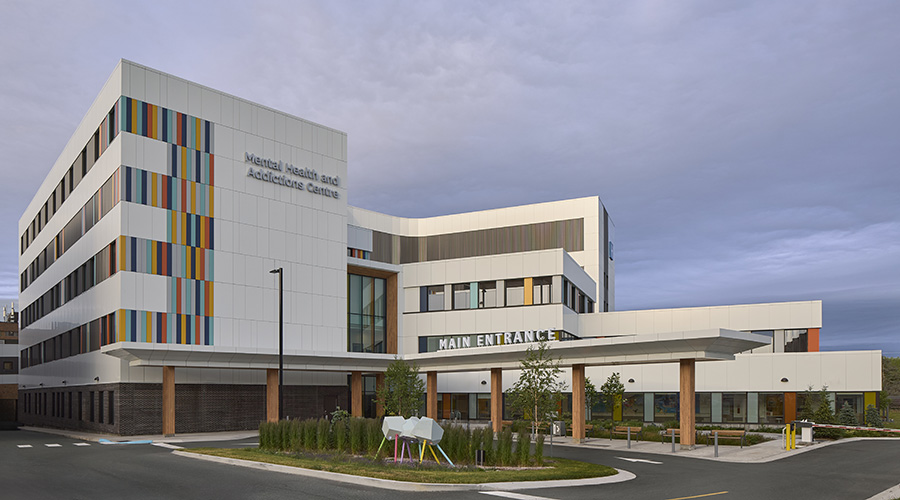
Mental health facilities have long been associated with places of isolation, shame and control with the patients inside being hidden away from their communities and families as they undergo treatment. The newly built Mental Health and Addictions Centre (MHAC) in St. John’s, Newfoundland and Labrador has challenged this stigma head-on, using design as a tool to reshape how mental health care is viewed.
Designed by B+H Architects in partnership with John Hearn Architects, the six story, 240,000 square-foot facility located right on a body of water embraces a completely new approach to care rooted in transparency, accessibility and community interaction. The blend of inpatient and outpatient services allows for a more open and welcoming design from the very start.
“It’s a building that is supposed to be integrated with the surrounding community,” says Michele Cohen, principal of healthcare at B+H Architects. “The city of St. John’s has grown around the 170-year-old campus, so people are coming on a daily basis. It’s not just an inpatient model where you leave and never come back.”
The building’s C-shaped form replaces the traditional layout of healthcare facilities, allowing for more daylight to shine into the interior while also framing the courtyards and other outdoor spaces.
“In a way, we physically cracked the building open to demonstrate physically how we want the facility to work psychologically,” Cohen says.
At the heart of the facility is the “therapeutic mall,” a central corridor lined with program spaces meant to mimic a more normalized experience. Just like a mall has stores on either side of a long hall, Cohen explains that their model has educational and therapy spaces that are available for inpatients and outpatients to create a community feel. The group therapy and education programs are located near the entrance while more specialized programs are positioned deeper within the building to keep that sense of privacy.
The design also recognizes the critical role that families play in the care process. A 60-room on-site hostel allows loved ones to stay overnight or for extended visits. These rooms are directly connected to the building’s public and communal spaces, allowing families to remain present without disrupting the clinical operations.
“When a family sees their loved one in a space that’s full of color and light and it’s an inviting place... that makes a huge impact, not just on them, but on everyone connected to their care,” Cohen says. “I just feel really encouraged by this project and I think it will spark change on how these facilities are viewed and built in the future.”
The outdoor spaces also help foster a sense of openness. Terraces, courtyards and therapy gardens are distributed across multiple levels of the campus, offering distinct outdoor environments for patients, staff and visitors. Each of these spaces are designed to balance security with freedom, avoiding that institutional feel often associated with mental health settings.
“It’s so important to allow patients to have access to being outside,” Cohen says. “We built walls that have vision panels so patients can maintain their dignity and privacy while also reaping the benefits of fresh air and sunshine. They aren’t stuck in a fishbowl.”
Elaina Myers is the assistant editor of the facilities market.
 5 Reasons Engineering is the Edge in Healthcare Master Planning
 Building an AI-Ready Healthcare Facility
  Family Medical Associates of Raleigh Reports April 2026 Data Breach
 Every Detail Matters: A Patient's Story of Healing, Hope and Healthcare Facilities
 Geisinger Wyoming Valley Medical Center Tops Off New 11-Story Tower