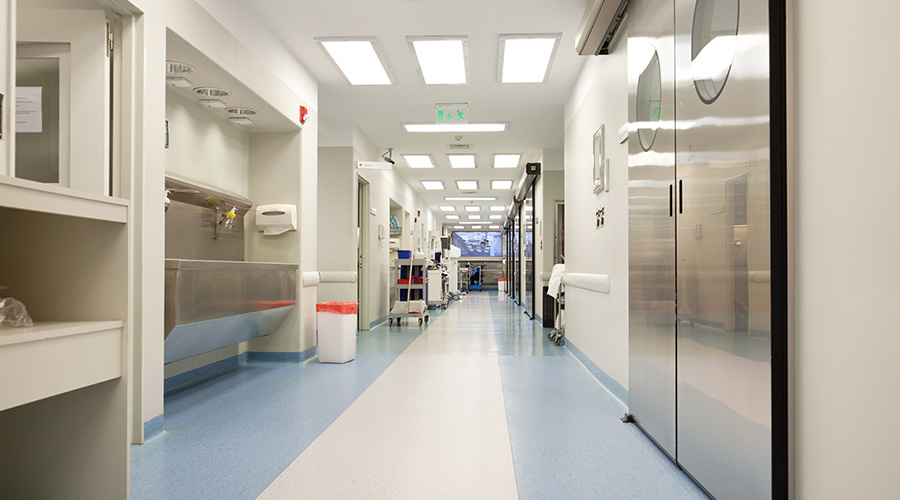
Lighting in healthcare facilities is not just a technical layer that designers and facility managers have to navigate. It helps people feel, focus, gather and connect in spaces that are designed to promote healing. But lighting also is complex because it sits at the center of everything that occurs in the building.
Healthcare Facilities Today recently spoke with Patricia Rizzo, senior healthcare product marketing with Kenall Manufacturing, and Tommy Nichols, senior director of sales for healthcare with Acuity Brands Lighting, about the future of lighting technology and the impact it will have on healthcare facilities.
HFT: How has the role of lighting evolved in healthcare facilities over the past decade?
Tommy Nichols: From our perspective, lighting in healthcare has evolved from being a must-have to being viewed as a strategic investment. Healthcare networks are increasingly focused on improving the patient experience, and many are looking at the built environment, with lighting being one of the significant investments they make to help create spaces that support how patients feel while in those environments.
But it's not just about good-quality illumination. It's also about providing intuitive control for both the patient and the caregiver. The ability to adjust light levels based on caregiver needs or patient preferences is paramount, particularly in patient rooms.
At the same time, healthcare facilities are moving away from the traditionally sterile, institutional look that people have long associated with hospitals. They are creating environments that feel warmer, are more welcoming and offer a hospitality like feel. Decorative lighting in lobbies, corridors and atriums can play an important role in shaping that experience and helping create a positive first impression for patients and visitors.
Patricia Rizzo: From healthcare in general to behavioral health specifically, the focus has shifted from treating the illness to healing the patient, as well as supporting the caregivers. Because clinical staff are often working to older ages, they need additional illumination for visual tasks but are more sensitive to glare and poor lighting — just like the patients and families visiting them. So visual comfort, glare control and lighting that supports circadian rhythms are given greater consideration. In addition, luminaires have become less institutional and more attractive, using hospitality-inspired designs (and) incorporating softer edges and contours rather than rigid squares and rectangles.
HFT: What role does lighting play in supporting patient healing and overall well-being?
Nichols: Lighting plays an important role in supporting both patient and caregiver well-being because individuals in healthcare environments often have limited opportunities to go outside and connect with nature throughout the day. For caregivers such as nurses, doctors and surgeons working long shifts, good-quality lighting in staff-focused spaces is critical. Incorporating biophilic elements and creating environments that help people feel connected to outdoor experiences can support areas such as nursing stations, staff respite spaces and other settings where caregivers need time to recharge, complete charting or focus on important tasks. These spaces benefit from task-appropriate lighting and lighting that aligns with the feel of the time of day, helping create environments that feel more relaxed, calm and conducive to focus.
For patients, connections to nature are also an important consideration. Research has explored how exposure to nature and nature-inspired elements can positively influence the patient experience. As a result, healthcare facilities are increasingly looking for ways to incorporate these elements into the built environment, including through lighting and lighting-integrated design features, to create spaces that feel more comfortable and supportive for patients during their stay.
Rizzo: Lighting has a profound impact on patient comfort, sleep quality, orientation and overall well-being. Patients often spend days or weeks in healthcare environments with limited access to daylight or outdoors, so electric lighting plays an important role in reinforcing normal day-night patterns. Exposure to sufficient daytime light while reducing light at night can help support circadian rhythms, minimize sleep disruption and enhance recovery.
Lighting also affects how patients feel within their environment. Comfortable, glare-free illumination can reduce stress and anxiety and help healthcare settings feel less institutional. When patients can read comfortably, recognize visitors clearly and navigate their room safely, lighting contributes to the healing environment rather than simply a necessary element.
HFT: How should healthcare organizations balance clinical lighting needs with creating a welcoming, comfortable environment?
Nichols: Healthcare organizations should begin thinking about lighting early in the design process, particularly when making a significant capital investment in a new facility or major renovation. Too often, lighting is considered too late, and many organizations still view it as something they simply have to have rather than a strategic part of the built environment.
One of the most important steps is looking at the available research and examples from other healthcare facilities. Resources such as the Center for Health Design and other evidence-based design repositories can help healthcare leaders and designers better understand how lighting and controls may influence the patient and caregiver experience.
Following an evidence-based design process helps healthcare organizations evaluate lighting and control strategies using available research and project experience. Using research to guide decisions can help organizations maintain focus on the design elements that support the intended experience for patients, visitors and staff.
Rizzo: Balancing clinical performance with patient comfort is easier today than it was a decade ago. Lighting has become as architecturally pleasing as it is functional. Modern luminaires are designed to be multifunctional, providing ambient, exam, reading and nighttime illumination within a single fixture while avoiding the compartmentalized appearance of older products.
The key is recognizing that clinical and comfort goals do not need to compete with one another. Healthcare providers require sufficient light levels, accurate color rendering and shadow-free visibility for patient care, while patients benefit from visually comfortable, glare-controlled lighting. Advanced optical design can achieve both objectives simultaneously. Light output and beam distributions vary via secondary optics or lens design to provide smoothly transitioning modes for ambient, exam and reading light, as well as an amber nightlight, creating spaces that are functional for caregivers and welcoming for patients and families.
HFT: What maintenance considerations should facility managers evaluate before selecting a lighting system?
Nichols: In addition to serviceability and the availability of replacement components, facility managers should be mindful of how luminaires support the day-to-day operational needs of the healthcare environment. When reviewing lighting systems for a significant renovation or new construction project, it is important to balance operational requirements with maintenance and infection-control considerations.
One key consideration is fixture design. Luminaires that minimize crevices, ledges or other areas where dust can accumulate can help support cleaning and maintenance activities. These factors should be considered by everyone involved in fixture selection, including facilities personnel, designers and project stakeholders.
Facility managers should also evaluate how lighting systems fit within broader operational workflows. This includes considerations such as serviceability, ease of maintenance, intuitive controls and integration with other room systems where applicable. Because facilities teams are often heavily involved in the selection, review, procurement and long-term maintenance of lighting systems, their input can help ensure that the lighting solution aligns with both operational and maintenance needs.
Finally, healthcare organizations are increasingly making investments through renovation projects, making long-term maintainability an important consideration. Facility managers should assess the availability of replacement components, ongoing manufacturer support and the ability to maintain lighting systems over time while supporting the intended function of the space.
Rizzo: The simplest answer is to select fixtures that have been independently tested and certified for sealing, cleanability, durability and maintainability. Healthcare facilities should look for luminaires with appropriate ingress protection (IP) ratings to prevent the accumulation of dust, insects and other contaminants. Fixtures that have passed NSF testing can provide greater confidence that they will withstand the harsh cleaning and disinfecting protocols common in healthcare environments.
Maintenance access is equally important. Fixtures that allow room-side access to drivers and electronics can reduce service time, minimize disruption to patients and staff and help maintain the integrity of the ceiling plenum. This approach not only improves maintenance efficiency but also supports infection prevention efforts by limiting unnecessary access above the ceiling.
HFT: How do you envision lighting becoming more personalized for patients while remaining practical for facility operations?
Nichols: In many ways, personalized lighting is already here today. Particularly in newer healthcare facilities, there has been a growing emphasis on giving patients intuitive control over their surroundings. That has expanded beyond lighting to include considerations such as window shades, room temperature and other environmental controls.
At its core, the goal is to give patients a greater sense of control over their environment in what is often an unfamiliar setting. In many patient rooms today, patients already have the ability to adjust lighting around their bed area, including dimming lights or turning them on and off based on their preferences.
Advances in LED lighting and controls have also made it possible to provide different light levels throughout the day. Rather than always relying on a single lighting setting, facilities can program lighting scenes that provide appropriate illumination for specific tasks while helping maintain a comfortable environment for patients. This approach allows healthcare organizations to balance personalized patient control with the practical operational requirements of the space.
Rizzo: I believe patients will be given more control and greater flexibility to tailor their space to their preferences, while facilities will maintain centralized control over critical operational and clinical requirements.
Today, patients may be limited to dimming controls, but future systems may allow them to select preferred lighting scenes, adjust light levels for reading or relaxation or select a color from an RGBW-enabled luminaire that they find soothing — like a cool blue or warm coral — to enhance comfort and reduce stress. They may be able to control the lighting settings from an app on their phones, not limited to the bedside pillow speaker or remote control. These are not widely adopted yet, but the concept is certainly possible.
The challenge will be balancing patient choice with caregiver needs, safety requirements and operational consistency. Success may mean offering patients a bit of autonomy through meaningful control over their immediate environment while ensuring that clinical staff have override ability to return the room to standardized settings when needed.
Mackenna Moralez is the managing editor of the facilities market and the host of the Facilities in Focus podcast.
 HealthPartners and Essentia Health to Combine Organizations
 Three Oaks Hospice Reports Email Breach
 Achieving Better Treatment Spaces Through Co-Design
 Prisma Health to Acquire 36 Urgent Care Sites in South Carolina from Novant Health