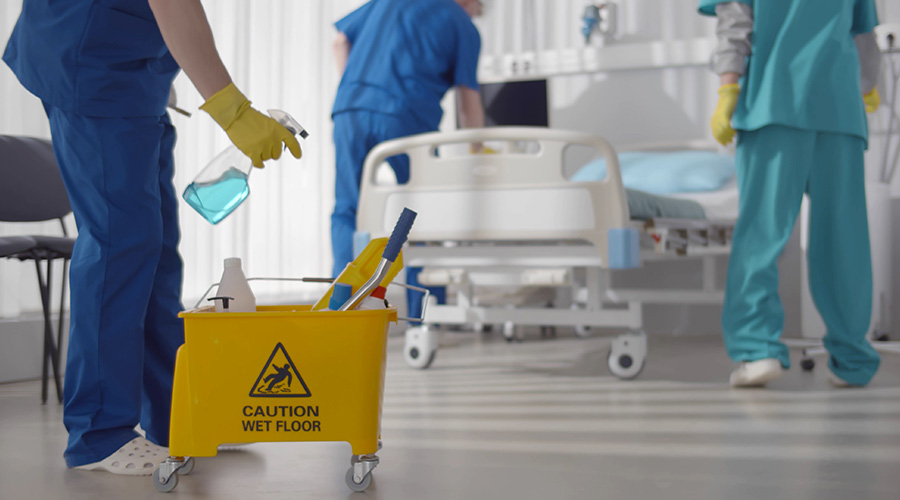
A quick daily wipe with a hospital-approved disinfectant — especially if contact time, coverage and mechanical action are suboptimal — often does little more than skim the surface and might leave the biofilm community largely intact. Most environmental services (EVS) workers are still cleaning as if they are wiping dust off a countertop, not disrupting a living, structured community.
Why does daily cleaning often fail?
Insufficient mechanical disruption. Most protocols underemphasize physical removal. Biofilms are glued into micro-crevices, so a light wipe does not break that structure.
Inadequate contact time and wetness. Workers often wipe away disinfectants before the required dwell time, and biofilm exopolymeric substances (EPS) slows penetration even when contact time is met.
Organic load and residues. Detergent and disinfectant residues and organic soil actually can provide nutrients, supporting regrowth once the active agent dissipates.
No biofilm-specific validation. Many products are tested against planktonic organisms on smooth carriers, not mature dry-surface biofilms on real-world materials.
By not acknowledging the biofilm reality, EVS managers are essentially feeding and watering a protected community while feeling reassured by the appearance of the surface and the smell of the disinfectant.
What a biofilm-aware strategy looks like
Think of this strategy as moving from “wipe and hope” to “disrupt, remove and prevent.”
Related Content: Biofilms: The New Frontier for Reducing MDRO
First, prioritize mechanical removal:
- Use friction as a core parameter — elbow grease and light scrubbing
- Use microfiber or other high-friction textiles, and use deliberate, overlapping strokes, especially on high-touch points, including bed rails, call buttons, overbed tables, door handles and monitor controls.
- Use better tools. These tools include flat mops and cloths that maximize surface contact. Avoid worn, low-friction textiles. Consider color-coding and single-use wipes in high-risk zones to avoid cross-transfer of biofilm fragments.
- Second, use chemistries that target biofilm structure:
- Biofilm-disrupting agents. EPS-focused chemistry — i.e., surfactants, enzymes, oxidizing agents and certain novel formulations — is being developed and tested specifically against biofilms on medical devices and surfaces.
- Two-step clean–disinfect. The first step is to break up and lift soil and EPS. The second step to inactivate exposed organisms. But be careful. Combining into one rushed wipe often underperforms in biofilm contexts.
- Validation against biofilms. Use products with data against dry surface biofilms or at least against biofilm models, not just planktonic log reductions.
- Third, rethink frequency and intensity by risk:
- Risk-based schedules with a high-touch, high-risk focus. Increase frequency and intensity — mechanical plus chemistry — for bed spaces, near-patient equipment and frequently handled controls rather than treating all surfaces equally.
- Periodic biofilm reset. At defined intervals or at discharge and terminal cleaning, use more intensive methods — including enhanced friction, longer contact times and possibly adjunct technologies — to reduce mature biofilm burden.
Design and materials
The goal here is to make surfaces less biofilm-friendly:
- Surface topography. Focus on smooth, intact surfaces. Micro-cracks, seams and rough finishes provide niches for biofilm anchoring. Choosing smoother, non-porous, easily cleanable materials for high-touch items reduces biofilm footholds.
- Equipment design. Focus on cleanability by design. Look for fewer seams, hidden ledges, complex geometries, detachable parts that can be periodically soaked or reprocessed, and clear instructions for cleaning around controls and joints.
EVS managers and cleaners often treat the environment as inanimate when in fact it is teeming with life — often, more cells than the patient healthcare facilities are trying to protect.
For practice change, a new mindset means reframing education, from dirt to ecology. Teach staff that they are not just removing visible soi. They are disrupting a microscopic ecosystem that can seed infections. Use images, analogies — microbial cities, villages under a shield — to make it vivid.
Linking to outcomes means healthcare-associated infection stories and data. Connect environmental biofilms to real patient harm and multidrug-resistant organism transmission so that cleaning becomes clinical work, not housekeeping.
Finally, measure what matters beyond adenosine triphosphate (ATP) alone. Explore methods that assess biofilm presence or regrowth over time, not just momentary surface cleanliness. Even if imperfect, the mindset shift — How fast does this surface repopulate? — is crucial.
J. Darrel Hicks, BA, MESRE, CHESP, Certificate of Mastery in Infection Prevention, is the past president of the Healthcare Surfaces Institute. Hicks is nationally recognized as a subject matter expert in infection prevention and control as it relates to cleaning. He is the owner and principal of Safe, Clean and Disinfected. His enterprise specializes in B2B consulting, webinar presentations, seminars and facility consulting services related to cleaning and disinfection. He can be reached at darrel@darrelhicks.com, or learn more at www.darrelhicks.com.
 Preparing Healthcare Facilities for Wildfire Air Quality Events
 UW Health Set to Open Expansion at East Madison Hospital
 Central Ohio Primary Care Physicians Falls Victim to Cyberattack
 The Role of Biophilic Design in Healthcare Facilities
 TriStar Centennial Medical Center Invests $90M in Women, Children's Hospital Expansions