Some states and municipalities are experiencing a rising number of cases of childhood hand, foot and mouth disease (HFMD) in emergency departments and urgent care facilities. Physicians and public health experts in a number of states in the Mid-Atlantic region are reporting an uptick in HFMD, a highly contagious viral illness that primarily affects infants and young children. It is not the same as foot-and-mouth disease, which affects farm animals, such as cattle, sheep, pigs and goats, and it does not infect humans.
HFMD — Enterovirus D68 or EV-D68 — gets its name from the small blister-like sores it causes on the hands and feet and inside the mouth. While the illness can be uncomfortable, it is generally mild and resolves on its own.
HFMD, which is caused by enteroviruses such as coxsackievirus, can occur among people of all ages. But it is particularly common in children, especially those younger than 5 years old, according to the Centers for Disease Control and Prevention (CDC). It is characterized by flu-like symptoms, mouth sores and a rash on the hands and feet, as well as buttocks, legs and arms.
Related Content: Better, More Thorough Cleaning Saves Lives
A person can become infected after being exposed to droplets released when someone with the illness coughs, sneezes or talks. It also can spread through touching an infected person, such as hugging, kissing and sharing cups and utensils.
The virus also is present in feces, so changing diapers or helping a sick child in the bathroom can lead to infection if hands are not washed thoroughly. Adults can spread coxsackievirus even without symptoms, so consistent cleaning and handwashing are critical.
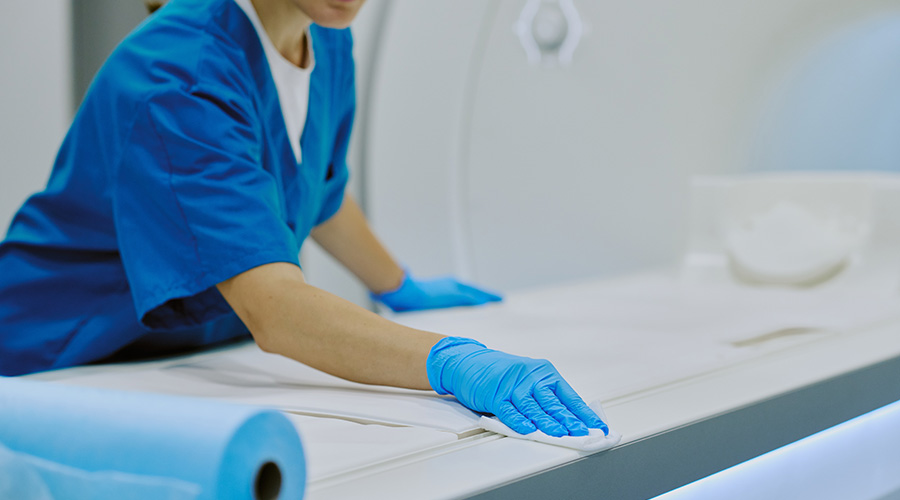
When cleaning and disinfecting surfaces in healthcare facilities that might be contaminated with HFMD, environmental services workers should only use a disinfectant with a labeled kill-claim for small, non-enveloped viruses — e.g., norovirus, poliovirus and rhinovirus. Disinfecting the room of a contact isolation pediatric patient with HFMD, one should focus on surfaces that are frequently touched by the child and caregivers.
Surfaces can be disinfected using a 1:10 bleach solution, according to the CDC website for HFMD. It takes 13 ounces of bleach added to 128 ounces — 1 U.S. gallon — of water to make a 1:10 solution. Unless the hospital has a way of ensuring a 1:10 bleach solution, workers must use an EPA registered disinfectant.
Proper hand hygiene is the other foundational element of containing the spread of this highly contagious virus. Alcohol-based hand sanitizers (ABHS) are not reliably effective against coxsackievirus, which is the main cause of HFMD. Soap and water handwashing is the gold standard for removing these viruses from hands. Coxsackievirus is a non-enveloped enterovirus. ABHS primarily disrupts lipid envelopes, which coxsackievirus lacks.
As for environmental stability, these viruses can survive on surfaces for days, making it harder to inactivate with ABHS alone. And regarding transmission routes, they spread via saliva, vesicle fluid, feces and contaminated surfaces. ABHS does not reliably break this chain.
J. Darrel Hicks, BA, MESRE, CHESP, Certificate of Mastery in Infection Prevention, is the past president of the Healthcare Surfaces Institute. Hicks is nationally recognized as a subject matter expert in infection prevention and control as it relates to cleaning. He is the owner and principal of Safe, Clean and Disinfected. His enterprise specializes in B2B consulting, webinar presentations, seminars and facility consulting services related to cleaning and disinfection. He can be reached at darrel@darrelhicks.com, or learn more at www.darrelhicks.com.
 Building Around Care: Lessons in Modernizing Active Healthcare Environments
 St. Luke's Heart Hospital Opens at Anderson Campus in Pennsylvania
 WindRose Health Network Ensnared in Vendor Data Breach
 How Efficiency Checklists Help Hospitals Save Energy, Water and Money
 Intermountain Healthcare Receives $50M Gift for Standalone Children's Hospital