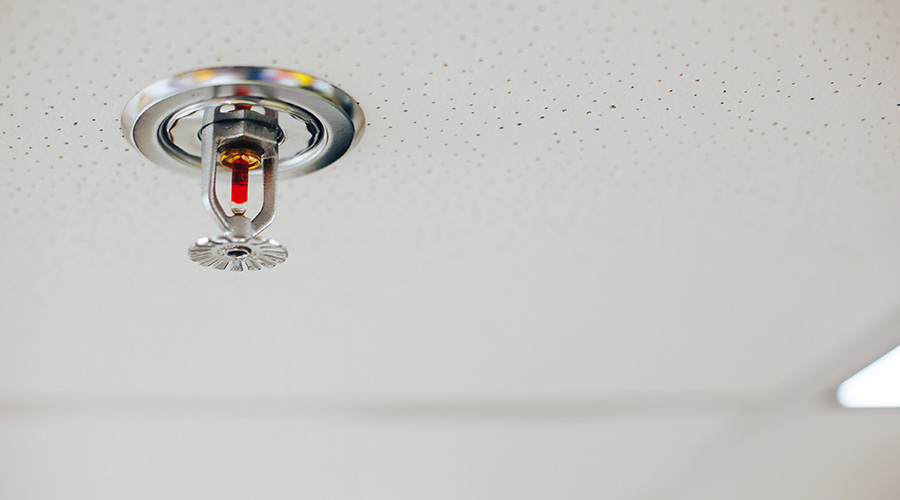
Sprinkler protection in healthcare facilities is a foundational requirement shaped by the Life Safety Code and reinforced by federal oversight. However, confusion remains around renovation thresholds, grandfathered buildings and looming CMS compliance deadlines.
Healthcare Facilities Today spoke with Pamela Reno, regional practice leader at Telgian Engineering & Consulting, LLC, to break down how NFPA 101, state fire codes and sprinkler design strategies intersect.
HFT: Which fire and life safety codes most directly drive sprinkler requirements in healthcare occupancies today, and where do you see the most confusion or misinterpretation among facility teams?
Pamela Reno: Well, it’s the Life Safety Code — NFPA 101 — that really dictates the requirements for hospitals and healthcare systems. One of the focuses in the Life Safety Code is sprinkler protection. It’s essentially a rule that all healthcare facilities have to be fully sprinklered.
We moved to the 2012 edition of the Life Safety Code, which was adopted back in 2016, and those are still the requirements we’re operating under today.
HFT: How do sprinkler mandates differ between new construction, major renovations and existing healthcare facilities, and what triggers typically force upgrades in older buildings?
Reno: Typically, when you’re renovating, it depends on the square footage involved. At a certain point, you’ll need to bring the floor or portion of the hospital you’re renovating up to current code if the renovations are extensive enough. However, the Life Safety Code outlines those requirements, along with the building and fire codes for the state the hospital is in.
Related Content: What Fire Sprinklers and Alarms are the Best for Hospitals?
Those codes mandate when you need to upgrade your sprinkler system and when you may not need to. For example, if you’re just updating a small office within a hospital, that space doesn’t necessarily have to be brought up to current code. However, if you’re renovating an entire patient floor or several floors, that may trigger the requirement to upgrade to current standards.
With existing buildings, some are grandfathered in. But again, once you hit certain square footage thresholds, you would still need to bring those areas up to current code.
And speaking of current code, now that we’re in 2026, it’s important to remember that CMS requires high-rise hospitals that are not fully sprinklered to be brought into compliance by July 5, 2028. So those are things we need to stay cognizant of. CMS and The Joint Commission are looking closely at Life Safety Code compliance because they’ve adopted these requirements.
HFT: Beyond basic compliance, how can healthcare facilities leverage sprinkler system design — such as zoning, system type or redundancy — to better support patient safety and operational continuity?
Reno: Any time a new hospital project comes into play, using sprinklers in the building is a given. But then the question becomes: how are we going to do it? If it’s a high-rise, you’re
dealing with different zones and system considerations. At the same time, you have to think about the defend-in-place concept — compartmentalization, smoke barriers and how those work alongside a fully sprinklered building.
You must ask: If a fire were to start, can we move patients into another fully sprinklered area? Whether it’s a new hospital or an existing one, those are the things you have to take into consideration. If we’re renovating one portion of a building, is it sprinklered? Is the adjacent area sprinklered? If so, can we relocate patients there temporarily?
The goal is to avoid disrupting patient safety and patient care. So from a holistic standpoint, especially during renovations, you have to phase the work carefully. You can’t just shut down an ICU or a critical suite without a plan.
Our main focus is always the patients. Can we protect them using defend-in-place strategies? If something happens, can we move them into another protected area? Yes, we need to make sure spaces are sprinklered, but we also have to ensure the defend-in-place mechanisms are fully in place as well.
Jeff Wardon, Jr., is the assistant editor of the facilities market.
 Hospitals Are Energy Super-Users. Why Is It So Hard to Modernize Them?
 Encompass Health Rehabilitation Hospital of Bangor Officially Opens
 Early Entry: Manager's Critical Role in Construction Planning
 The Evolution of Lighting in Patient Care
 HealthPartners and Essentia Health to Combine Organizations