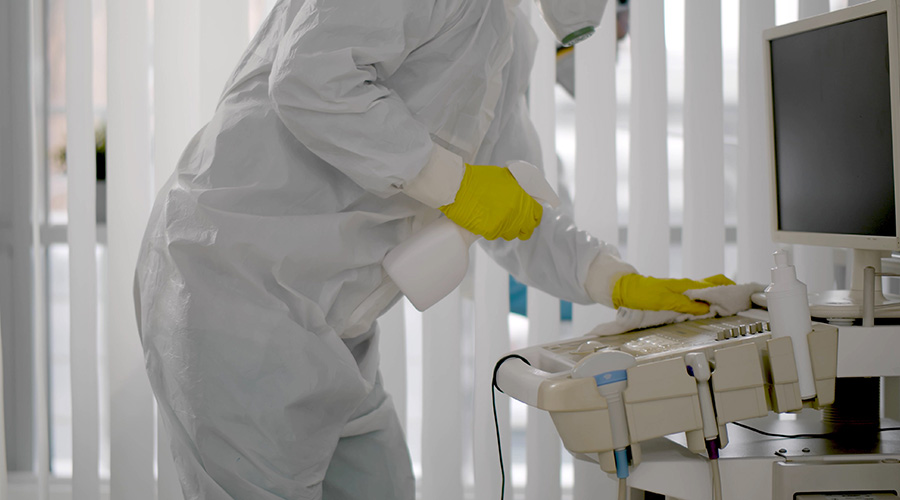
People love to say that anyone can be an environmental services (EVS) department leader no matter what their background might be. A person can read some guidelines, memorize some criteria, and watch a few webinars, and they are on their way to leading a team of patient room cleaners.
While it is true that anyone could be hired as an EVS manager, not all people can succeed in that role. In today’s climate of rising healthcare associated infections (HAI) and surgical site infections, EVS managers must demonstrate mastery of infection prevention standards, accountability through measurable outcomes and visible collaboration with clinical teams.
People in this leadership role must know the following:
OSHA’s role. Managers must understand OSHA’s role in healthcare facility cleaning. OSHA enforces workplace safety regulations, including standards for controlling bloodborne pathogens and hazardous chemicals. Key OSHA requirements:
- Bloodborne pathogens standard (29 CFR 1910.1030), which requires proper handling and disinfection of surfaces contaminated with blood or bodily fluids
- Hazard communication standard (29 CFR 1910.1200), which mandates labeling, safety data sheets (SDS) and staff training on cleaning chemicals
- Personal protective equipment (PPE) requirements on the use of gloves, masks, gowns and eye protection when cleaning contaminated areas.
Managers should keep OSHA posters and safety protocols visible in EVS staff areas to reinforce compliance.
Related Content: Environmental Services Workers Deserve More Respect
CDC guidelines. The Centers for Disease Control and Prevention (CDC) provides evidence-based recommendations on environmental infection control to prevent HAIs. Core CDC recommendations:
- Use EPA-registered hospital-grade disinfectants.
- Follow manufacturer’s instructions for contact time, meaning dwell time.
- Clean and disinfect high-touch surfaces regularly.
- Perform terminal cleaning of patient rooms after discharge.
- Implement standard precautions, including hand hygiene and PPE use.
Managers must review the CDC’s Guidelines for Environmental Infection Control in Health-Care Facilities for detailed procedures.
Cleaning frequency requirements. OSHA and CDC emphasize the importance of regular and thorough cleaning schedules. Recommended frequencies:
- High-risk areas, including intensive care units, emergency rooms and operating rooms: multiple times daily and after each patient
- Patient rooms: daily and upon discharge
- Restrooms and waiting areas: several times daily
- Common areas and offices: at least daily.
Managers need to document cleaning frequency in logs for accountability and audit readiness.
Waste management procedures. OSHA and CDC stress the safe handling of medical and hazardous waste. Waste management best practices:
- Use labeled biohazard containers for sharps and contaminated waste.
- Seal and dispose of waste according to local and federal regulations.
- Train staff on proper waste segregation and disposal.
Managers need to provide color-coded bins to simplify compliance with waste-segregation protocols.
Staff training and documentation. Ongoing education ensures cleaning teams stay compliant and effective. Training requirements:
- PPE use and disposal
- bloodborne pathogen handling
- chemical safety and SDS familiarity
- cleaning procedures for various facility zones.
Managers must maintain training records and offer periodic refresher courses to reinforce best practices.
This EVS field demands more than just knowledge. If that was the only requirement, the job would be easy. But this field demands so much more, including endurance, judgement, communication skills, emotional intelligence and social awareness. Managers need to have the willingness to be disliked and still do what protects patients, staff and the community.
Anyone can be an EVS manager, and anyone can wear the title. But only a few can carry the weight of the title in their organization — those who stay, grow, lead and elevate the profession.
J. Darrel Hicks, BA, MESRE, CHESP, Certificate of Mastery in Infection Prevention, is the past president of the Healthcare Surfaces Institute. Hicks is nationally recognized as a subject matter expert in infection prevention and control as it relates to cleaning. He is the owner and principal of Safe, Clean and Disinfected. His enterprise specializes in B2B consulting, webinar presentations, seminars and facility consulting services related to cleaning and disinfection. He can be reached at darrel@darrelhicks.com, or learn more at www.darrelhicks.com.
 Building Around Care: Lessons in Modernizing Active Healthcare Environments
 St. Luke's Heart Hospital Opens at Anderson Campus in Pennsylvania
 WindRose Health Network Ensnared in Vendor Data Breach
 How Efficiency Checklists Help Hospitals Save Energy, Water and Money
 Intermountain Healthcare Receives $50M Gift for Standalone Children's Hospital