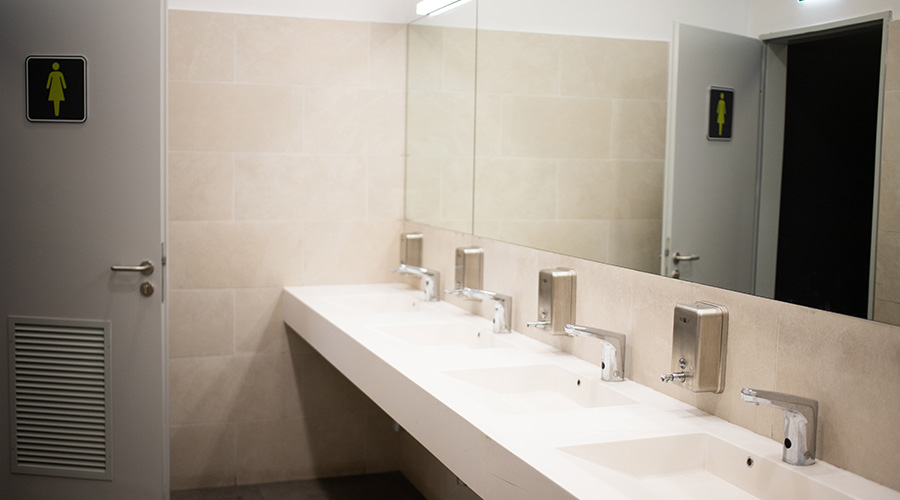
As healthcare facilities teams face persistent staffing constraints and heightened expectations around hygiene, accessibility and reliability, restroom design and maintenance are undergoing a fundamental shift.
In this manufacturer roundtable, Healthcare Facilities Today spoke with restroom fixture manufacturers about how the next five years will bring designs that prioritize automation, visibility and ease of maintenance.
Looking ahead, what broader trends—technological, architectural, workforce-related or otherwise—do you expect to most significantly shape how healthcare restrooms are designed and maintained over the next five years?
“Over the next five years, healthcare restroom design will continue to be shaped by workforce constraints, evolving expectations around hygiene and the need for operational efficiency. With leaner maintenance teams, facilities will favor designs that simplify servicing, reduce manual labor and improve visibility into system status.
There will also be continued emphasis on privacy, accessibility and inclusive design. Research shows that restroom cleanliness and privacy influence whether people feel comfortable using these spaces. Technologically, touchless and integrated handwashing systems will become increasingly standard as facilities seek to reinforce hygiene best practices and user confidence. Together, these trends point to a future where healthcare restrooms are designed as essential infrastructure — supporting safety, efficiency, sustainability and the overall care experience.”
— Cassie Keeler, product manager of handwashing products, Bradley Company
“Over the next five years, healthcare restroom design will continue to shift from manual oversight toward system-level intelligence. Facilities are recognizing that paper logs and periodic checks are difficult to sustain, especially in large or multi-building environments with constrained staffing.
What we are seeing across healthcare is a clear shift away from manual oversight and toward system-level intelligence. Facilities are being asked to do more with fewer resources, and that’s accelerating interest in approaches that provide continuous visibility and reduce reliance on paper logs or periodic checks. Technologically, there is growing momentum toward automation, centralized visibility and continuous data capture at the point of use. Architecturally, restrooms are increasingly viewed as active components of building infrastructure, not passive endpoints.
Workforce realities are also accelerating change. As staffing pressures persist, demand is growing for systems that reduce repetitive manual tasks and allow teams to focus on higher-value work. Collectively, these trends point toward healthcare restrooms that are more connected, more accountable and better aligned with patient safety, regulatory readiness and operational resilience.”
— Greg Hunt, commercial product manager, Chicago Faucets
“From a technology perspective, we have seen facilities teams that are increasingly excited about and exploring connected plumbing systems that support remote monitoring, automated alerts, and insights into usage patterns. These tools can help identify unusual flow events, low-use fixtures, or potential equipment failures before they disrupt operations. In healthcare settings, this connectivity also supports proactive water management by highlighting areas where flushing or increased turnover may be necessary to maintain water quality.
Moreover, we have seen a lot of interest from architects and designers now in designs and materials that resist degradation, which help reduce microbial risk and improve reliability. We will of course see a continued push toward touchless operation, but with an emphasis on intuitive user interfaces and patient-centric restroom layouts that support accessibility. With maintenance teams constantly stretched thin, fixtures that require less manual intervention and offer predictable, usage-based maintenance schedules are becoming increasingly valuable to the organizations' bottom line.
All this points toward restroom environments that are more intelligent, more resilient and more aligned with the evolving demands of healthcare operations and patient safety.”
— Dan Danowski, product manager, Zurn Elkay
“Over the next five years, the Internet of Things (IoT) will help reshape restroom design and maintenance, making facilities predictive rather than reactive. Connected fixtures will provide data that informs everything from cleaning schedules to handwashing compliance programs, directly impacting patient outcomes.
Architecturally, we will see more modular, adaptable restroom designs that can be easily updated to meet new standards. Finally, a persistent maintenance workforce shortage will accelerate the demand for products that are simpler to install and service, with smart diagnostics becoming an essential tool for maximizing staff efficiency.”
— Morgan Kish, director of product management, Sloan
Jeff Wardon, Jr., is the assistant editor of the facilities market.
 Creating Healthcare Campus Master Plans That Allow Movement and Respite
 Aspirus Health Celebrates Opening of Chippewa Falls Hospital and Clinic
 AdventHealth to Open Aurora Highlands Medical Campus
 The Future of Healthcare Facility Construction Projects
 Arnprior Regional Health Upgrades Building Controls to Improve IEQ